

Agreeing to declare an artificially low purchase price at the notary might sound like an easy way to trim your upfront taxes, but it virtually guarantees a financial nightmare later. If you're wondering what happens if you under-declare property value in Spain, the modern reality is uncompromising: the Spanish tax agency (Hacienda) actively tracks transactions with sophisticated digital systems, turning old-fashioned under-the-table practices into an immediate legal liability.
We understand how unsettling this feels, especially when outdated advice about cash envelopes collides with modern anti-fraud laws. You deserve complete peace of mind when investing in a Mediterranean lifestyle. In this guide, you'll discover the severe fines, inspection triggers, and future capital gains traps of under-declaring, alongside clear guidance on how the Cadastral Reference Value protects your legal standing. We'll also examine the regional tax differences between the Costa Blanca (Valencia region, with its 9% transfer tax) and the Costa Cálida (Murcia region, at 7.75%), showing you how to complete a transparent, stress-free purchase, whether you're settling in Puerto de Mazarrón, Bolnuevo, Isla Plana, or La Azohía.
Key Takeaways
- Understand what happens if you under-declare property value in Spain, from retroactive tax demands to severe financial penalties reaching up to 150% of the unpaid tax.
- Discover why the official Cadastral Reference Value makes historical cash-in-hand arrangements obsolete by setting an automatic minimum tax threshold for property transfers.
- Uncover the future capital gains trap, ensuring you do not exchange modest short-term savings for an unexpectedly punitive tax bill when selling your home years later.
- Clarify essential regional tax distinctions between the Costa Blanca (9% transfer tax) and the Costa Cálida (7.75% transfer tax), particularly when investing around Puerto de Mazarrón, Bolnuevo, Isla Plana, or La Azohía.
- Learn the crucial steps to take if you receive a tax reassessment notice from Hacienda, including strict statutory deadlines and the protective value of independent legal support.
What Does Under-Declaring Property Value Mean in Spain?
Under-declaring occurs when a buyer and seller record a purchase price in the official public deed that sits below the actual amount paid. The buyer pays the declared figure via traceable bank draft, while handing over the rest in undeclared funds. Many overseas purchasers explore what happens if you under-declare property value in Spain because an unscrupulous seller suggested it to reduce their immediate liability for Property Transfer Tax (ITP). In practice, doing so exposes the purchaser to severe tax audits and hefty fines from the Spanish Tax Agency (Agencia Tributaria, commonly known as Hacienda).
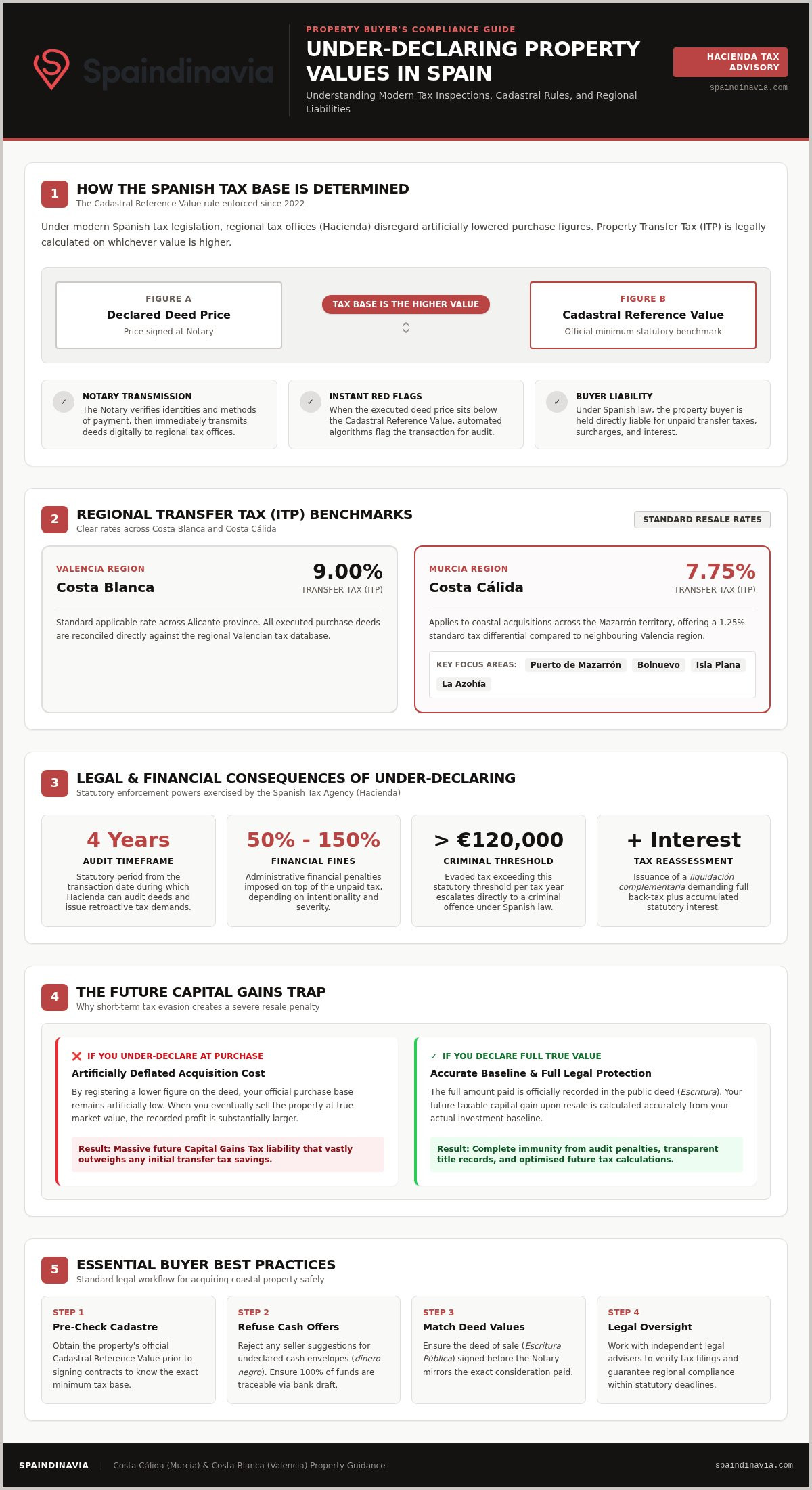
Hacienda cross-checks residential transactions against automated registry databases. Since 2022, tax authorities enforce the Cadastral Reference Value (Valor de Referencia Catastral), which calculates a statutory minimum valuation for every home based on localised sales data. If your agreed price is lower than this benchmark, tax officers ignore your deed price and demand tax on the higher cadastral amount regardless.
Historical Cash Payments Versus Modern Spanish Transparency
Decades ago, cash envelopes (often called dinero negro) circulated freely during Spanish property completions. Sellers used undeclared cash to slash capital gains tax, while buyers shaved points off regional transfer taxes. Those practices have vanished under robust European anti-money laundering legislation and strict digital banking limits. Foreign buyers unfamiliar with local rules often fall victim to illicit seller requests, failing to realise that tax inspectors hold the buyer directly responsible for underpaid transfer taxes.
The Role of the Public Deed and the Notary
Every legal real estate transfer requires signing the deed of sale (Escritura Pública de Compraventa) before a Spanish Notary. Understanding the notary's actual duty prevents costly assumptions:
- Deed verification, not valuation: The notary verifies legal identities, clears title registry documents, and witnesses payment methods, but never inspects physical property to check whether the agreed price reflects fair market value.
- Direct automated reporting: Notaries transmit all executed transaction figures directly to regional tax offices in both the Costa Blanca (Valencia region) and the Costa Cálida (Murcia region).
- Instant audit triggers: Whenever an executed figure drops below official reference benchmarks, regional auditors receive an immediate digital flag.
Whether you're purchasing a coastal townhouse in Puerto de Mazarrón or acquiring an apartment along the beaches of Bolnuevo, Isla Plana, and La Azohía, accurate deed declaration remains your primary legal defence. Understanding what happens if you under-declare property value in Spain ensures your investment remains secure and fully compliant from day one.
The Serious Consequences of Under-Declaring Spanish Property Values
Agreeing to depress the declared purchase price on an official deed exposes you to substantial legal liabilities. When evaluating what happens if you under-declare property value in Spain, the consequences extend far beyond a polite letter requesting clarification. Hacienda possesses four years from the date of the transaction to audit property transfer filings, assess retroactive liabilities, and impose severe punitive measures.
Complementary Tax Assessments and Financial Penalties
When regional tax inspectors detect that a transaction settled below official benchmarks, they issue a complementary tax assessment (liquidación complementaria). This notification demands immediate settlement of the unpaid transfer tax alongside accumulated statutory interest. Beyond the back-taxes, Hacienda classifies intentional under-declaration as tax fraud:
- Administrative fines: Financial penalties range from 50% up to 150% of the avoided tax amount, scaled according to whether authorities determine simple non-compliance or fraudulent intent.
- Criminal thresholds: If the evaded tax exceeds €120,000 per tax year, the violation escalates to a criminal offence under the Spanish Penal Code, carrying potential prison sentences of one to five years and fines up to six times the avoided sum.
The Resale Capital Gains Tax Trap for Buyers
Sellers often suggest under-declaration because it trims their immediate capital gains exposure. Buyers who accept this arrangement walk directly into an expensive fiscal trap. By artificially recording a lower purchase price today, you permanently depress your official acquisition baseline.
When you eventually sell your villa or apartment, your future taxable capital gain is calculated as the difference between your artificially low declared purchase figure and your actual exit price. Non-resident capital gains tax sits at 19% for EU/EEA residents and 24% for non-EU residents. Saving a modest percentage on regional transfer tax today can easily cost you tens of thousands of euros in inflated capital gains tax upon resale.
Mortgage Refusal and Legal Vulnerabilities
Under-declaration introduces operational disruptions during and after the acquisition process:
- Mortgage restrictions: Spanish mortgage providers lend exclusively against the lower figure between the independent bank valuation and the declared deed price. Artificially low declared figures severely reduce borrowing capacity.
- Loss of undeclared funds: If the private purchase contract collapses before notary completion, reclaiming unrecorded funds from the vendor is practically impossible, as Spanish courts refuse to enforce illicit agreements.
Whether you are considering investment properties across the Costa Blanca or exploring resale apartments around the Costa Cálida, safeguarding your capital requires pristine paperwork. Exploring thoroughly vetted resale apartments and villas with verified legal standing guarantees that your Spanish dream home remains an enduring source of joy rather than a lingering fiscal threat.
How the Cadastral Reference Value Determines Your Tax Base
Understanding the Cadastral Reference Value (Valor de Referencia) changes how buyers view property acquisition. Introduced in 2022, this statutory figure serves as the non-negotiable minimum tax base for Property Transfer Tax (ITP). When evaluating what happens if you under-declare property value in Spain, remember that the tax office no longer relies on subjective inspector visits. Hacienda simply applies the rule: tax is calculated on whichever figure is higher between your actual purchase price and this official reference value.
Understanding Valor de Referencia Versus Market Price
The General Directorate of Cadastre calculates this benchmark annually using anonymised transaction data recorded by notaries across each postcode. If you negotiate a genuine bargain below the published reference figure, regional tax inspectors will still levy transfer tax against the official benchmark. Under-declaring your agreed price below this threshold serves no purpose at all, as the algorithm automatically adjusts your taxable base upwards.
Regional Tax Variations: Costa Cálida Versus Costa Blanca
Property Transfer Tax rates vary between autonomous communities, creating distinct financial environments along the Mediterranean coast:
- Costa Cálida (Murcia region): Resale purchases incur a general ITP rate of 7.75%. Stamp duty (AJD) on new build properties sits at 1.5%, providing competitive conditions for buyers securing homes in the Mazarrón area, including Puerto de Mazarrón, Bolnuevo, Isla Plana, and La Azohía.
- Costa Blanca (Valencia region): The general ITP rate for resales stands at 9% (rising to 11% for luxury properties over €1 million), while stamp duty on new builds is 1.4%.
For a detailed breakdown of all purchase levies and regional closing costs, consult our buying property in Spain guide before making an offer.
Challenging an Inflated Cadastral Valuation Legally
Occasionally, an older property in poor decorative order carries a reference value far higher than its physical condition warrants. If you purchase a home requiring extensive structural repairs, don't attempt an off-the-books arrangement. You can challenge the valuation legally:
- Pay the assessed tax first: Never withhold initial tax settlement; paying within the standard 30-day window prevents automatic interest charges and fiscal penalties.
- Commission an independent appraisal: Hire a qualified architect to conduct an official valuation (tasación pericial contradictoria) documenting internal defects, outdated installations, or structural damage.
- Lodge an administrative appeal: Submit a formal appeal (recurso de reposición) or file directly with the Regional Economic-Administrative Tribunal within one month of notification to claim an official rebate.
Knowing what happens if you under-declare property value in Spain makes one thing clear: working transparently within legal appeal channels protects your investment, whereas artificial price suppression invites immediate regulatory scrutiny.
What to Do If You Receive a Tax Inspection or Reassessment
Receiving an official brown envelope from regional tax authorities can feel daunting. If you have ever wondered what happens if you under-declare property value in Spain, this notification marks the start of the formal review process (comprobación de valores). The document lays out the administration's revised assessment of your home and outlines additional transfer tax owed. Staying calm, organised, and proactive helps you protect your financial interests without panic.
Deadlines and Initial Actions Upon Receiving a Demand
Check the exact delivery date stamped on the notification immediately. Spanish administrative law grants you a strict statutory window of exactly one month from the day following receipt to either settle the demand or submit formal legal challenges. Never ignore these letters. Disregarding regional tax notices leads straight to enforcement proceedings, meaning authorities can freeze Spanish bank accounts or place embargos directly onto your property title registry.
If you hold a digital tax certificate (certificado digital), review the electronic tax portal regularly to catch notifications before formal postal attempts lapse.
Assembling Evidence to Justify a Lower Purchase Price
Tax algorithms generate reference values from general neighbourhood statistics without stepping foot inside your home. If you paid below that threshold because the property suffered from significant physical damage, build a solid evidentiary portfolio to substantiate your declared deed value:
- Detailed photographic logs: Take high-resolution images showing active damp, cracked load-bearing walls, degraded roofs, or outdated wiring.
- Certified architectural surveys: Commission a collegiate architect or registered valuer (tasador) to produce a comprehensive technical assessment detailing structural liabilities.
- Contractor quotes: Collect itemised quotes from licensed builders showing the extensive repair costs required to make the property habitable.
The Role of Independent Legal Representation
Never rely on an estate agent to handle tax disputes; you need an independent Spanish property solicitor (abogado) or a registered tax consultant (gestor administrativo). Legal counsel will assess whether to file an administrative appeal (recurso de reposición) with the local tax office or take the claim directly before the Regional Economic-Administrative Tribunal.
Your solicitor can also request a temporary suspension of the tax collection process, preventing automatic asset freezing while the tribunal examines your counter-valuation. Tax offices in both the Costa Blanca (Valencia region) and the Costa Cálida (Murcia region) enforce these procedural rules strictly. When sourcing new build villas or resale properties in the Mazarrón area, including Puerto de Mazarrón, Bolnuevo, Isla Plana, and La Azohía, partnering with vetted professionals prevents these disputes entirely.
To ensure total compliance from the very beginning, browse fully vetted properties with Spaindinavia and enjoy complete transparency throughout your Mediterranean journey.
How Spaindinavia Ensures Safe and Legally Compliant Property Purchases
Buying a home abroad should be an uplifting journey towards sunshine and relaxed living, never an exercise in navigating tax anxiety. Knowing what happens if you under-declare property value in Spain underscores why working with a transparent, client-focused partner matters. Spaindinavia ensures your purchase remains fully protected from fiscal complications, providing reassuring guidance across both the Costa Cálida and the Costa Blanca.
Specialist Focus on Costa Cálida and Costa Blanca Communities
Finding the right balance between lifestyle and legal certainty starts with deep local knowledge. While the lively Costa Blanca (Valencia region) offers dynamic resort living and international hubs, the Costa Cálida (Murcia region) delivers authentic Spanish character alongside peaceful seaside settings. Within Murcia, our specialist focus centres on the charming Mazarrón area. We guide buyers through distinct coastal micro-markets, including the bustling marina lifestyle of Puerto de Mazarrón, the red-sand shores of Bolnuevo, the tranquil coves of Isla Plana, and the breathtaking mountain backdrop of La Azohía. Establishing realistic, market-accurate purchase contracts prevents discrepancies before notary day arrives.
Vetted Portfolios: From New Build Villas to Resale Apartments
Every home in our portfolio undergoes thorough initial scrutiny before it reaches your viewing schedule. Whether you are looking for contemporary new build villas with fixed developer pricing and bank guarantees, or charming resale apartments and townhouses, we verify legal paperwork in advance. We review registry titles, verify cadastral values, and examine community documentation so that your agreed deed figure represents an honest, fully defensible valuation.
Partnering with Independent Experts for Absolute Peace of Mind
True peace of mind comes from clear boundaries and professional integrity. We work closely with independent, English-speaking conveyancing solicitors and registered fiscal advisors who act solely in your interests. These independent legal experts verify that your declared purchase figure aligns perfectly with the official Cadastral Reference Value, preventing unexpected post-completion inspections or costly capital gains penalties on future resales.
When you're ready to explore high-quality coastal properties without legal compromises, connect directly with Spaindinavia's property portfolio and advisory team to start your Mediterranean chapter on secure ground.
Secure Your Spanish Property Investment with Complete Confidence
Understanding what happens if you under-declare property value in Spain reveals a simple truth: cutting corners on official deeds leaves you exposed to retroactive tax assessments, punitive fines, and inflated capital gains on resale. With digital tracking and Cadastral Reference Values firmly established, total legal transparency is the only dependable way to safeguard your wealth.
As an independent real estate agency operating since circa 2016, Spaindinavia guides you safely through every milestone of buying along the Costa Blanca and Costa Cálida. Through our direct collaboration with independent solicitors and fiscal representatives, we ensure your transaction remains fully compliant from the initial deposit to final deed execution. Whether you're searching for contemporary villas or coastal resale apartments in Puerto de Mazarrón, Bolnuevo, Isla Plana, or La Azohía, you can embrace the Mediterranean lifestyle with absolute peace of mind. Explore legally secure properties with Spaindinavia today and take the next step towards your new coastal home.
Frequently Asked Questions
Can I legally pay part of a Spanish property purchase in cash?
No, physical cash payments are practically impossible in lawful property acquisitions. Spanish anti-fraud laws strictly limit cash transactions involving businesses or non-resident parties, and notaries demand fully traceable payment records before executing deeds. Buyers must provide certified bank drafts or verified electronic bank transfers showing the origin of funds. Paying cash in an envelope is entirely illegal, leaving you without legal proof of payment or contract protection.
How does the Spanish Tax Agency detect an under-declared property value?
The tax agency uses automated digital systems that immediately cross-reference deed prices against official property databases. Whenever a notary executes a sale, transaction details are transmitted electronically to Hacienda. If you wonder what happens if you under-declare property value in Spain, the algorithm automatically flags any deed where the price sits below the statutory Cadastral Reference Value, triggering a formal inspection notice without needing a physical visit.
What is the difference between Valor de Referencia and Valor Catastral in Spain?
While both figures originate from the General Directorate of Cadastre, they serve completely different fiscal purposes. The traditional cadastral value (valor catastral) is an administrative baseline used to calculate annual municipal property taxes (IBI). The Cadastral Reference Value (valor de referencia), introduced in 2022, reflects annual market sales data and establishes the mandatory minimum tax threshold for Property Transfer Tax and inheritance valuations.
Will I pay more capital gains tax later if I declare a lower price today?
Yes, substantially more. When you resell, your capital gains tax is calculated against your officially declared acquisition deed figure. If you artificially depress that baseline to save transfer tax today, you create a far larger taxable profit on future sale. With capital gains tax rates set at 19% for EU/EEA residents and 24% for non-EU residents, future liabilities will easily erase any initial savings.
Can I appeal if the official Cadastral Reference Value is higher than what I paid?
Yes, you can contest the valuation legally. You must first pay the assessed Property Transfer Tax within the statutory 30-day window to avoid interest penalties, then file an administrative appeal within one month. Supporting your claim requires an independent valuation report from a registered collegiate architect or surveyor, proving that the physical condition, layout, or structural defects of your property justify a lower market value.
Does the notary in Spain verify whether the declared purchase price is fair?
No, the notary does not assess whether your purchase price reflects realistic market conditions. A Spanish notary acts as an impartial public official responsible for verifying legal titles, buyer and seller identities, and traceable payment methods. They ensure the deed complies with statutory formalities, but they never physically inspect the property. However, notaries must submit all financial figures directly to regional tax authorities immediately after completion.
How long does Hacienda have to audit a property transaction in Spain?
The Spanish Tax Agency has a statute of limitations of exactly four years to audit real estate transactions and demand unpaid taxes. This four-year clock starts the day after the statutory deadline for filing your property transfer tax return. Understanding what happens if you under-declare property value in Spain highlights this risk: any formal inquiry or notification issued by Hacienda during this four-year window resets the statutory timer.
Why do some sellers in Spain still ask buyers to declare a lower value?
Sellers typically propose under-declaration to reduce their personal tax exposure, specifically national capital gains tax and the municipal plusvalía tax. By pocketing unrecorded funds, they lower their reported profit. However, agreeing to this illicit proposal transfers all long-term risks to you as the buyer, leaving you vulnerable to immediate inspection penalties and higher resale taxes across both the Costa Blanca and Costa Cálida.


