

What if the only thing standing between you and a sunset over Puerto de Mazarrón was a stack of paperwork you didn't quite understand? It's a common worry for many who dream of a new life in the sun, especially when the fear of hidden debts or complex Spanish bureaucracy starts to cloud the excitement. Whether you're looking at a modern villa in Isla Plana or a charming apartment in the Costa Blanca, understanding the legal process for buying property in Murcia is the most important step you'll take towards a secure investment.
We know that the transition to the Costa Cálida lifestyle should feel like a fresh start, not a legal headache. You deserve to feel confident that every contract is sound and every local regulation is met. In this 2026 guide, we'll master the essential legal requirements together, from obtaining your NIE to finalising the deeds at the notary. We'll explore the specific nuances of the Mazarrón area, including Bolnuevo and La Azohia, whilst comparing the requirements to neighbouring regions like the Costa Blanca. By the end of this article, you'll have a clear timeline and the professional insight needed to make your Spanish dream a reality.
Key Takeaways
- Learn why appointing an independent solicitor and obtaining your NIE is the essential first step for any purchase in Puerto de Mazarrón or the Costa Blanca.
- Master the legal process for buying property in murcia by understanding the critical role of the "Contrato de Arras" in protecting your deposit and commitment.
- Discover how to use a "Nota Simple" to uncover hidden debts and ensure the legal health of your dream home in Bolnuevo, Isla Plana, or La Azohia.
- Navigate the completion at the notary with confidence, ensuring you understand the signing of the "Escritura" for properties in both the Costa Cálida and Valencia regions.
- Budget accurately for your investment by breaking down the 2026 tax differences and additional fees you'll encounter across the Mediterranean coast.
The Foundation: Essential Legal Preparations Before You Start
Success in the Spanish property market begins long before you set foot in a notary's office. Understanding the legal process for buying property in murcia ensures your journey from browsing villas in Bolnuevo to holding the keys is smooth and secure. Whether you're drawn to the rugged beauty of the Costa Cálida or the vibrant energy of the Costa Blanca; getting your paperwork in order is the first step to peace of mind.
The NIE Number: Your Gateway to Spanish Property
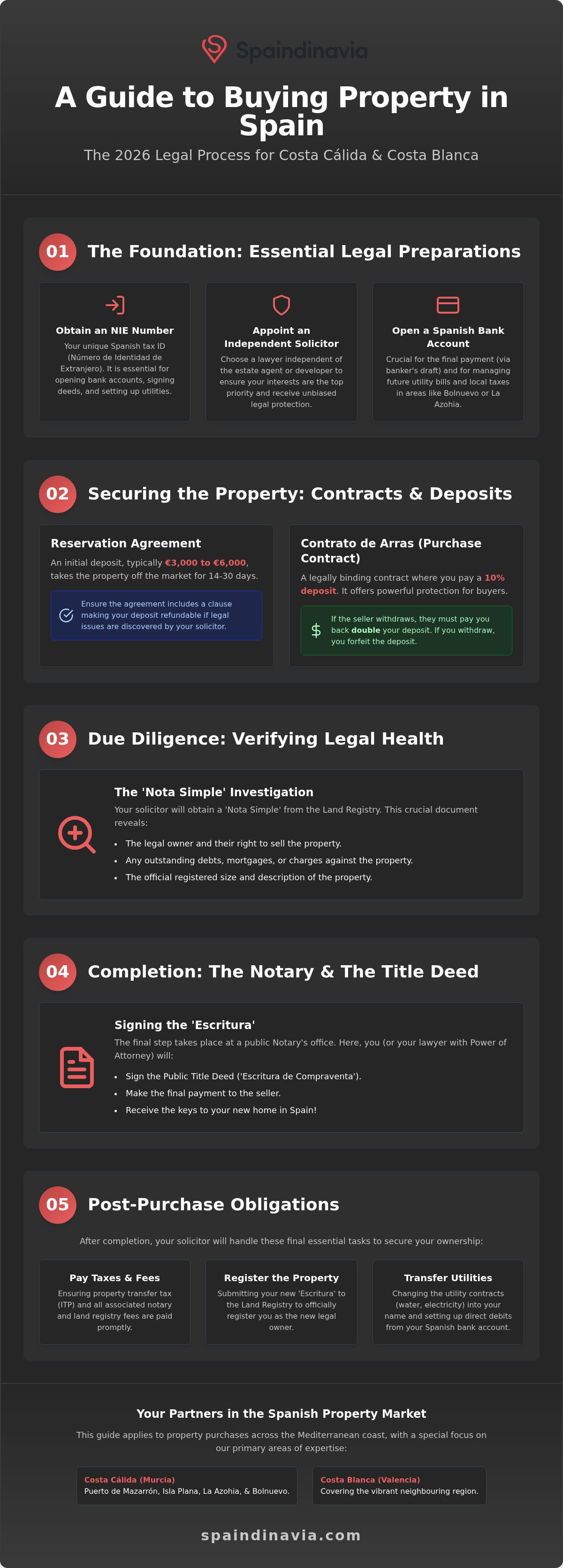
Your NIE (Número de Identidad de Extranjero) is your unique tax identification number. You'll need it for everything: opening a bank account, setting up utilities in Isla Plana, and, most importantly, signing the purchase deed. For British nationals in 2026, we recommend starting this early. You can apply through the Spanish Consulate in the UK, which often takes several weeks, or locally in Murcia once you arrive. Without this number, the entire transaction stops in its tracks. Whether you're buying in the Costa Cálida or the Costa Blanca; this number is the primary identifier for the Spanish tax authorities and must be present on every legal document.
Choosing Independent Legal Representation
We can't overstate the importance of hiring an independent property lawyer. Whilst a "gestor" can help with basic administrative tasks like filing taxes, a qualified lawyer provides the deep legal protection you need for a major investment. Ensure your solicitor is independent of the estate agent or developer. This ensures their only priority is your interests; verifying that the penthouse in Puerto de Mazarrón or the townhouse in the Costa Blanca is legally sound and free of hidden liabilities. They'll perform essential checks on building licences and ensure the seller actually has the right to sell the property before any money changes hands.
Banking and Power of Attorney
You'll also need a Spanish bank account. It's vital for completion because the final payments are usually made via a Spanish banker's draft. Beyond the purchase, having a local account makes managing your new home much easier. You'll use it to pay local taxes and utility bills in La Azohia or Bolnuevo via direct debit; much like you would for a property in the Costa Blanca. If you can't be in Spain for every step, consider a "Poder Notarial" (Power of Attorney). This legal document allows your lawyer to sign documents or open accounts on your behalf; saving you multiple trips whilst keeping the legal process for buying property in murcia moving forward efficiently.
Securing the Property: Reservation and the Arras Contract
Once you've found that perfect villa in Bolnuevo or a sleek apartment in the Costa Blanca, you'll want to stop others from viewing it. This is where the legal process for buying property in murcia moves into its second phase. It's an exciting moment, but it's also where the paperwork becomes serious. You're moving from being a casual viewer to a committed buyer, and the contracts you sign now will dictate the security of your deposit.
The Reservation Agreement and Initial Deposit
The first document you'll likely encounter is the Reservation Agreement (Documento de Reserva). By paying a small initial fee, typically between €3,000 and €6,000, the seller agrees to take the property off the market for a set period, usually 14 to 30 days. This gives your lawyer time to perform initial due diligence. Whether you're looking in Puerto de Mazarrón or across the border in the Costa Blanca, always ensure this agreement includes a clause stating the deposit is refundable if legal issues arise. It's a simple safeguard that provides immediate peace of mind whilst your solicitor starts their checks in areas like Isla Plana or La Azohia.
The Arras Contract: Making it Legally Binding
The most critical document in the entire process is the "Contrato de Arras". This is a private purchase contract that goes much deeper than the reservation. At this stage, you'll usually pay a deposit equal to 10% of the purchase price. In the Murcia region and the Costa Blanca, the most common type is the "Arras Penitenciales". This contract carries heavy weight for both parties. If you decide to withdraw from the purchase, you'll forfeit your 10% deposit. However, if the seller pulls out, they're legally required to pay you back double your deposit. This "double-deposit rule" is a fantastic protection for buyers, especially in high-demand spots.
When drafting this, your lawyer will set a completion date. If you're applying for a mortgage, ensure this timeframe is realistic. Spanish banks can take time, and you don't want to be rushed. For those looking at new build villas in Puerto de Mazarrón, specific clauses regarding bank guarantees are essential. These "Avales Bancarios" protect your stage payments if the developer runs into trouble. If you're feeling overwhelmed by the paperwork, looking at specialised property options can help you find a team that handles these negotiations on your behalf. By the time the Arras is signed, the path to the notary is clear and legally paved.
Due Diligence: Verifying the Legal Health of the Home
Once the Arras contract is signed and the deposit is safely held, the focus shifts to the property's history and legal standing. This investigation is perhaps the most vital part of the legal process for buying property in murcia. It's the moment your solicitor ensures that your dream home in Puerto de Mazarrón or the Costa Blanca isn't carrying any unwelcome surprises from its past. You want to move into your new life with total confidence, knowing every brick and tile is legally accounted for.
The Nota Simple: The Property’s CV
The first document your lawyer will request is the "Nota Simple" from the Land Registry. Think of this as the property's CV. It provides a snapshot of the home's legal status, including the names of the current owners and any outstanding debts or embargos. If the name on the Nota Simple doesn't match the person selling the villa in Isla Plana, your lawyer will stop the process until the discrepancy is resolved. We also use this document to verify that the property's description matches what you've seen. If a resale apartment in La Azohia has a large terrace that isn't on the Nota Simple, it might have been built without the correct permissions. Correcting these records before completion is essential to avoid future fines or issues when you eventually decide to sell.
Town Planning and Structural Checks
The legal requirements vary slightly depending on whether you're buying a brand-new villa or a resale townhouse. For new build villas in Bolnuevo or Puerto de Mazarrón, the "Licencia de Primera Ocupación" (Habitation Licence) is your golden ticket. This document confirms the building meets all health and safety standards and allows you to connect water and electricity. In the Costa Blanca, similar certificates are required, though the local town hall procedures can differ slightly from those in the Murcia region.
For properties close to the Mediterranean, your lawyer must also check the "Ley de Costas" (Coastal Law). This is especially important in beachfront spots like Bolnuevo or Isla Plana. This law protects the shoreline and can restrict renovations or even ownership rights if a property was built too close to the sea. Whilst your lawyer handles the legalities, we often suggest a technical survey for resale properties in La Azohia. A surveyor will check for structural integrity and damp, ensuring the home is as healthy as the legal paperwork suggests. This two-pronged approach; legal and technical; is the best way to secure your investment in the Spanish sun.
The Completion: The Notary and the Public Title Deed
Reaching the completion stage is a milestone moment. After weeks of due diligence and anticipation, the legal process for buying property in murcia reaches its finale at the Notary's office. This is where the physical reality of your new home in Puerto de Mazarrón or the Costa Blanca officially becomes a legal certainty. In Spain, the Notary (Notario) is much more than a simple witness; they are a public official who ensures the entire transaction complies with Spanish law.
The Big Day: Meeting at the Notary Office
The signing of the "Escritura de Compraventa" (Public Title Deed) usually takes place around a large table in the Notary’s office. It’s a formal yet celebratory occasion. You’ll be joined by the sellers, your lawyer, and a representative from the bank if you’ve arranged a mortgage. If you’re purchasing a new build villa in Bolnuevo or a resale apartment in Isla Plana, the Notary will read the deed aloud in Spanish. Your lawyer will be there to provide a translation and ensure every detail is correct.
The final payment is typically made via bank-guaranteed cheques. Once these are handed over and the deed is signed by all parties, the Notary adds their official signature. This is the exact moment the keys are placed in your hand. It’s a unique part of the legal process for buying property in murcia that feels incredibly rewarding; especially when you step out into the sunshine of La Azohia or the Costa Blanca as a legal homeowner.
From Signing to Ownership
Immediately after signing, you’ll receive a "Copia Simple". This is an unofficial copy of your deed that allows you to start setting up your life. However, the legal work doesn't stop at the Notary's door. Your lawyer must now register the deed at the Land Registry (Registro de la Propiedad). This process can take several weeks, but it’s the final step that protects your ownership against any third-party claims. It provides the ultimate security for your investment, whether you've chosen the Murcia region or the neighbouring Valencia region.
Whilst your lawyer handles the registry, they’ll also update the Catastro (the Spanish tax office) to reflect the new ownership. Whether your investment is a bungalow in the Costa Blanca or a luxury villa in Puerto de Mazarrón, these administrative steps are vital for future tax obligations. If you're looking for professional guidance to reach this stage smoothly, browse our latest property listings to find your dream home and a team that supports you every step of the way.
Post-Purchase Obligations: Taxes, Utilities, and Management
Holding the keys to your new home in Puerto de Mazarrón or a bright apartment in the Costa Blanca is a wonderful feeling. However, the final stage of the legal process for buying property in murcia involves a few administrative steps to ensure your transition is seamless. These post-purchase obligations are just as vital as the initial due diligence, as they protect your investment and ensure you're fully compliant with local regulations from day one.
Taxes and Fees: The Final Breakdown
Budgeting correctly for your purchase is essential for a stress-free experience. We always suggest setting aside an additional 12% to 15% of the purchase price to cover taxes, notary fees, and registry costs. If you're buying a resale property in Bolnuevo or Isla Plana, you'll be subject to ITP (Transfer Tax). In contrast, new build villas attract IVA (VAT) and a smaller Stamp Duty fee. Whilst the Murcia region and the Valencia region share many similarities, tax rates can fluctuate between them; so it's wise to verify the exact costs for your specific area with your lawyer.
Keep every receipt and invoice from this stage. These documents aren't just for your records; they're essential for offsetting future Capital Gains Tax should you decide to sell your property later. Your solicitor will typically handle the payment of these taxes on your behalf, ensuring you meet the strict 30-day deadline following the signing of the deeds. Missing these deadlines can result in unnecessary penalties, so having a professional eye on the calendar is a huge advantage.
Settling Into Your New Life
Once the legalities are settled, focus shifts to the practicalities of homeownership. You'll need to transfer utility contracts for water and electricity into your name and set up direct debits from your Spanish bank account. If your home is part of a complex in Costa Blanca South or a residential area in La Azohia, you'll also have community fees to organise. These ensure the communal pools and gardens stay in top condition throughout the year. It's a small price to pay for the lifestyle you've worked so hard to achieve.
Managing a second home from the UK can feel daunting, but you don't have to do it alone. Many holiday homeowners find peace of mind by using Spaindinavia’s property management services to handle the day-to-day care of their investment. For a comprehensive overview of your journey, read our Buying Property in Spain Guide: The Essential 2026 Checklist. Remember to also account for the annual IBI (Council Tax) and Non-Resident Income Tax, which are the final pieces of the puzzle in maintaining your dream life in the sun.
Step Into Your Mediterranean Future with Confidence
Your journey to a new life in the sun is closer than you think. By mastering the legal process for buying property in murcia, you've already cleared the biggest hurdle. From securing your NIE to navigating the specific tax nuances between the Murcia and Valencia regions, you now have the roadmap to purchase safely. Whether you're dreaming of a modern townhouse in the Costa Blanca or a sea-view villa in Bolnuevo; your investment is protected by the rigorous due diligence and notary steps we've explored.
Since 2016, we've acted as a trusted bridge for British buyers, specialising in the unique charm of Puerto de Mazarrón, Isla Plana, and the wider Costa Blanca. Our team provides comprehensive support from your first NIE appointment to final key holding, ensuring your transition is as calm as the Mediterranean itself. Ready to find your perfect home? View our hand-picked portfolio of New Build Villas in Costa Cálida and let's make your dream a reality. The warmth of the Spanish sun and a secure, legal purchase are waiting for you.
Frequently Asked Questions
Do I really need a lawyer to buy a property in Murcia?
Yes, appointing an independent lawyer is the single most important step for a secure investment. Whilst a notary ensures documents are signed correctly, your lawyer performs the deep due diligence required for the legal process for buying property in murcia. They'll verify ownership in Puerto de Mazarrón or the Costa Blanca and ensure no hidden debts exist. It's about having a professional who is solely on your side throughout the journey.
What is the total cost of legal fees and taxes when buying in Spain?
You should budget for an additional 12% to 15% on top of the purchase price to cover taxes and fees. This includes the ITP (Transfer Tax) for resales in the Murcia region or the Costa Blanca, alongside notary and registry costs. New builds attract IVA (VAT) instead. These rates can vary slightly between the Costa Cálida and Valencia regions, so always ask your solicitor for a precise breakdown based on your chosen location.
How long does the legal process take from offer to completion?
The timeline typically ranges from four to twelve weeks depending on the complexity of the sale and whether you need a mortgage. Resale apartments in Isla Plana or La Azohia can often complete faster if the paperwork is in order. If you're buying a new build villa in Puerto de Mazarrón, the schedule will follow the construction phases. Having your NIE and Spanish bank account ready early will significantly speed up the entire process.
Can I buy a property in the Costa Cálida remotely from the UK?
Yes, you can certainly purchase your dream home in the Costa Cálida or Costa Blanca without being physically present for every step. By granting your lawyer a "Poder Notarial" (Power of Attorney), they can sign the Arras contract and the final deeds on your behalf. This is a common choice for our British clients buying in Bolnuevo who want to ensure the legal process for buying property in murcia continues whilst they are in the UK.
What is an NIE number and how do I get one in 2026?
An NIE is your Spanish tax identification number, and it’s mandatory for any property transaction in the Murcia or Valencia regions. In 2026, British citizens can apply via the Spanish Consulate in the UK or in person at a local police station in Spain. Because appointment wait times can vary, we recommend starting this process as soon as you begin your search for a villa in Puerto de Mazarrón or the Costa Blanca.
What happens if the property has illegal extensions?
If a property has illegal extensions, your lawyer will identify them during the "Nota Simple" check and advise you on the risks. In areas like Bolnuevo or Isla Plana, unrecorded structures can lead to fines or issues with future sales. You might request the seller to legalise the extension before completion or negotiate a price reduction. Never proceed until your independent solicitor confirms the urbanistic situation is fully resolved and safe.
Is the process different for new build villas versus resale apartments?
The main difference lies in the taxes and the protective guarantees required. New builds in the Costa Cálida or Costa Blanca attract 10% IVA plus Stamp Duty, whilst resale properties are subject to ITP. For a new villa in Puerto de Mazarrón, you must also ensure the developer provides bank guarantees for your stage payments. Resale purchases focus more heavily on checking for historical debts and ensuring all previous building work was permitted.
What taxes must I pay as a non-resident property owner in Spain?
As a non-resident, you'll be responsible for two main annual taxes: IBI (Council Tax) and Non-Resident Income Tax. IBI is paid to the local town hall in places like La Azohia or the Costa Blanca and covers local services. Even if you don't rent out your property, the Spanish tax office assumes a "deemed income" from your ownership. Keeping on top of these ensures your home remains in good legal standing for years to come.


