

What if sharing the dream of a holiday home also means sharing decisions you would rather make alone? The pros and cons of buying a holiday home with friends come down to a clear trade-off: you can divide the purchase and ongoing costs, but you also share responsibility, maintenance and control. Agreeing how you will use the home, who pays for what and what happens if someone wants to sell can make all the difference.
It is easy to see the appeal. A place in the sun may feel more achievable when friends contribute, and shared visits can make a coastal home even more enjoyable. But good intentions are no substitute for a practical plan, especially when finances or priorities change.
In this guide, you will learn how shared costs, mortgages, upkeep and ownership structures affect the decision. We will also cover the conversations to have before buying, so you can weigh the benefits against the commitments and decide whether co-owning is right for your group.
Key Takeaways
- Agree how ownership shares, property use, decisions and exit arrangements will work before you buy.
- Build a full picture of the ongoing costs, and understand how a shared mortgage could leave each borrower responsible for repayments.
- Set a maintenance budget and divide routine jobs and larger repair decisions clearly between co-owners.
- Discuss holiday dates, guest stays and letting the property early, while everyone’s expectations are aligned.
- Compare shared ownership with buying alone, then explore suitable holiday homes with Spaindinavia when you’re ready to consider properties.
Control, management costs, and choosing an ownership model
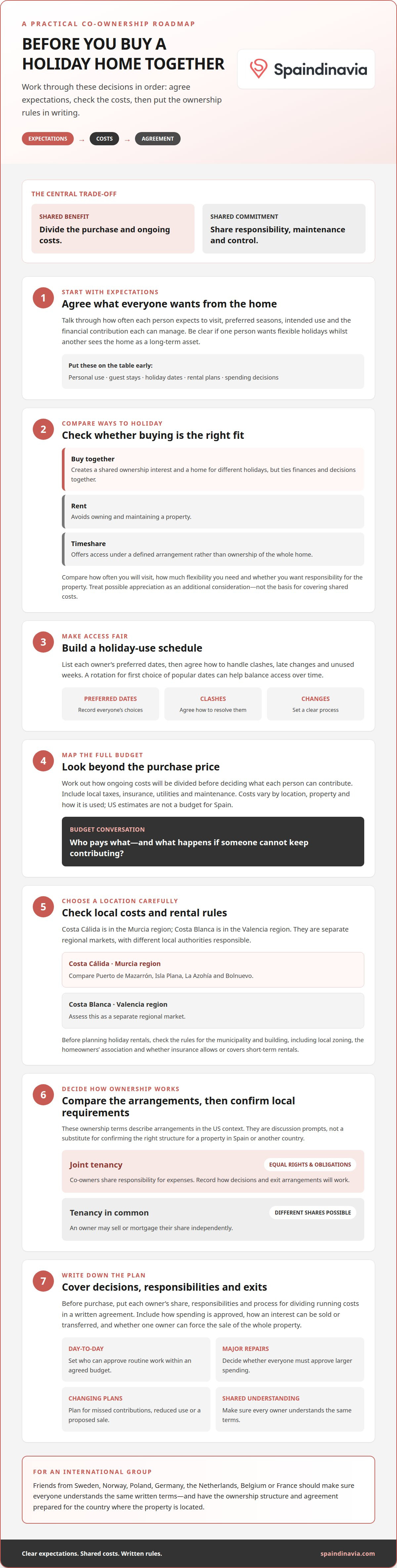
Choose an ownership arrangement before viewing properties together. It affects who can make decisions, how costs are divided and what happens when an owner’s plans change. The pros and cons of buying a holiday home with friends depend as much on these rules as on the home itself. Write down how you will share use, approve spending and resolve disagreements.
For a property in Spain, check the rules that apply to its municipality and building before planning holiday rentals. Costa Cálida is in the Murcia region, while Costa Blanca is in the Valencia region, so different local authorities are responsible. In either area, check whether local zoning, the homeowners’ association and insurance allow or cover short-term rentals.
Ownership terms also need careful thought. In a joint tenancy arrangement, co-owners have equal rights and obligations and share responsibility for expenses. Under tenancy in common, owners can hold different percentages and may sell or mortgage their shares independently. These terms describe arrangements in the US context, not a substitute for confirming the appropriate ownership structure for a property in Spain or another country.
Put the operating agreement in writing before purchase. Set out each owner’s share, responsibilities, decision-making process and method for dividing running costs. Include how an interest can be sold or transferred, and whether one owner can force the sale of the whole property. For example, agree whether major repairs need everyone’s approval or whether a named owner can approve routine work within an agreed budget.
Plan for financial changes as well as everyday disagreements. One friend might need to sell, stop contributing or use the home less, while another wants to rent it out or book peak dates. Agree how to handle missed contributions, changes to visit dates and a proposed sale. In the described US tenancy-in-common situation, resolving a dispute may involve the parties and a court-appointed receiver paying three lawyers, illustrating how costly unresolved conflict can become.
| Ownership option | Shares | Control and exit |
|---|---|---|
| Joint tenancy | Equal rights and obligations | Co-owners share expenses; record decision and exit arrangements. |
| Tenancy in common | Different ownership percentages are possible | An owner may sell or mortgage their share independently. |
| Written co-ownership agreement | Sets out agreed interests | Defines responsibilities, transfers and whole-property sale rules. |
Use the table as a discussion prompt, not as a ready-made legal template. The right choice depends on how much control each person wants and whether contributions will be equal. Before committing, agree on a written process for spending decisions, rental plans, personal use and an owner’s departure. For an international group, including friends from Sweden, Norway, Poland, Germany, the Netherlands, Belgium or France, make sure everyone understands the same terms. Then have the ownership structure and agreement prepared for the country where the property is located.
Q: How should one begin the process of co-owning a vacation home?
Start by agreeing how often each person expects to use the home, what ongoing costs they can share and whether buying suits everyone’s plans. Then compare ownership with renting and timeshare use, and make a schedule before choosing a property.
Buying Together, Renting or Timeshare Use
Buying gives friends a shared ownership interest and a home they can use for different holidays, but it also ties their finances and decisions together. Renting avoids owning and maintaining a property, while a timeshare offers access under a defined arrangement rather than ownership of the whole home. Compare how often you will visit, how much flexibility you need and whether you want responsibility for the property.
Start with a realistic example: if one friend prefers summer visits and another wants winter breaks, consider whether both can use the home enough to justify owning it together. A property’s value may rise, but appreciation depends on factors such as location, condition and resale timing. Treat a possible gain as an additional consideration, not as the basis for covering shared costs.
Sharing Property-Use Schedules
A shared schedule makes access clearer, especially for popular holiday periods. List each owner’s preferred dates, then agree how to handle clashes, late changes and unused weeks. For example, friends could rotate first choice of peak dates each year, while leaving less popular periods open for flexible bookings. Record the arrangement so everyone understands how access works.
Next, map out the full running costs before deciding what each person can contribute. Property taxes vary by location and property, while insurance and utilities depend on the home and how it is used. Treat those figures as US estimates, not a budget for Spain.
For a home in Spain, distinguish the Costa Cálida in the Murcia region from the Costa Blanca in the Valencia region. On the Costa Cálida, compare locations such as Puerto de Mazarrón, Isla Plana, La Azohía and Bolnuevo; the Costa Blanca is a separate regional market. Include local taxes and household running costs in your property budget rather than assuming US figures apply.
Before viewing homes, write down each friend’s intended use, financial contribution and preferred location. Then compare those priorities with the likely total costs and the time each person expects to spend there. If one friend wants a flexible holiday while another wants a long-term asset, revisit renting or timeshare use before committing to a shared purchase. For those who realise their priority is capital appreciation rather than shared leisure, consulting luxury real estate specialists such as SANSAV Properties can help explore dedicated investment properties instead.
Sharing maintenance responsibilities
Shared maintenance can make caring for a holiday home more manageable, but only when owners agree who handles each task. Separate routine cleaning from repairs, then set a clear process for approving and paying for work.
Cleaning, Maintenance and Repairs
Cleaning follows each stay, while maintenance keeps the property in good condition and repairs address damage or faults. Agree whether the departing owner cleans, everyone takes a turn or you share the cost of arranging cleaning. For example, a simple handover checklist can record rubbish removal, laundry and any new damage, giving the next visitor a clear starting point.
Assign one person to coordinate bookings and routine checks, while recording larger jobs for all owners. A shared log can note the date, issue, action taken and who approved it. This helps when an owner lives far away or visits less often. The benefit is clearer accountability, not less responsibility: each co-owner should know how urgent problems are reported and handled.
Maintenance and Repair Budgeting
Budgeting turns unpredictable repairs into a planned shared responsibility. One commonly used recommendation is to set aside 1% to 4% of a holiday home's value annually for maintenance and repairs. This is a planning guide, not a prediction of the property’s actual costs. The home’s condition, age, location and use all affect what needs attention.
Agree how contributions go into the shared reserve and who can approve spending. For example, routine supplies could follow a simple agreed process, while owners discuss larger repairs before work begins. Record invoices and decisions in one shared place. That makes it easier to see what the reserve has covered and whether contributions need adjusting.
- Routine care: list cleaning, ventilation and garden tasks, then assign an owner or rotation.
- Unexpected damage: agree how owners report an issue and who arranges the response.
- Larger repairs: set an approval process and record each owner’s contribution.
Review the plan together after each visit and before a new season of use. A coastal property, for instance, may need different checks from a home used occasionally inland, so base the schedule on the actual building and its surroundings. Note recurring issues, such as a leaking tap or damaged seal, rather than waiting for the next visit to discover them.
Keep the maintenance agreement practical: name the task, the person responsible, the spending process and how updates reach every owner. When friends share these details from the outset, upkeep becomes a visible part of co-ownership instead of a recurring source of disagreement.
Sharing the purchase cost and mortgage
Start by separating purchase funds, mortgage repayments and ongoing ownership costs.
There is no single total for buying and maintaining a property with co-owners: the purchase price, financing, ownership shares and upkeep all shape each person’s contribution. Build a shared budget that separates one-off purchase costs from regular payments and a maintenance reserve.
Financing and Mortgage Responsibility
A joint mortgage lets friends apply for financing together, combining their financial circumstances in one application. Before proceeding, work out how each person will pay their contribution and what happens if someone misses a payment. When several buyers sign the same mortgage, its terms may make each buyer responsible for the full payment if another owner does not contribute.
That potential responsibility matters even if friends plan to divide repayments equally. For example, if one person loses income, the others may need to cover a shortfall while they resolve the issue. Put payment dates, contribution shares and a plan for missed payments in writing, alongside the ownership agreement.
Purchase and Maintenance Costs
Separate purchase funds from the costs of keeping the home usable. Owners can spread the upfront purchase cost across two families, but unequal contributions should be reflected in the agreed ownership shares. Include the ongoing maintenance reserve discussed earlier, as well as property taxes, insurance and utilities, so the purchase budget does not obscure regular commitments.
Mortgage affordability also depends on each buyer’s other financial commitments. Someone already paying a mortgage on their main home needs to consider both sets of repayments, plus their agreed share of the holiday home’s running costs. Working through loan options with experienced advisers, such as Mortgage Suite Ltd for residential and investment property loans, can help buyers assess their financial capacity before committing to shared debt. Compare each person’s expected contribution with their own budget, rather than treating the group’s combined borrowing capacity as everyone’s personal affordability.
Keep a simple cost schedule showing who pays, when payments are due and how shared expenses are recorded. Separate mortgage payments from utilities, insurance and repair contributions, which may have different due dates and approval arrangements. If one owner pays a bill for everyone, record the amount and how the others will reimburse their shares.
Before making an offer, agree what happens if an owner wants to stop contributing or sell their interest. A sale can take time, and the remaining owners may need to manage costs during the transition. Make the exit process part of the financial plan, not an issue left until someone’s circumstances change.
For a home in Spain, assess the figures for the specific property and financing arrangement. The US mortgage estimate above is a comparison point only, not a forecast for a purchase in Spain.
Informal co-buying with friends or family
Informal co-buying often starts with a shared tradition: friends or relatives return to the same place and decide to own it together. One group sharing an island property off the coast of Maine has used it every summer since 1960. That continuity is an advantage, but long-standing friendships still need clear arrangements for money, access and decisions.
Without written rules, everyday assumptions can clash. One family may expect to use the home during school holidays, while another wants to rent it to holidaymakers. Owners can also disagree about who organises repairs, how much to spend or whether a quiet period should remain available for personal visits. Discuss these examples before looking at properties together.
A written agreement turns those conversations into a practical plan. Include each person’s contribution, how stays are scheduled, who manages routine tasks and how shared expenses are recorded. Set out how owners decide on repairs or rental plans, and what happens when someone wants to leave. For instance, agree whether the remaining owners can buy an outgoing owner’s interest or whether a sale must be considered.
Plan for uneven use and payments, too. During the pandemic, half of the island-sharing group’s per-person nights went unpaid that year. That example shows why a group should decide how to handle unused nights and missed contributions, rather than assuming every owner will use or pay for their share in the same way.
- Use: agree how peak dates are allocated and how swaps are recorded.
- Costs: decide when contributions are due and how unpaid amounts are handled.
- Decisions: clarify who can arrange routine work and how larger choices are approved.
- Exit: document the steps if an owner wants to transfer or sell their interest.
Keep the arrangement workable by reviewing it together when circumstances change. A new job, family commitments or a change in finances can affect how often someone visits and what they can contribute. A planned discussion gives the group a way to update schedules or responsibilities before frustration builds.
For friends considering a home in Spain, compare the group’s preferred location and intended use before committing. A shared place only works as a joint plan when everyone agrees on the practical details as well as the dream. Explore property options as you shape that plan.
Spaindinavia: Holiday Rental Properties
Spaindinavia offers Holiday Rental Properties for those who want to enjoy time in Spain before committing to shared ownership. If you and your friends are ready to buy, explore New Build Villas, Resale Apartments and Townhouses as different property options.
Compare the Costa Cálida in the Murcia region with the Costa Blanca in the Valencia region. On the Costa Cálida, consider Puerto de Mazarrón, Isla Plana, La Azohía and Bolnuevo; the Costa Blanca offers a different regional setting. Your group’s preferred location, budget and plans for using the property can help narrow the search.
If you’re weighing a rental stay against buying together, or are ready to explore homes, contact Spaindinavia to discuss your plans.
Turn your shared plans into a clear next step
The pros and cons of buying a holiday home with friends are easier to weigh once everyone agrees what they want from the property. Before moving forward, turn your conversations into a shared brief: preferred location, style of home, intended use and the decisions your group still needs to make. This gives you a practical starting point for exploring real options together.
If Spain is your focus, compare the Costa Cálida in the Murcia region with the Costa Blanca in the Valencia region. Around Mazarrón, Puerto de Mazarrón, Isla Plana, La Azohía and Bolnuevo offer a focused starting point on the Costa Cálida; the Costa Blanca provides a different regional setting to consider. Spaindinavia offers New Build Villas, Resale Apartments and Townhouses to help you explore different property types.
When you’re ready to discuss what could suit your group, discuss co-ownership with Spaindinavia. A considered next step can bring your shared plans closer to a place you’ll enjoy together.
Frequently Asked Questions
How are ongoing holiday home expenses divided?
Owners divide ongoing expenses according to the arrangement they agree before buying. Some split fixed bills equally; others allocate them by ownership share or property use. For example, agree whether an owner who books extra heating or cleaning pays that additional cost. Keep shared bills, payment dates and contributions in one record so everyone can see what has been paid and what remains due.
What does it mean to buy a holiday home with friends or family?
It means two or more people contribute towards a property and share ownership, use and responsibilities. The arrangement may involve friends, relatives or both, with each person’s rights recorded in the ownership documents and a separate agreement. Unlike renting, co-owners hold an interest in the property; unlike simply sharing holidays, they also have ongoing financial commitments and decisions to make together.
What happens when one owner wants to sell?
Follow the sale or transfer process agreed by the owners. That might give the remaining owners an opportunity to buy the departing person’s interest before it is offered elsewhere. The agreement should also explain how the share’s value is assessed and what happens if nobody buys it. The applicable ownership documents and local rules shape the available options.
What are the pros and cons of buying a holiday home with friends?
The main advantage is sharing the purchase and ongoing responsibilities, which can make owning a property together more practical. The trade-off is shared control: owners need to coordinate dates, spending, maintenance and decisions about selling. For instance, friends may disagree about using the home during a popular holiday period. Co-ownership suits a group willing to make decisions together, not just people with similar holiday plans.
How should friends split the deposit, mortgage, taxes, insurance, and maintenance costs?
Agree each person’s contribution before making an offer, then record how it relates to their ownership share. A group might divide the deposit according to contributions and split routine bills equally, provided everyone accepts that arrangement. Set out who pays each mortgage instalment, tax bill and insurance premium. If borrowers share a mortgage, its terms may leave each responsible for the full payment if another does not contribute.
What legal ownership structures can friends use to buy a holiday home together?
Joint tenancy and tenancy in common are ownership structures described in the US context. Joint tenancy involves equal rights and obligations; tenancy in common allows different ownership percentages, with owners able to sell or mortgage their shares independently. These terms should not be assumed to apply in Spain or another country. The ownership structure must suit the property’s location and be reflected in the purchase documents.
What should a co-ownership agreement cover for a shared holiday home?
Cover each owner’s share, use of the home, contributions, routine responsibilities and the process for approving larger decisions. Include what happens after missed payments, how disagreements are handled and how an owner can transfer or sell their interest. For example, specify whether the remaining owners get the first opportunity to buy a departing owner’s share. Clear wording gives the group a shared reference when circumstances change.
How should co-owners schedule holiday-home use and resolve booking conflicts?
Set a booking process before the first visit, including how owners request dates and resolve clashes. You could rotate who chooses first for popular periods, then open the remaining dates for booking. Record confirmed stays in a shared calendar and agree how changes or cancellations are handled. If two owners want the same week, follow the agreed rotation or another rule everyone accepted beforehand, rather than relying on informal messages.


