

A coastal setting and a business-ready location are central reasons for buying commercial property in Costa Cálida. The region’s 250 km of Mediterranean coastline in Murcia receives around 320 days of sunshine a year, making it an appealing place to explore for businesses with a local customer base or a lifestyle-led vision.
You may be weighing coastal appeal against practical concerns such as seasonal footfall, property condition and the space your business needs. Costa Cálida is in Murcia, while Costa Blanca is in the Valencia region, and each market has its own setting. Around Mazarrón, compare Puerto de Mazarrón, Isla Plana, La Azohía and Bolnuevo against the business you plan to run.
This guide covers the practical checks involved in choosing commercial premises, from legal support and inspections to layout and potential drawbacks. It explains how an estate agent, independent solicitor and notary can support a purchase, and what to assess when deciding whether a property suits your plans.
Key Takeaways
- Match the premises to your business model, whether you’re considering a restaurant, hotel, office or other commercial space.
- Understand how legal guidance can support the purchase process and help you assess a property before committing.
- Weigh location-specific factors, including seasonal demand and property condition, when comparing Costa Cálida in Murcia with Costa Blanca in Valencia.
- Explore how different premises sizes and layouts may suit your plans, with particular attention to Puerto de Mazarrón, Isla Plana, La Azohía and Bolnuevo.
- Learn when Spaindinavia’s commercial premises offering may fit your search, alongside selected residential property options.
Why Buy Commercial Properties in Costa Cálida?
Businesses buying commercial property in Costa Cálida can choose between coastal, town-centre and inland settings across Murcia. The region’s 250 km Mediterranean coastline includes places suited to different business plans, from hospitality premises to offices and local services.
Costa Cálida is in Murcia, while Costa Blanca, including Alicante, is in the Valencia region. Costa del Sol is a separate market. Compare locations and premises against your intended customers and business model rather than assuming one coastal area will suit every business.
Commercial property types
Listings include restaurants, hotels, offices and other business premises. A hotel in Calabardina, Águilas, is listed with 9 bedrooms and 10 bathrooms, while a restaurant or bar in Águilas’ Casco Antiguo is another example of the range available. These different property types call for different layouts and operating plans.
List what the premises must accommodate before comparing locations. A restaurant needs suitable space for customers and daily operations; a hotel needs appropriate guest and service areas. Around Mazarrón, compare Puerto de Mazarrón, Isla Plana, La Azohía and Bolnuevo according to the business you intend to establish.
Offices and business centres
For an office, consider whether the layout works for staff, meetings and client visits. Assess the rooms, access and surrounding area against your working arrangements. A business serving local customers may have different priorities from one whose team mainly works remotely; for entrepreneurs exploring digital alternatives before committing to a commercial lease, Bunnymama.biz offers resources on building home-based enterprises.
Other commercial premises may suit customer-facing services, administration or retail. List the activities the space must support, then compare each property against that list. When buying commercial property in Costa Cálida, weigh location and layout together rather than choosing on appearance alone.
Assessing area prospects
No single town is the best choice for every investment. Puerto de Mazarrón, Isla Plana, La Azohía and Bolnuevo are key areas to explore around Mazarrón, alongside Águilas, Torre-Pacheco and Murcia city. The strongest prospect depends on your customers, business model and preferred setting.
Commercial listings in the region include premises in Puerto de Mazarrón and Isla Plana, as well as Águilas and Torre-Pacheco. Use these locations to build a shortlist, then compare the individual premises and their surroundings. A plan for buying commercial property in Costa Cálida should reflect the needs of your business, not just a town’s name.
Hotels and hospitality businesses may appeal to buyers planning accommodation, food or drink ventures. Costa Cálida receives around 320 days of sunshine per year, and summer temperatures often reach 30°C or more. These conditions help explain the region’s appeal, but your plan should also consider the customers you intend to serve across the year.
Compare customer patterns, premises and location before deciding. A coastal hospitality business in Bolnuevo may have different requirements from an office elsewhere in the region. Consider how the business will operate outside its busiest periods, and whether the property’s layout and setting support that plan.
Legal assistance and purchase guidance
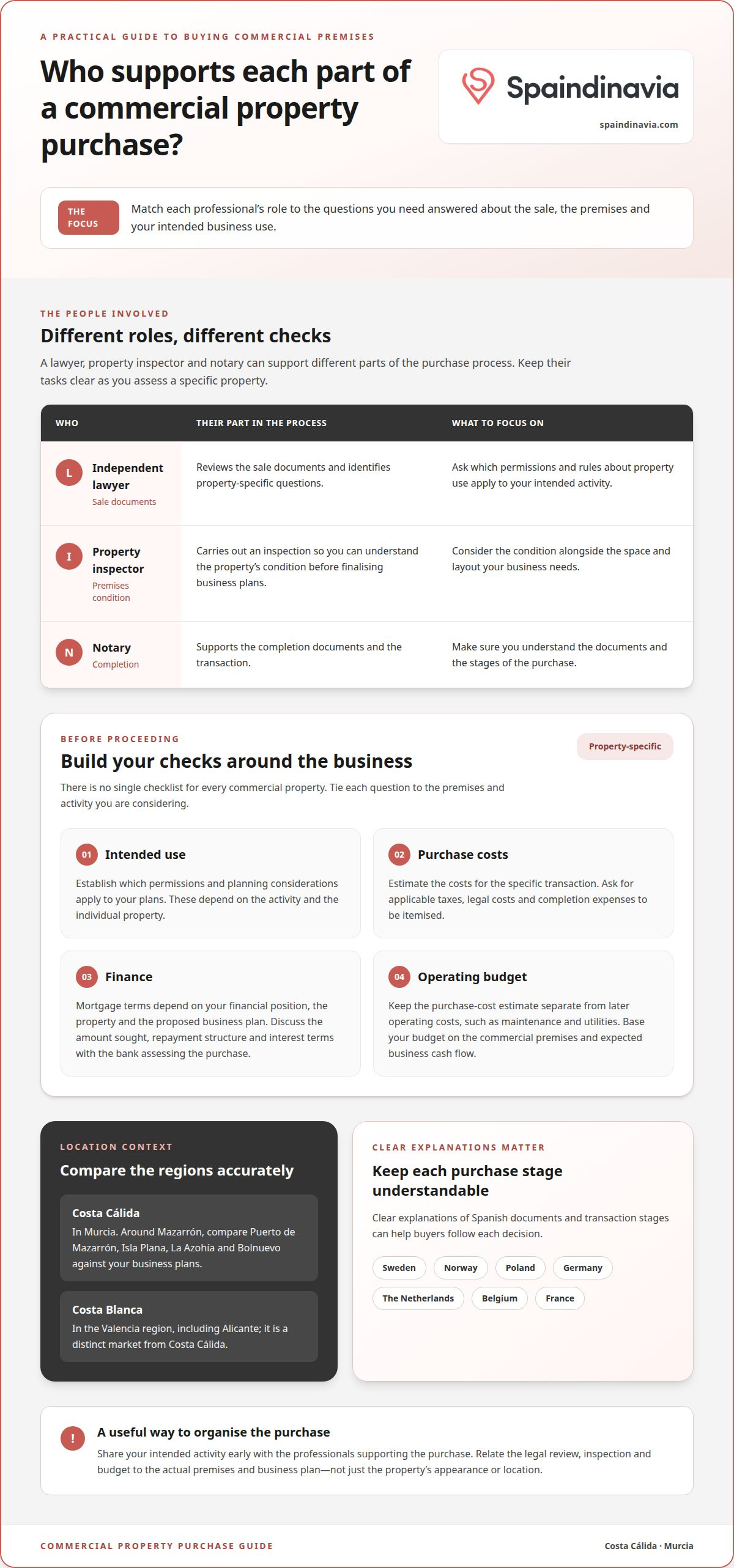
Buying commercial property in Costa Cálida involves decisions about the premises, its intended use and the sale itself. A lawyer, notary, property inspector and real estate agent can each support a different part of the process.
Start by setting out your business plan and the type of premises you’re considering. A restaurant in Águilas, for example, raises different practical questions from an office or a tourist business. For buyers from Sweden, Norway, Poland, Germany, the Netherlands, Belgium and France, clear explanations of Spanish documents and transaction stages can make it easier to follow each decision.
Permits, licences and rules about property use
Permissions and planning considerations depend on the intended activity and the individual property. There isn’t one checklist that applies to every commercial premises. Before proceeding, establish which permissions and rules about how the property may be used apply to your plans. A restaurant in Puerto de Mazarrón and an office elsewhere in Murcia may involve different considerations, so link the legal review to the actual business plan.
Taxes and purchase costs
Taxes and purchase expenses depend on the transaction and property. Build a cost estimate for the specific sale, including applicable taxes, legal costs and completion expenses. Ask for the components to be itemised so you can see what each amount covers and plan your budget. Keep this estimate separate from later operating costs, such as maintenance and utilities.
Financing a commercial purchase
Mortgage terms depend on the buyer’s financial position, the property and the proposed business plan. Discuss the amount sought, repayment structure and interest terms with the bank assessing the purchase. Buying commercial property in Costa Cálida may involve different financing considerations from buying a home, so base your budget on the commercial premises and the business’s expected cash flow.
Keep the process organised with these practical steps:
- Have an independent lawyer review the sale documents and identify property-specific questions.
- Arrange an inspection to understand the premises’ condition before finalising business plans.
- Discuss completion documents and the transaction with the notary involved in the purchase.
Share your intended activity early with the professionals supporting your purchase. For a hospitality project in La Azohía or Bolnuevo, relate the proposed use to the premises and its planning details. The same careful approach applies in Isla Plana and Puerto de Mazarrón. If comparing with Costa Blanca in Valencia, consider that as a separate region from Costa Cálida in Murcia. Buying commercial property in Costa Cálida calls for decisions grounded in the specific premises, transaction and business plan.
As you shortlist properties, commercial property guidance can help you explore premises while keeping the purchase process in view.
Local professionals and property inspections
A commercial purchase in Murcia brings several professionals into the process, each with a different role. A real estate agent can guide the property search, while a lawyer, notary and property inspector can support different stages. Agreeing who handles each task helps you keep documents, inspection findings and decisions organised.
Coordinate professional support
Start with an experienced local agent who understands the area and your intended business. For example, a restaurant search in Puerto de Mazarrón needs a different property brief from an office search in Murcia city. The agent can help you assess how each premises fits your priorities, then arrange viewings and keep the purchase moving.
A lawyer can review the sale documents and explain points that affect the specific premises. Share your intended use early, whether you’re considering a restaurant in Águilas or a holiday-related business near Bolnuevo. That context helps direct attention to the property’s paperwork and any questions needing resolution before you proceed.
The notary supports the formal transaction and completion documents. Keep the lawyer and notary informed as the purchase develops, so questions about the contract, buyer details or property description can be addressed at the appropriate stage. International buyers from Sweden, Norway, Poland, Germany, the Netherlands, Belgium and France may also need help following Spanish-language paperwork.
Make the inspection useful
Arrange an independent property inspection before finalising your business plans. Ask the inspector to assess the premises’ condition and identify issues that could affect its intended use. Consider a former restaurant in light of the layout and facilities your planned operation requires, not its appearance alone.
Walk through the property with a clear list of areas to examine. Consider the entrance, customer areas, storage, staff spaces and visible signs of wear. For an office, focus on work areas and meeting rooms; for a hotel, consider guest rooms and shared spaces. Record findings by room to make the report easier to discuss.
Look beyond the interior. Note the condition of the exterior, access points and any shared areas serving the premises. In Puerto de Mazarrón, a customer-facing business may depend on convenient access, whilst an office may have different priorities. The inspection should help you understand the actual property, not assume that every commercial unit has the same needs.
Once the report is available, review it with your lawyer and relate its findings to the purchase documents. Separate urgent questions from routine maintenance, then consider how each issue affects your plans and budget. This step can help you make a considered decision about a commercial property, whether you’re comparing Costa Cálida in Murcia with the Costa Blanca in Valencia.
Potential drawbacks of buying in the region
A commercial purchase in Murcia involves practical trade-offs as well as coastal appeal. Costa Cálida includes varied locations, from coastal towns to inland areas. A property that suits one business may not suit another, so define your customers, operating needs and preferred setting before comparing premises.
Tourism-focused plans need careful demand planning. A holiday business in Bolnuevo, for example, may depend on customers whose routines differ from those of local office users. Build a business plan around the customers you intend to serve, and consider how the offer works throughout the year. Avoid relying on a single busy period to support the whole operation.
Premises can also require adaptation to your business. A former restaurant in Águilas might have a layout that doesn’t match your service model, whilst an office in Cartagena may need a different arrangement for staff and clients. Compare the existing space with the daily tasks your team will perform. Treat changes to the layout as a planning consideration, not an assumed benefit.
Distance between locations can affect how easily you manage a business. If you’re comparing Puerto de Mazarrón, Isla Plana, La Azohía and Bolnuevo, consider where staff, suppliers and customers will travel from. A coastal address may suit one concept, while a town-centre location elsewhere in the region may better fit another. Map regular journeys before settling on a shortlist.
Keep the regional comparison precise. Costa Cálida is in Murcia, whereas Costa Blanca is in Valencia; Alicante and Cartagena belong to different regional searches. A similar business idea can face different property choices in each place. Compare the specific premises, surroundings and intended customer base rather than assuming one coast offers the same conditions as another.
- Demand: Test your business plan against different customer patterns, especially for tourist-focused concepts in Bolnuevo or Águilas.
- Fit: Match the property’s current layout to your operation before counting on changes to make it suitable.
- Access: Consider routine journeys for staff, suppliers and customers when comparing Cartagena with Mazarrón-area locations.
- Location: Assess each Costa Cálida property in Murcia on its own merits, rather than using Costa Blanca in Valencia as a direct substitute.
Before proceeding, bring these points together in one property comparison. For each premises in Cartagena, Puerto de Mazarrón or Isla Plana, record its intended use, practical fit and customer base. This makes drawbacks easier to identify early and helps you decide whether the location supports your business plan, rather than simply appealing at first viewing.
Commercial property sizes
Choose a premises size by mapping the space to your business, not by looking at floor area alone. In Costa Cálida, Murcia, a customer-facing venue in Puerto de Mazarrón may need different rooms from an office serving Cartagena. The Costa Blanca is in Valencia, so listings there offer comparisons, not direct substitutes for Murcia properties.
There is no single price per square metre that applies to every commercial property in Costa Cálida. Asking prices depend on location, condition, layout and intended use. Assess each premises on its own details rather than treating a regional average as a quote for a particular property.
Commercial listings elsewhere on the Costa Blanca show how widely floor areas can vary. Examples include a 13 m² office in San Vicente del Raspeig, a 35 m² premises in Torrevieja and a 122 m² property in the same town. Larger listings include 210 m² in Formentera del Segura and 387 m² in Rojales. These examples illustrate size differences, not Costa Cálida prices or a recommended size.
Use your operating plan to estimate the space you need. List the areas your business requires, then compare that list with the property’s floor plan:
- Restaurant: allow for customer seating, food preparation, storage and staff movement.
- Office: consider desks, meeting space, storage and the way staff and visitors move through the rooms.
- Hotel: assess guest rooms alongside reception, shared areas and service space.
- Shop or service business: balance customer-facing space with work areas and stock storage.
For a Mazarrón-area search, compare the layout and usable space of premises in Puerto de Mazarrón, Isla Plana, La Azohía and Bolnuevo. A coastal climate and lifestyle may shape how customers use outdoor or indoor areas, but the floor plan still needs to support your daily operation. Note which rooms are essential before weighing extra space.
During a viewing, check how the listed area works in practice. Measure key rooms, entrances and storage, then compare them with the equipment and furniture your business needs. More floor area may still be a poor fit if the layout makes customer access or daily work difficult. An inspection can clarify the premises’ condition and practical limitations.
For each Costa Cálida property, compare usable area, room layout, intended purpose and any space your plan does not need. This makes it easier to assess commercial premises in Murcia alongside Costa Blanca examples in Valencia, while keeping the regional differences clear.
Spaindinavia: Commercial Premises
Spaindinavia can help you explore commercial premises across Costa Cálida in Murcia and Costa Blanca in Valencia. Turn to the team when you’ve narrowed your search and want guidance through the purchase process, from considering a property to working with independent solicitors, banks and local experts.
Share the kind of business you have in mind, your preferred location and the space it needs. This gives the property search a clear focus, whether you’re considering Puerto de Mazarrón, Isla Plana, La Azohía or Bolnuevo. If your plans also include a home, Spaindinavia offers new-build villas, resale apartments and townhouses.
To discuss your commercial property search, contact Spaindinavia.
Shape your next property move
A considered approach to buying commercial property in Costa Cálida begins with a clear picture of the business you want to build. Set out your preferred location, the space your operation needs and the questions you want resolved before making a commitment. This gives your search a practical direction, whether you’re exploring Puerto de Mazarrón, Isla Plana, La Azohía or Bolnuevo.
Keep regional comparisons clear: Costa Cálida is in Murcia, while Costa Blanca is in Valencia. Assess each property against its own setting and your business plans rather than judging it by the appeal of a coastal address alone.
If your plans also include a home, Spaindinavia offers New Build Villas, Resale Apartments and Townhouses. For your commercial search, Spaindinavia can help you explore premises and guide you through the purchase process alongside independent solicitors, banks and local experts.
Take the next step at your own pace. Contact Spaindinavia about commercial property to discuss the kind of premises you have in mind and begin shaping your search.
Frequently Asked Questions
What types of commercial property are available to buy in Costa Cálida, and in which towns?
Listings include restaurants, hotels and other business premises across Costa Cálida in Murcia. Examples include hospitality properties in Águilas, commercial premises in Torre-Pacheco and Lo Pagán, and premises in Santiago de la Ribera and Puerto de Mazarrón. Each listing has its own intended use and layout, so match those details to your business plan. Costa Blanca, in Valencia, is a separate regional market to compare on its own terms.
What legal checks and property inspections are required before buying commercial property in Spain?
Arrange independent legal checks and a property inspection before committing to a purchase. A solicitor can review ownership details, debts associated with the property and the sale contract. Also establish whether the premises’ authorised use fits your plans, and identify any permissions that may apply to the intended business. An inspector can assess the building’s condition. Keep written records of questions and findings, then resolve them before proceeding with the transaction.
Do foreign buyers need a Spanish NIE, bank account, or company to purchase commercial property?
A foreign buyer needs a Spanish NIE (Número de Identidad de Extranjero, or foreigner identification number) for a property purchase and financial transactions. A Spanish bank account is not required, but is strongly recommended for handling payments and expenses. Whether to buy personally or through a company depends on your ownership and business plans. Discuss the structure with an independent Spanish solicitor before signing, so the purchase arrangements suit your circumstances and the premises’ intended use.
What rental yields and investment returns can commercial properties in Costa Cálida generate?
Returns depend on the property’s purchase and operating costs, rental terms, occupancy and periods without a tenant. A restaurant in a busy location and an office serving local businesses may have different income patterns and expenses. Build a forecast using the specific premises and a realistic letting plan. Include maintenance and any time needed to prepare the space for tenants, then compare expected income with the full cost of ownership.
What are the main risks of buying commercial property in Costa Cálida, including vacancy and coastal restrictions?
Vacancy, a poor fit between premises and business use, and unexpected building work can affect an investment. Planning or use restrictions may also apply to a particular property, so ask an independent solicitor to review the relevant details before committing. Consider how the business would manage periods without tenants and whether the location suits its customer base beyond peak holiday periods. Assess the specific property rather than assuming every coastal premises carries the same risks.
How does buying commercial property in Costa Cálida compare with buying in Alicante or the Costa del Sol?
Costa Cálida is in Murcia, while Costa Blanca, including Alicante, is in the Valencia region. Costa del Sol is a separate market. Compare each area’s premises and location with your intended customers and business model.


