

Imagine handing over your life savings for a dream home in Bolnuevo, only to discover months later that you've inherited the previous owner's decade-old tax debts. It's a scenario that keeps many buyers awake at night, and it's the reason so many people ask: do I need to have a solicitor when I purchase a property in Spain and why? Whilst the Spanish Notary is a central figure, they're a neutral official who doesn't represent your personal interests. We understand that navigating the legalities of the Costa Cálida and the Costa Blanca can feel daunting, especially when language barriers and unfamiliar contracts stand between you and your Mediterranean dream.
You deserve to feel completely secure and inspired as you start this new lifestyle. In this guide, you'll discover why an independent solicitor is your most vital safeguard when navigating the Spanish property market in 2026. We'll provide total clarity on the buying process, from protecting your deposit to understanding the distinct tax differences between the Murcia and Valencia regions. Whether you're searching for a villa in Puerto de Mazarrón or a retreat in Isla Plana or La Azohia, we'll show you how to ensure your transaction is legally sound and beautifully simple.
Key Takeaways
- Understand the vital difference between a neutral Notary and your own solicitor to ensure your Mediterranean dream stays on solid legal ground.
- Navigate the regional tax nuances between the Costa Cálida (Murcia) and the Costa Blanca (Valencia) to plan your 2026 purchase with total confidence.
- Find the definitive answer to "Do I need to have a solicitor when I purches a property in Spain and why?" and how they prevent you from inheriting a previous owner's debts.
- Discover essential legal checks for coastal gems like Bolnuevo, Isla Plana, La Azohia, and Puerto de Mazarrón, including local 'Coastal Law' insights.
- Learn how to secure your deposit and gain peace of mind by partnering with an independent legal expert who puts your interests first.
Is a Solicitor Legally Mandatory for a Spanish Property Purchase?
Technically, Spanish law doesn't require you to hire a solicitor for a property purchase. This often leads many buyers to ask: do I need to have a solicitor when I purches a property in Spain and why? Whilst it isn't a legal mandate, proceeding without one is a high-risk strategy amongst international investors. In Spain, the "legal" requirement for a transfer of property is the Notary. However, the role of a civil-law notary in Spain is vastly different from a solicitor in the UK. They are public officials who ensure the paperwork meets state requirements, but they don't represent your personal interests. They don't conduct deep-dive due diligence on your behalf.
The Risk of the "Mandatory" Misconception
Many buyers mistakenly believe the Notary provides full legal protection. They see the formal signing ceremony and assume the property is "clean". This is a dangerous assumption. The Notary won't tell you if the seller has unpaid community fees in Puerto de Mazarrón or if the extension on that villa in Isla Plana was built without permission. Relying on the seller’s or developer’s legal suggestions is equally risky; their priority is closing the deal, not protecting your deposit. Your solicitor is the only independent advocate whose sole duty is to protect your interests throughout the entire transaction.
The 2026 Landscape: Why Security Matters More Than Ever
The legal landscape in 2026 is evolving, with regional regulations in both the Costa Blanca (Valencia region) and Costa Cálida (Murcia region) becoming increasingly complex. Whether you're eyeing a modern bungalow in Bolnuevo or a resale apartment in La Azohia, local laws vary significantly between these two areas. You'll want to ensure your NIE and bank accounts are organised correctly from the start to avoid unnecessary delays. For a secure investment, following a comprehensive buying property in spain guide is essential. A solicitor acts as your insurance policy, checking for urbanistic infractions and hidden liabilities before you commit your funds. If you're still wondering, "do I need to have a solicitor when I purches a property in Spain and why?", remember that a legal expert is a vital safeguard for your Mediterranean future.
Notary vs. Solicitor: Understanding the Difference in Spain
Many buyers arrive in the Costa Blanca or Costa Cálida expecting the Notary to perform the same role as a conveyancing lawyer in the UK. This is a frequent misunderstanding that can lead to costly mistakes. You might ask yourself, do I need to have a solicitor when I purches a property in Spain and why? The answer lies in the fundamental difference between a state official and your personal legal advocate. Whilst the Notary is essential for the transaction to be recorded, they don't provide the bespoke protection you need when investing your hard-earned savings.
Whose Side is the Notary On?
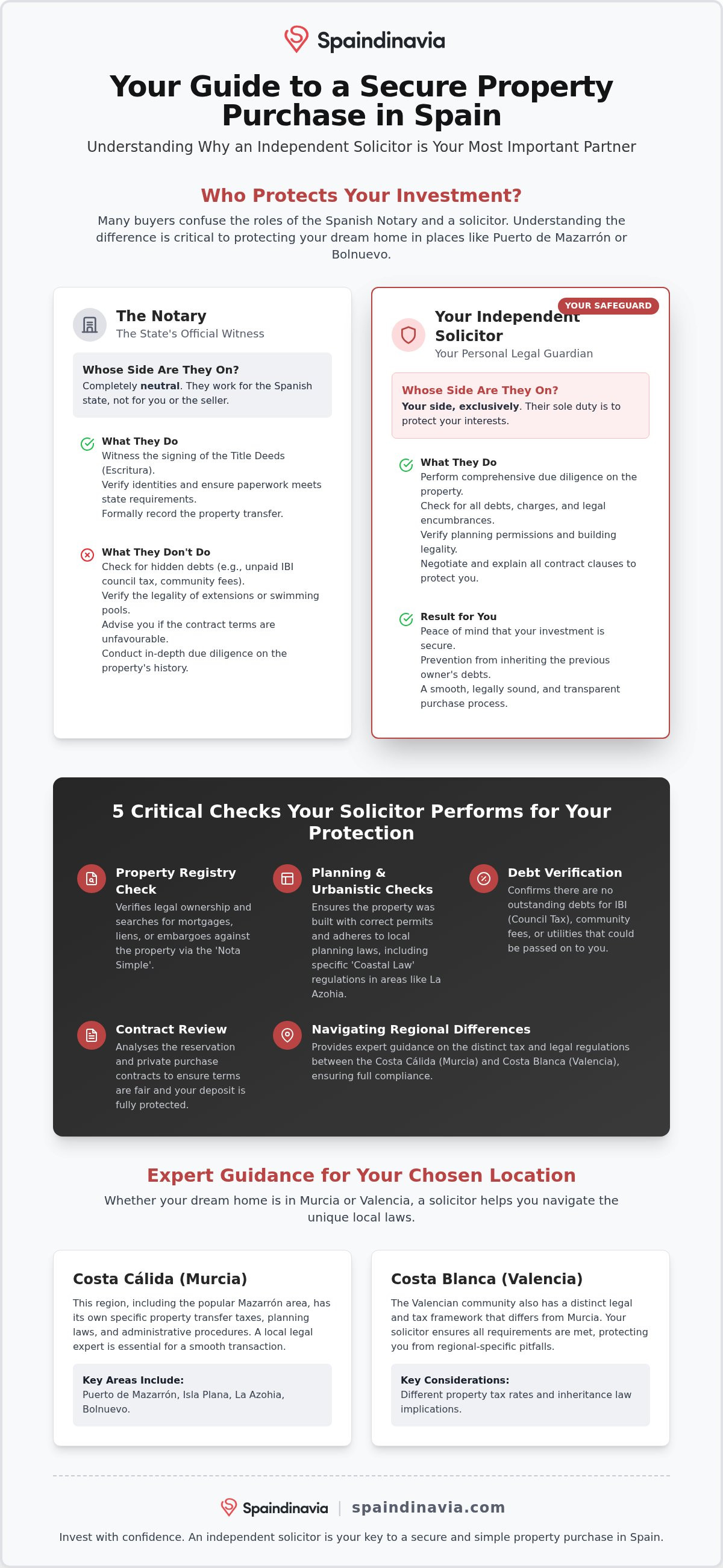
It's vital to realise that the Notary is entirely neutral. They work for the Spanish state, not for you, the seller, or the developer. Their primary job is to verify that the paperwork meets legal requirements and to witness the signing of the "Escritura" (Title Deeds). They won't advise you on whether the deal is "good" or if the terms of a contract for a new villa in Puerto de Mazarrón are weighted against you. In contrast, your solicitor has an exclusive duty of care to you. They represent your interests alone, ensuring you understand every clause before you commit.
What the Notary Doesn’t Check
The Notary doesn't visit the property or verify its physical state. They won't know if the stunning extension on a townhouse in Isla Plana or the swimming pool in Bolnuevo is fully legalised. They also don't typically investigate hidden debts, such as unpaid "IBI" (Council Tax) or community fees, unless they appear on the specific documents presented on the day of completion. Your solicitor performs a deep-dive "due diligence" process long before you reach the Notary’s office. This involves verifying the "Nota Simple" from the Land Registry to ensure the property is free of charges and that the seller actually owns what they're selling.
According to the UK Government guidance on buying property in Spain, using an independent, qualified lawyer is the most effective way to safeguard your purchase. They'll translate the complex legal language of the deeds and act as your eyes and ears on the ground in La Azohia or across the wider Murcia region. If you're ready to start your journey, exploring our selection of quality-checked properties is a great way to ensure you're looking at homes that meet the highest standards of transparency and security.
The 5 Key Reasons You Need a Solicitor When Buying
When you're standing on the golden sands of Puerto de Mazarrón, it's easy to get swept away by the excitement of a new lifestyle. However, the practical side of the transaction requires a steady hand. You might still be wondering: do I need to have a solicitor when I purches a property in Spain and why? Beyond the basic paperwork, a legal expert provides five essential layers of protection that ensure your investment is safe and your future in the sun is secure.
- Conducting "Due Diligence": Your solicitor verifies that the seller actually owns the property and that all planning permissions are in order. This is vital for villas in La Azohia or Isla Plana, where coastal regulations can be strict.
- Debt Verification: In Spain, debts stay with the property. A solicitor ensures you don't inherit the previous owner's mortgage, utility bills, or unpaid community fees.
- Contract Management: They review the "Arras" (Deposit) contract to ensure the terms are fair and that your money is protected if the deal doesn't proceed as planned.
- New Build Protections: For off-plan villas, your solicitor secures bank guarantees. This is a critical safeguard in 2026, ensuring your stage payments are protected if the developer encounters financial difficulties.
- Fiscal Representation: They calculate and pay the correct taxes on your behalf. This includes the 8% Property Transfer Tax (ITP) in the Costa Cálida or the 9% rate currently applicable in the Costa Blanca.
Protecting Your Deposit in the Early Stages
The "Arras" contract is the moment the deal becomes serious. Without a solicitor's review, you could risk losing your deposit if the seller pulls out or if hidden legal issues arise later. In the Mazarrón area, including Bolnuevo and Isla Plana, local customs regarding deposit timings can vary. Your solicitor acts as a shield, ensuring that the contract includes "escape clauses" that protect your funds if the property's legal status isn't 100% clear. They'll also verify the "Nota Simple" from the Land Registry before a single Euro leaves your account.
Handling the Power of Attorney (PoA)
You don't need to be physically present in Spain for every step of the process. By granting your solicitor Power of Attorney, they can complete the purchase, organise your NIE (tax identification number), and set up your Spanish bank account whilst you're back home. Securing a Power of Attorney allows your solicitor to handle every administrative hurdle in your absence, saving you multiple flights and weeks of potential stress. This bridge between your home country and the local markets of the Costa Blanca and Costa Cálida ensures the process never stalls, regardless of your location.
Regional Nuances: Costa Cálida and Costa Blanca Considerations
Spain isn't a single property market; it's a collection of autonomous regions, each with its own tax rates and administrative quirks. When clients ask, "do I need to have a solicitor when I purches a property in Spain and why?", we often point to the sharp differences between the Costa Cálida and the Costa Blanca. Whilst these regions sit side-by-side, the legal and fiscal reality of buying a bungalow in Bolnuevo can be quite different from purchasing a resale apartment in Torrevieja. A solicitor who understands these local boundaries is your best asset for a smooth transaction.
Costa Cálida: Focus on the Mazarrón Area
In the Murcia region, particularly around the beautiful Mazarrón coastline, your solicitor must be an expert in the local "Ley de Costas" (Coastal Law). This is especially true in areas like Puerto de Mazarrón, Isla Plana, and La Azohia, where strict regulations govern how close to the sea a property can be built or renovated. Your legal representative will also navigate the crucial distinctions between "Urban" and "Rustic" land. Buying on rustic land in Murcia without professional guidance is a gamble you don't want to take, as it can lead to complications with utility connections. If you're looking near the famous "Gredas" in Bolnuevo, your solicitor will also ensure the property doesn't infringe on any protected landscape zones through the local Mazarrón Ayuntamiento (Town Hall).
Costa Blanca: Comparing the Valencia Region
Crossing the border into the Valencia region (Costa Blanca) brings a different set of financial rules. As of June 2026, the Property Transfer Tax (ITP) for resale properties here is 9%, whilst in the Murcia region, it remains at 8%. For those interested in new build villas, the Stamp Duty (AJD) was reduced to 1.4% in Valencia in mid-2026, compared to 1.5% in Murcia. A solicitor in the Costa Blanca will prioritise the "Licence of First Occupation", a document that confirms a new development in areas like Orihuela Costa meets all safety and planning standards. Whilst the Costa Blanca is incredibly popular, we often find our clients are drawn back to the authentic, tranquil lifestyle found in the Mazarrón area.
Understanding these regional nuances is the key to a stress-free purchase. It's why we always tell our clients that the answer to "do I need to have a solicitor when I purches a property in Spain and why?" is a resounding yes, as they're the only ones who can navigate these specific regional legalities for you. If you're ready to explore these regions further, you can view our latest property listings to see the quality of homes available in both the Costa Blanca and Costa Cálida.
Next Steps: Choosing Your Independent Solicitor
Selecting the right legal partner is the final piece of the puzzle when securing your home in the sun. Whilst you might still be wondering, do I need to have a solicitor when I purches a property in Spain and why?, the peace of mind they provide is priceless. The most critical factor is independence. Your solicitor should have no commercial ties to the seller, the developer, or even the estate agent. This ensures their advice is entirely unbiased and focused solely on protecting your investment in the Costa Cálida or Costa Blanca.
Before signing a retainer, take the time to ask potential lawyers a few key questions:
- Are you fully independent from the developer of this project?
- Do you specialise in property law within the Murcia or Valencia regions?
- Can you provide a clear, written breakdown of all fees and regional taxes?
- How will you keep me updated if I am back in the UK during the process?
The Spaindinavia Approach to Secure Buying
We act as a dedicated bridge between your Mediterranean aspirations and the local legal reality. We don't just show you beautiful resale villas in Bolnuevo or new build apartments in Puerto de Mazarrón; we ensure you have access to reputable, English-speaking solicitors who know the local landscape inside out. Our hand-picked portfolio is already quality-checked for transparency, but we always insist that our clients use independent legal representation. This commitment to your security means we're with you from that first exciting viewing in Isla Plana or La Azohia to the moment you receive your keys and beyond.
Final Checklist for Your 2026 Purchase
Preparing for a new life in the Orihuela Costa or the Mazarrón basin should be an inspiring journey. To ensure your 2026 purchase is as smooth as possible, keep this essential checklist in mind:
- Solicitor: Appoint an independent expert before signing any contracts.
- NIE: Organise your tax identification number early to avoid delays.
- Bank Account: Set up a local account for easy utility and tax management.
- Survey: Consider a professional survey for resale properties to identify structural needs.
Securing Your Mediterranean Future with Confidence
Your journey to a new life in Puerto de Mazarrón or across the vibrant Costa Blanca should be filled with excitement rather than worry. We've explored how a solicitor acts as your personal advocate, performing the deep due diligence that a neutral Notary simply doesn't cover. From navigating the 8% tax rate in the Murcia region to securing bank guarantees for new developments in Bolnuevo, having an expert by your side is the ultimate safeguard for your investment.
If you're still asking, "do I need to have a solicitor when I purches a property in Spain and why?", remember that they're the bridge between a risky deal and a secure home. At Spaindinavia, we specialise in quality-checked properties in Isla Plana and La Azohia, always collaborating with independent legal experts to ensure every transaction is transparent. Our support continues long after the keys are handed over, with comprehensive after-sales and rental management services tailored to your needs.
Take the first step towards your dream lifestyle today. Browse our hand-picked new build villas in Costa Cálida and let us help you navigate the process with ease and warmth. Your sun-drenched future is closer than you think.
Frequently Asked Questions
Is it expensive to hire a solicitor for a property purchase in Spain?
Hiring a solicitor is a small investment compared to the total property price. Typically, you pay around 1% of the purchase price plus VAT. Whilst it might seem like an extra cost, it's actually your most effective insurance policy. Whether you are securing a villa in Puerto de Mazarrón (Costa Cálida) or an apartment in the Costa Blanca (Valencia region), this fee covers the deep-dive checks that prevent you from inheriting hidden debts.
Can I use a UK-based solicitor for my Spanish property purchase?
You shouldn't use a UK-based solicitor because they aren't qualified to practice Spanish law. A Spanish transaction requires a lawyer registered with the local Bar Association who understands the specific regional regulations of the Costa Blanca (Valencia region) or the Costa Cálida (Murcia region). They need to be on the ground to visit the Land Registry and handle local "Ayuntamiento" (Town Hall) procedures in coastal spots like Mazarrón or Isla Plana.
What happens if I don’t use a solicitor and something goes wrong?
Proceeding without legal help puts your investment at risk. You might ask, do I need to have a solicitor when I purches a property in Spain and why? Without one, you could unknowingly buy a home with hidden mortgage debts in La Azohia (Costa Cálida) or planning infractions in the Costa Blanca (Valencia region). A solicitor ensures your deposit is protected and the property title is 100% clean, avoiding difficult legal battles later.
How much are the typical legal fees for a property purchase in 2026?
In 2026, legal fees remain consistent at approximately 1% of the property’s value. Most firms have a minimum fee, often around €1,500, to cover extensive due diligence. This is a standard rate across both the Costa Blanca (Valencia region) and the Costa Cálida (Murcia region). This cost covers everything from checking the "Nota Simple" to ensuring the "Licence of First Occupation" is valid for your new villa in Bolnuevo or Torrevieja.
Does the solicitor also handle the NIE number application?
Yes, most solicitors include the NIE application as part of their conveyancing package. They can handle the entire process via Power of Attorney, so you don't need to visit a Spanish police station in person. This is incredibly convenient for buyers who are still in the UK whilst their purchase progresses in Isla Plana (Costa Cálida) or across the Costa Blanca (Valencia region). They'll also help you set up the necessary Spanish bank accounts.
What is the role of the solicitor in a new build villa purchase?
For new build villas, your solicitor's role is even more critical. They ensure the developer has all the necessary building licences and secure bank guarantees for every stage payment. This protects your money if the construction stops for any reason. Whether you're buying in Bolnuevo (Costa Cálida) or the Costa Blanca (Valencia region), they'll also verify the "Licence of First Occupation" before you make the final payment at the Notary's office.
Can a solicitor help me with property management after the purchase?
Whilst a solicitor handles the legal side, such as tax returns, they don't usually manage day-to-day rentals. For those looking to rent out their holiday home in La Azohia (Costa Cálida) or a property in the Costa Blanca (Valencia region), we recommend using a specialist agency. We provide comprehensive after-sales and rental management to complement your solicitor's fiscal representation. This ensures your property is legally compliant and well-maintained in both Mediterranean regions.
How long does the legal process typically take in the Murcia region?
The legal process for a resale property usually takes between four and eight weeks. This timeline covers due diligence and the final signing. If you are wondering, do I need to have a solicitor when I purches a property in Spain and why?, remember that they manage these complex timelines for you. New build projects in the Mazarrón area (Costa Cálida) or the Costa Blanca (Valencia region) naturally take longer, depending on the construction schedule.


