

What if the survey is thorough, but a key document still raises questions? Buying a home is an exciting step, and it’s natural to want the details clear before you commit. A survey is essential, but it’s only one part of your due diligence checklist buying property in Costa Blanca.
This guide explains the main property and document checks, what a surveyor can assess, and how to make sense of technical findings. It also clarifies the different roles of a surveyor, solicitor and estate agent: a surveyor examines the property’s condition, a solicitor provides independent legal advice and reviews documents, and an agent supports you through the purchase process.
A clear sequence can help you move forward with confidence. Work through the practical checks in turn, from reviewing property information to understanding survey findings, and keep a record of what you know, what remains unclear and who can answer each question.
Key Takeaways
- Use this due diligence checklist buying property in Costa Blanca to organise your checks before deciding whether to proceed.
- Look beyond a viewing: review the property’s physical condition, ownership and documents, permissions, and purchase costs.
- Understand the roles: a surveyor assesses the property’s physical condition, while an independent solicitor reviews legal and documentary matters.
- Ask for survey findings and caveats to be explained in clear English, so you can identify questions that need follow-up.
- Keep the different checks organised and use support from Spaindinavia alongside independent solicitors, banks and local experts.
Why a due diligence checklist matters when buying property on the Costa Blanca
A sunlit terrace, a fresh coat of paint and a welcoming viewing can make a property feel like the one. But presentation alone can’t tell you whether there are defects you didn’t spot, whether the paperwork matches the home, or what costs you need to plan for. Due diligence means carrying out a set of checks to build a clearer picture before deciding how to proceed. A practical due diligence checklist helps you organise those checks instead of relying on first impressions.
Think of the process as several connected enquiries, each answering a different question. A physical inspection considers the property’s visible condition. Document checks help establish what information is available about ownership, planning and the purchase. Financial planning helps you understand the costs relevant to your transaction. One check cannot stand in for the others.
A survey informs you about the property’s physical condition, but it does not replace a solicitor’s legal review. Keeping that distinction clear helps you direct questions to the right professional and understand what remains to be clarified.
What does property due diligence cover?
Start by grouping information into four areas: the home’s condition, ownership records, planning information and purchase documentation. The right enquiries depend on the property and transaction, so treat a general checklist as a framework, not a verdict on a particular home. Make a note of anything that is missing, unclear or inconsistent, then ask an independent solicitor to interpret the documents and explain any legal implications.
A viewing is useful, but it offers only a snapshot. A room may look recently decorated, for example, but a viewing cannot establish what lies behind a wall or whether documents accurately reflect the property. Record questions as they arise, and keep observations about the building separate from questions about its records. This makes follow-up easier and helps prevent one type of check from being mistaken for another.
Why clear communication matters to overseas buyers
Technical terms can be hard to interpret in a second language, especially when a report distinguishes between what was observed, what could not be assessed and what may need further investigation. A clear written report gives you something to review at your own pace. Discussing its wording can help you understand the findings, the limits of the inspection and which questions to raise next.
Before a survey, note your priorities, such as signs of damp, the condition of visible finishes or concerns about a particular area of the home. Afterwards, separate the surveyor’s observations from your solicitor’s document review. If you’re learning about the coast as well as the purchase process, the Costa Blanca Wikipedia page provides general geographical context. For the transaction itself, rely on relevant professionals to interpret property documents and findings.
Use this checklist as a framework, not a substitute for advice tailored to the property. Keeping condition, documents and costs distinct gives you a calmer, more organised basis for deciding what to clarify before moving forward.
Which property checks belong in a Costa Blanca due diligence checklist?
A useful checklist separates the questions you need answered instead of treating “the paperwork” or “the survey” as one complete check. Organise your notes under four headings: physical condition, ownership and documentation, permissions, and purchase costs. The precise enquiries depend on the property and transaction, so treat the list as a framework to discuss with the relevant professionals, not a universal set of legal requirements.
- Physical condition: Record visible concerns and areas that may need closer inspection.
- Ownership and documentation: Gather the available records and have an independent solicitor review their meaning and relevance.
- Permissions: Note any questions about works or the property’s current use for professional review.
- Purchase costs: Build a clear picture of costs that apply to your circumstances, with figures checked for the specific transaction.
An estate agent can help explain the purchase process and coordinate communication, but that isn’t a substitute for independent legal advice. Ask your solicitor to interpret documents and explain any uncertainties before you rely on them. Spaindinavia supports buyers through the process in collaboration with independent solicitors, banks and local experts, helping you keep track of questions and next steps. The Buying Property in Spain Guide adds broader context on the purchase journey.
Documents and ownership information to review
Collect the ownership and property information available for the home, then ask your solicitor to assess it in context. Where relevant, note anything that needs reconciling. This could include a difference between the boundaries you understand to be included and the details shown in records, or questions about planning information and past works. Document names and procedures can depend on the circumstances, so have current terminology and requirements verified for the specific transaction rather than relying on a generic online list.
Keep a simple query log: name the document, write down what is unclear and record who is addressing it. This helps prevent an unresolved point from getting lost among viewing notes and practical arrangements.
Condition, access and practical use
During an inspection, note visible features such as cracks, roof or wall condition, signs of moisture, the state of services, access and general maintenance. These observations can help you identify points for discussion, but they don’t prove how a system will perform over time or replace specialist testing where that may be appropriate. Read the report’s limitations carefully, including areas the surveyor couldn’t inspect, and ask what those limits mean for your decision.
Finally, consider how you expect to use the property. Access that works for a short visit may feel different during everyday living, while maintenance needs may matter differently for a holiday home and a permanent residence. Spaindinavia can help you keep the purchase stages and outstanding questions organised, working alongside independent professionals rather than replacing their advice.
What an English-speaking surveyor can, and cannot, tell you
A survey report is most useful when you understand both its findings and its limits. If you’re buying from abroad, discussing observations and technical terms in English can make it easier to follow what the surveyor saw, what they couldn’t inspect and what may need further attention. English-language communication helps you ask clear questions, but it doesn’t turn a survey into a guarantee or remove every uncertainty about a property.
A surveyor focuses on physical condition. A solicitor reviews legal and documentary matters. The estate agent supports the property search and purchase process, while a lender considers the finance it provides and its own requirements. Their roles can overlap in practical discussions, but one professional’s explanation shouldn’t be treated as a substitute for another’s independent review.
| Professional | Typical focus | What the role doesn’t replace |
|---|---|---|
| Surveyor | Visible condition and observations within the agreed inspection | Legal or documentary review, or a guarantee against hidden defects |
| Independent solicitor | Legal and property documentation, interpreted for the transaction | A physical inspection of the home |
| Estate agent | Property search and support through the buying process | Independent legal advice or a surveyor’s technical findings |
| Lender | Its lending assessment and related requirements | A full survey or legal review for the buyer |
What a property survey may assess
Depending on the agreed service, access and property, an inspection may include visual observations of the structure, visible defects and general condition. The scope isn’t automatically the same for every home. Areas that are inaccessible may not be assessed, and specialist testing or investigation may sit outside the inspection. Before relying on a report, read how it describes its scope and limitations. Ask the surveyor responsible for it to clarify any wording you don’t understand.
For your due diligence checklist buying property in Costa Blanca, note the difference between an observed issue and a possibility that needs further investigation. A report can help you identify questions, but it can’t promise that every defect has been found or predict future performance.
How to make a survey report useful
Read the report with three headings in mind: findings, limitations and recommended follow-up. Mark unclear terms, note which areas weren’t inspected, and discuss technical language directly with the surveyor who prepared it. Then share relevant findings with your independent solicitor if they raise questions about documents or the transaction. The survey can inform that conversation, but it can’t answer legal questions.
Every purchase needs advice suited to its specific property and circumstances. Spaindinavia supports buyers through the process alongside independent solicitors, banks and local experts. Explore support with your property purchase as you organise the different strands of your checks.
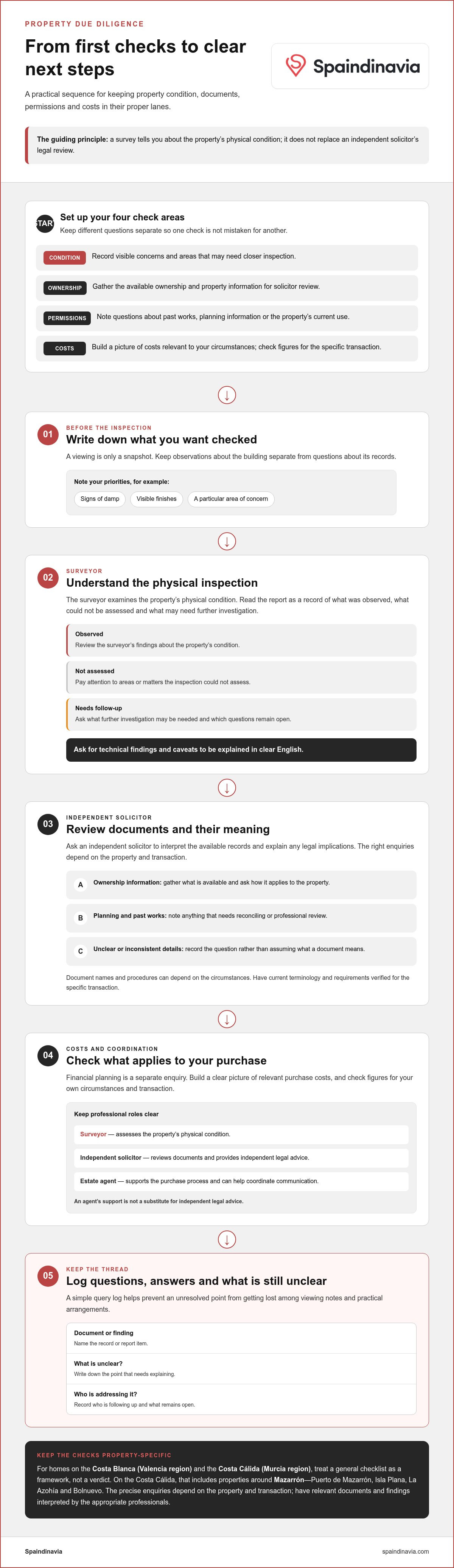
How to work through the Costa Blanca property due diligence checklist
A clear sequence makes it easier to spot what’s known, what still needs checking and who can help answer each question. Keep one working checklist for the property, the documents and the costs. Add a short note beside each item with the source of the information and any follow-up needed. This turns the due diligence checklist buying property in Costa Blanca into a practical record, rather than a collection of messages and viewing notes.
Consider legal and physical checks together: each reveals different information, and both can shape your understanding of the purchase. Don’t treat an inspection report as confirmation that documents are in order, or documents as proof of the property’s physical condition.
Before committing to a property
First, write down how you intend to use the home and what matters most to you. A property for year-round living may raise different practical questions from one you plan to use occasionally. Note your condition concerns, the records you’ve received and any information you still need. Keep the list focused on this particular property, since relevant checks can vary with its features and circumstances.
Then direct each question to the right professional. A surveyor can explain technical observations and the limits of an inspection. An independent solicitor can interpret ownership, planning and purchase documents, and explain their relevance to your transaction. An estate agent can support the buying process, but shouldn’t be treated as a source of independent legal advice.
After receiving inspection findings
Read the report carefully and sort its points into three working groups: matters that need prompt clarification, issues for further investigation, and routine maintenance observations. These are practical labels for your own notes, not formal risk ratings. Keep the surveyor’s exact wording alongside your summary so you don’t unintentionally turn a possibility into a confirmed defect.
- Record the finding: Note the relevant room or feature, what the surveyor observed and any stated limitation.
- Clarify the technical point: Ask the surveyor responsible for the report to explain unfamiliar terms or recommended follow-up.
- Route document questions: Share relevant findings with your independent solicitor if they raise questions about records, permissions or the transaction.
- Track the response: Add who is addressing each point, what information is outstanding and when you’ll revisit it.
Keep the record neutral. A survey finding doesn’t, by itself, establish what a seller must do or what options you may have. If it affects your decision or raises a legal question, discuss it with your solicitor before reaching conclusions. Likewise, a technical concern may need explanation from the surveyor or another relevant professional.
Use the checklist to support an informed decision, not to rush towards one. Spaindinavia helps buyers keep the stages and outstanding questions organised alongside independent solicitors, banks and local experts. Explore support with your property purchase as you work through the checks and consider your next steps.
Move towards a confident Costa Blanca purchase with Spaindinavia
Buying a home is a personal decision as well as a practical one. Due diligence helps you understand the property’s condition, the documents available and any questions that remain open before deciding how to proceed. It won’t remove every uncertainty, but it can give you a clearer basis for weighing what you’ve learned against how you plan to use the home.
A well-kept checklist also helps you see where each question belongs. A surveyor explains physical findings and inspection limits. An independent solicitor reviews legal and documentary matters. An estate agent supports the property search and purchase process, while a bank can explain its own financing requirements. Clear roles help you follow up on concerns without relying on one professional to answer questions outside their remit.
How guided purchase support fits around independent checks
Spaindinavia supports buyers through the purchasing process in collaboration with independent solicitors, banks and local experts. This process support can help you keep track of stages, information and outstanding questions as you move from considering a property to making an informed decision. It sits alongside, rather than replaces, the solicitor’s independent legal advice or a surveyor’s technical inspection.
Keep communicating as checks progress. If a report raises a point you don’t understand, note the exact wording and direct it to the professional responsible for that area. If the answer leads to another question, add it to your checklist instead of assuming it has already been resolved. A considered pace gives you room to understand the information in front of you.
Turn your checklist into a clear next step
Before looking further, write down what matters most to you: the property type, how you expect to use it, any condition concerns and the questions you want answered. Keep your notes practical. For example, distinguish a question about a visible feature from one about documentation, and record whether it needs a surveyor’s explanation or a solicitor’s review.
Then use those priorities to guide your next conversation about suitable homes and the purchase journey. Spaindinavia offers a hand-picked portfolio that includes new build villas, luxury villas and resale apartments, and supports buyers through the purchase process alongside independent professionals. Keep the specific property and your own plans at the centre of the decision.
A clear checklist, straightforward communication and time to consider the answers can make a complex purchase feel more manageable. Explore properties and buying support with Spaindinavia as you take your next step towards a home that suits you.
Take your next step with confidence
Your due diligence checklist buying property in Costa Blanca can be a starting point for a more considered decision, not a reason to rush. Use it to decide what matters most in your next home, which questions still need answers and what you need to feel ready to move forward. Compare each property against your own plans and priorities, rather than assuming one home will suit everyone.
Spaindinavia is an independent estate agency operated by local experts, supporting buyers through the purchase process alongside independent solicitors, banks and local experts. That guidance can help you keep the journey organised while each professional provides advice within their role.
Take your time, keep communication clear and let the information guide your decision. Explore properties and buying support with Spaindinavia, and take the next step towards finding a home that feels right for you.
Frequently Asked Questions
Do I need a survey when buying a property in Spain?
A survey can be a sensible step, but whether it’s right for you depends on the property and your concerns. For instance, if you’re buying from a distance or have noticed a crack, staining or a sticking door, an inspection may help you understand what can be seen and whether further investigation is suggested. Consider what you need clarified before deciding, and discuss the proposed scope with the surveyor.
Can an English-speaking surveyor inspect a property on the Costa Blanca?
You can arrange an English-speaking surveyor for a property on the Costa Blanca. Focus on the specific property and its inspection needs. Agree access and scope in advance, and ask how findings will be explained.
What does a property survey in Spain usually check?
A survey may cover visible features such as walls, ceilings, windows, accessible roof areas, and signs of moisture or wear. The exact inspection depends on the agreed service and what the surveyor can reach. Furniture or locked spaces, for example, might limit what can be seen. Check the report for exclusions and whether it recommends a specialist investigation, rather than assuming every system or hidden area has been tested.
Is a survey the same as a legal property check in Spain?
No. A survey looks at physical features, while an independent solicitor reviews legal and documentary questions. If an inspection notes an alteration, for example, it describes what the surveyor observed; it doesn’t establish the alteration’s legal status. Keep the report available when discussing relevant records with your solicitor, and ask them to explain any implications for your transaction. The two reviews answer different questions.
When should I arrange a property survey during the buying process?
Plan the inspection early enough to receive and consider the report before making decisions that depend on its findings. The suitable timing depends on access, the inspection arrangements and the circumstances of your purchase. Keep the timing aligned with any transaction commitments, and ask your independent solicitor how those commitments affect your situation. Avoid relying on a general online timetable as though it applies to every property or purchase.
Can a survey guarantee that a property has no defects?
No. A survey records an assessment within its agreed scope, and some issues may be concealed or outside the areas inspected. A clean-looking wall, for instance, can’t establish the condition of materials behind it. Read the report’s limitations and recommendations, and discuss any uncertainty with the surveyor. Treat the findings as useful information for your decision, not as a promise that no defect exists or will emerge later.
What should I do if a survey identifies a significant concern?
Ask the surveyor to clarify what was observed, what remains uncertain and whether further investigation is recommended. Keep the answer with the report, then consider whether the issue raises separate questions about documents or the transaction for your independent solicitor. Avoid making assumptions about repairs, negotiation or legal options based on the survey alone. Your solicitor can explain how the concern relates to your circumstances before you decide what to do next.


