

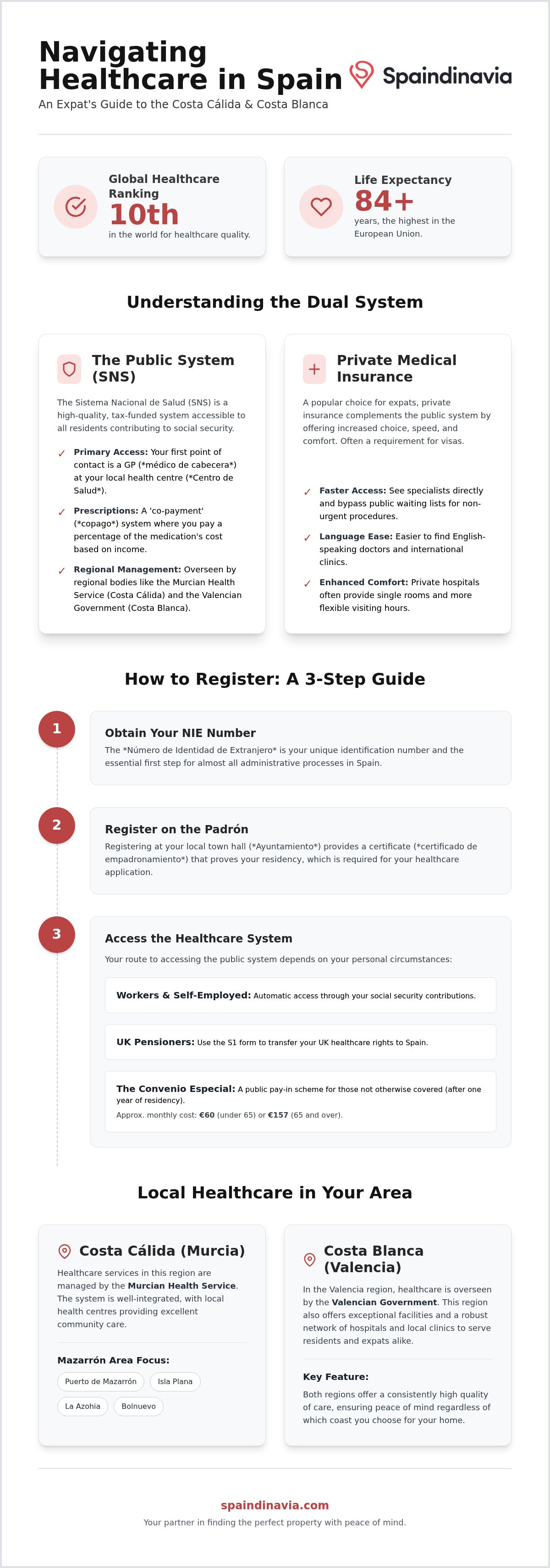
Spain currently ranks 10th in the world for healthcare quality, boasting a life expectancy that is now the highest in the European Union at over 84 years. Whilst the dream of a Mediterranean lifestyle is often about the sun and sea, understanding healthcare in spain for expats is the foundation that makes that dream feel permanent. We know that the transition can feel daunting, especially when you're trying to untangle the differences between your NIE and Social Security registration whilst navigating potential language barriers in a new country.
You deserve to feel completely at ease as you start this new chapter. This guide provides a clear roadmap for your journey, from the initial registration process to choosing between public care and private insurance. We'll explore the nuances of the 2026 regulations and look specifically at the facilities available across both the Costa Cálida and the Costa Blanca. Whether you're settling in the heart of Puerto de Mazarrón, the coastal charm of Isla Plana and Bolnuevo, or the quiet hills of La Azohia, we'll ensure you understand exactly how to access the high-quality medical care you need to enjoy your life in Spain with absolute peace of mind.
Key Takeaways
- Learn how to navigate the decentralised public system and choose the right private insurance to secure your healthcare in spain for expats.
- Follow our step-by-step guide to obtaining your NIE and registering on the padrón, ensuring you can access local medical services without unnecessary delays.
- Compare the medical infrastructure across the Costa Cálida and Costa Blanca to understand which regional hospital networks best serve your specific health needs.
- Gain practical knowledge of the 24-hour emergency services and health centres in the Mazarrón area, including Puerto de Mazarrón, Isla Plana, and Bolnuevo.
- Discover how to integrate healthcare proximity into your property search to ensure your new build villa or apartment offers both comfort and long-term security.
Understanding the Spanish Healthcare System: Public vs Private
Spain's medical reputation is well-earned. In 2026, it remains a global leader, holding the 10th spot in the Numbeo Health Care Index. This excellence is built on a dual-track system where public and private care work side-by-side to provide a safety net for everyone. For those exploring a Spanish healthcare system overview, it's clear that the decentralised nature of the state-run service allows for tailored regional management. In the Costa Cálida, services are overseen by the Murcian Health Service, whilst in the Costa Blanca, the Valencian government takes the lead. Both regions offer exceptional facilities, ensuring that healthcare in spain for expats is consistently high-quality regardless of which coast you choose.
The Public System (SNS) Explained
The Sistema Nacional de Salud (SNS) is a tax-funded system accessible to all residents contributing to social security. It operates on a 'gatekeeper' model, which might feel familiar if you've used the NHS. This means your first point of contact is always your médico de cabecera (general practitioner) at your local Centro de Salud. Whether you live in the heart of Puerto de Mazarrón or the quieter streets of Isla Plana, this local health centre is where you'll go for routine check-ups, vaccinations, and specialist referrals.
Prescription costs involve a 'co-payment' (copago) system that differs slightly from the UK. Instead of a flat-rate fee, the amount you pay in Spain is usually a percentage of the drug's price. This is determined by your income level and whether you're of pensionable age. It's a practical system that ensures essential medications remain affordable for the entire community.
The Benefits of Private Medical Insurance
Many people moving to the Mediterranean choose to supplement public care with private insurance. This is often a necessity for those on non-lucrative or digital nomad visas, as Spanish consulates require full coverage with no co-pays for the first year of residency. Beyond visa requirements, private insurance is a popular choice for healthcare in spain for expats because it offers a layer of choice and speed that complements the state system.
- Faster access: You can see specialists directly, bypassing the national waiting lists that reached record highs of over 850,000 patients in late 2025.
- Language ease: You'll have easier access to English-speaking doctors and international clinics, which is particularly helpful in expat-friendly areas like Bolnuevo or La Azohia.
- Comfort: Private hospitals often provide single rooms and more flexible visiting hours for families.
In the Mazarrón area, the local health centres in Puerto de Mazarrón and Mazarrón town provide a reassuring presence. The system's strength lies in its local integration; you aren't just a number, but a member of the community. Whilst the public system is excellent for serious conditions, the private sector provides that extra layer of speed and comfort that many find vital when settling into a new culture.
How to Register for Healthcare: A Step-by-Step Guide for Expats
Securing your medical access is a vital part of making your move feel permanent. The process for healthcare in spain for expats is logical, though it requires a few specific steps. Everything begins with your NIE (Número de Identidad de Extranjero). This is your unique identity number and the key to almost every administrative door in Spain. Once you have this, your next priority is the Padrón. Registering at your local town hall, whether in the Mazarrón town centre or a coastal municipality in the Costa Blanca, proves you're a resident in the community. This certificate is essential for your healthcare application.
Registration for Retirees and Workers
Your path into the system depends on your circumstances. If you're working for a Spanish company or registered as an autónomo (self-employed), your social security contributions grant you automatic access. For UK pensioners, the S1 form remains the golden ticket in 2026. This allows you to transfer your healthcare rights from the UK to Spain, ensuring you receive the same care as a local. If you don't fit these categories but have lived in Spain for at least a year, the Convenio Especial offers a public pay-in scheme. As of 2026, this costs approximately €60 per month if you're under 65, or €157 if you're 65 and over. EU citizens can also find specific guidance on using the European Health Insurance Card (EHIC) in Spain for temporary stays before residency is finalised.
Navigating the Paperwork
Preparation is the best way to maintain your composure whilst dealing with bureaucracy. Royal Decree 180/2026 has recently standardised these procedures across the Murcia and Valencia regions, making access dependent on proving habitual residence rather than just social security contributions. You'll need to visit the Tesorería de la Seguridad Social to get your social security number before heading to your local health centre. In areas like Puerto de Mazarrón, Isla Plana, La Azohia, or Bolnuevo, the local staff are used to helping new arrivals. Bring your original passport, NIE, Padrón certificate, and the relevant application forms.
Once registered, you'll receive your Tarjeta Sanitaria Individual (TSI). This physical card is your passport to medical services and must be presented at every appointment and pharmacy visit. As you focus on settling into your new home, remember that this administrative phase is simply the bridge to your new, secure life by the Mediterranean. Taking these steps early ensures that whether you're in the Costa Cálida or the Costa Blanca, you're fully protected from day one.
Healthcare Infrastructure in Costa Cálida and Costa Blanca
Choosing between the Costa Cálida and the Costa Blanca often comes down to lifestyle preference, but the medical infrastructure in both regions is a significant draw for international residents. Spain's commitment to modern, accessible care is reflected in the high density of hospitals and specialised clinics along these southern coastlines. While both regions offer world-class treatment, the way they deliver services can vary slightly due to their regional management. This high standard is supported by the World Health Organization on healthcare in Spain, which highlights the country's robust cooperation with international health standards.
Medical Facilities in the Costa Cálida
If you're looking at the Mazarrón area, you'll find a well-organised network of local care. Puerto de Mazarrón serves as a primary hub with its own comprehensive health centre on Calle Sierra del Carche. This facility handles everything from routine appointments to minor emergencies. For residents in the charming coastal villages of Isla Plana, La Azohia, and Bolnuevo, day-to-day healthcare is managed through local clinics known as consultorios. These are perfect for prescriptions and general check-ups, though they operate on more limited hours than the main centres.
When more specialised treatment is required, the Hospital General Universitario Santa Lucía in Cartagena is the premier regional hub. It's a modern, award-winning facility located about 30 minutes from Mazarrón. For private care, the Hospital Virgen de la Caridad in Cartagena is a favourite for healthcare in spain for expats, largely due to its multilingual staff and efficient referral systems. Having these facilities within easy reach provides a vital sense of security for those moving to the Murcia region.
Healthcare Centres in the Costa Blanca
The Costa Blanca, situated in the Valencia region, is renowned for its high concentration of both public and private medical facilities. Because this area has a long history of welcoming international residents, the infrastructure has evolved to be exceptionally expat-friendly. In the south of the region, cities like Alicante and Torrevieja offer massive hospital networks, including the Hospital General Universitario de Alicante. The sheer density of the population here means that specialised clinics for everything from cardiology to physiotherapy are never far away.
Private healthcare in spain for expats is particularly robust in the Costa Blanca. Facilities such as Hospital Vithas Medimar in Alicante and Hospital IMED Levante in Benidorm are specifically geared towards international patients, often providing dedicated translation services. This regional focus on modern, tech-driven medicine ensures that whether you're in a bustling coastal city or a quiet inland village, your health is always in expert hands. The blend of high-tech public hospitals and specialised private clinics makes the Valencia region one of the most secure places to start a new life abroad.
Essential Practicalities: Pharmacies, Emergencies, and the GHIC
Understanding the day-to-day rhythm of medical care is just as important as the initial registration. When you walk through the streets of Puerto de Mazarrón or any coastal town in the Costa Blanca, the first thing you'll notice are the bright, green flashing crosses. These signify a farmacia. In Spain, these aren't just retail outlets; they're vital health hubs staffed by highly trained professionals. Pharmacists in Spain can often provide advice for minor ailments, reducing the need for a GP visit. This is a practical first step for healthcare in spain for expats when dealing with non-urgent issues like hay fever or minor skin irritations.
The 'Farmacia de Guardia' System
Spain operates a brilliant 'duty' system to ensure 24-hour access to medication. Every pharmacy displays a list on its front door or window called the farmacia de guardia. This tells you which local chemist is open out-of-hours, including Sundays and public holidays. In the Mazarrón area, including Bolnuevo and Isla Plana, this rotation ensures you're never without support; the pharmacy in Bolnuevo on Avenida de Bolnuevo is a vital local anchor. Similarly, across the Costa Blanca and Valencia region, this system is equally robust, ensuring that residents in even the busiest holiday spots have access to a pharmacist at any hour. You might also find that certain medications, such as specific asthma inhalers or antibiotic ointments, are available over the counter here, whereas they require a prescription in the UK.
Emergency Care (Urgencias)
For life-threatening situations, the number to dial is 112. This service is free and operators can often communicate in English. If you can travel, your first stop for urgent but non-life-threatening issues should be the Urgencias (emergency department) at your nearest health centre. In the Mazarrón region, the primary 24-hour emergency service is located at the Mazarrón Health Centre in the main town. In the Costa Blanca, the infrastructure is similarly accessible, with major health centres and hospitals providing round-the-clock care to the high density of international residents.
Upon arrival at Urgencias, you'll go through a triage system. This means patients are seen based on the severity of their condition rather than arrival time. Whilst waiting times can vary, the quality of emergency care in Spain is exceptional. If you're using private insurance, your provider will usually have a specific list of hospitals with dedicated emergency wings. If you're still in the process of moving and need assistance with property management and local settling services, having a local partner can make these practical hurdles much easier to clear.
For those in the early stages of their move, the UK Global Health Insurance Card (GHIC) remains a vital tool. In 2026, reciprocal agreements ensure that the GHIC covers necessary state healthcare for temporary stays. This provides a safety net whilst you finalise your residency. If language is a concern in areas like La Azohia or Isla Plana, or indeed anywhere along the Costa Blanca, many hospitals now offer 'tele-translation' services via a tablet or phone, ensuring you can communicate clearly with your doctor even if your Spanish is still a work in progress.
Integrating Healthcare into Your Property Search
When you imagine your new life in the sun, you likely see yourself on a terrace in Bolnuevo or walking along the beach in Puerto de Mazarrón. Whilst the aesthetic of a home is vital, the long-term success of your move often depends on factors that aren't immediately visible. Considering healthcare in spain for expats during your property search is a strategic move that ensures both personal peace of mind and future resale value. A property located within a short drive of a primary health centre or a major hospital is always a more secure investment, especially as your needs evolve over time.
Choosing a Location for Retirement
Balancing your desire for seclusion with the need for accessibility is a key part of the selection process. You might fall in love with a quiet, traditional villa in La Azohia or a modern apartment in Isla Plana, but it's essential to evaluate the local medical support. Puerto de Mazarrón is a fantastic strategic choice because it combines a vibrant coastal lifestyle with the region’s most comprehensive health infrastructure. Similarly, in the Costa Blanca, choosing a home near well-serviced hubs like Torrevieja or Alicante ensures you're never far from world-class care. For a deeper look at making a safe purchase, explore our Buying Property in Spain Guide: The Essential 2026 Checklist for Secure Investment.
How Spaindinavia Supports Your Transition
At Spaindinavia, we don't just find you a house; we act as a bridge between your current life and your new Mediterranean future. Our role is to guide you through the entire journey, which includes understanding how healthcare in spain for expats fits into your specific situation. We collaborate with independent solicitors and local experts to ensure your NIE and residency paperwork are handled correctly from the start. This proactive approach means you can focus on the joy of your move whilst we help you navigate the administrative hurdles that often cause anxiety.
Whether you're looking at New Build Villas in the Murcia region or Resale Apartments in the Valencia region, our local expertise is your greatest asset. We help you identify the communities that offer the best balance of beauty and essential services. From the tranquil hills of Bolnuevo to the bustling promenades of the Costa Blanca, we ensure your new home is a place where you can live a healthy, active, and secure life for many years to come. We're here to make sure every step of your journey is as calm and inspiring as the Mediterranean itself.
Your New Chapter Begins with Peace of Mind
Navigating the medical landscape is a vital step in making your move to the Mediterranean feel permanent. By understanding the dual public and private systems, you ensure that healthcare in spain for expats becomes a source of comfort rather than confusion. Whether you settle amongst the modern facilities of the Costa Blanca or the welcoming community clinics of the Costa Cálida, you're choosing a lifestyle backed by one of the world's finest health systems. It's about securing your well-being whilst enjoying everything the Spanish coast has to offer.
At Spaindinavia, we offer specialised knowledge of the Mazarrón coastal area, including Puerto de Mazarrón, Isla Plana, La Azohia, and Bolnuevo. We provide expert guidance through the residency and buying process, partnering with independent solicitors to ensure every step is secure. We're here to act as your local bridge, helping you find a home that perfectly balances coastal beauty with essential medical accessibility. Your dream of a healthier, sunnier life is well within reach.
Start your Spanish journey today: Explore our New Build Villas in Costa Cálida and Costa Blanca. We look forward to welcoming you home.
Frequently Asked Questions
Can British expats still use the Spanish NHS after Brexit?
British expats can access the public system if they are working, self-employed, or pensioners. UK pensioners use the S1 form to transfer their healthcare rights, which ensures healthcare in spain for expats remains accessible post-Brexit. You'll need your residency and social security registration finalised to get your local health card. This process is standard across both the Costa Cálida and Costa Blanca, providing a secure path to medical support.
Is private health insurance mandatory for a Spanish residency visa in 2026?
Yes, private insurance is a mandatory requirement for most residency visas in 2026, including the Non-Lucrative and Digital Nomad visas. The policy must offer full coverage with no co-payments and be issued by a Spanish-registered company. This provides the necessary cover for your first year of residence whilst you settle into the Murcia or Valencia regions. It also ensures you have immediate access to specialists without waiting for public registration.
How much does the Convenio Especial cost for expats in 2026?
The Convenio Especial is a public pay-in scheme for those not otherwise eligible for state care. In 2026, the monthly cost is approximately €60 for under 65s and €157 for those older. You must have been a legal resident in Spain for at least one year before applying. This is an excellent option for early retirees living in coastal areas like Bolnuevo and Isla Plana, or those settling in the Costa Blanca.
Do Spanish doctors speak English in public hospitals?
English is not the official language of the public system, though many doctors in coastal areas like Puerto de Mazarrón or Alicante speak it well. It is always wise to bring a translator for healthcare in spain for expats when dealing with complex consultations. Private hospitals in the Costa Blanca and Costa Cálida often have dedicated international departments with multilingual staff to support you throughout your journey.
What is the difference between a GHIC and a Spanish health card (TSI)?
A GHIC is designed for temporary visitors and covers only essential or emergency treatment. Once you become a resident, you must transition to the Spanish system and obtain a Tarjeta Sanitaria Individual (TSI). This card identifies you within the local health network and is required for routine appointments and subsidised prescriptions. It's your permanent link to the system whilst living in the Mazarrón area or across the wider Costa Blanca region.
How do I register with a local GP once I have moved to Puerto de Mazarrón?
To register with a GP in Puerto de Mazarrón, visit the local Centro de Salud with your passport, NIE, and Padrón certificate. If you are settling in the Costa Blanca, you would follow a similar process at your local Valencian health centre. Once you present your social security entitlement document, they will assign you a doctor and issue your health card, providing a local anchor for your well-being in either region.
Are prescriptions free for pensioners in Spain?
Prescriptions are not entirely free for pensioners, but they are significantly subsidised. Most retirees pay around 10% of the medication's cost, often with a monthly cap based on income levels. This system ensures that essential treatments remain affordable for everyone living in the Mazarrón area or across the wider Costa Blanca region. You simply present your health card at the pharmacy to receive the discounted rate on your prescribed medicines.
What happens if I have a medical emergency before I have my residency card?
If an emergency occurs before your residency is finalised, you can use your GHIC or private medical insurance at any 'Urgencias' department. Spanish law ensures that emergency care is provided to everyone regardless of their status. However, without a health card or insurance, you may receive a bill later. Having your private policy active from day one ensures your transition to the Mazarrón area or the Costa Blanca is completely stress-free.


