

The choice between holiday lets and long-term rentals in Spain can change how soon you need to move on and how much security you have as a tenant. Holiday lets generally run from 1 to 31 days; seasonal rentals have no fixed legal maximum, although they commonly last up to 11 months. Long-term residential tenants can have the right to stay for up to five years, or seven when the landlord is a company.
If you’re planning a coastal stay, the contract’s label may not tell you everything. In Spain, the purpose of your stay matters too. Residential leases can carry renewal rights and limits on rent increases that holiday lets do not offer in the same way.
Explore how duration, eligibility, renewals and rent increases differ, so you can choose an arrangement that fits your plans, whether you’re settling near Puerto de Mazarrón, Isla Plana, La Azohía or Bolnuevo on the Costa Cálida, or looking at the Costa Blanca in the Valencia region.
Key Takeaways
- Learn how Spain’s tenancy rules distinguish temporary stays from homes rented as a main residence.
- Understand why the purpose of your stay can matter more than the label written on the contract.
- See what makes a seasonal rental genuinely temporary and why the reason for the stay should be documented.
- Find out how renewal rights and rent-increase limits can shape the security of a long-term tenancy.
- Explore how the rental category can affect the tax treatment of income from a property.
Spain 2026: Tourist, Temporary & Long-Term Rentals
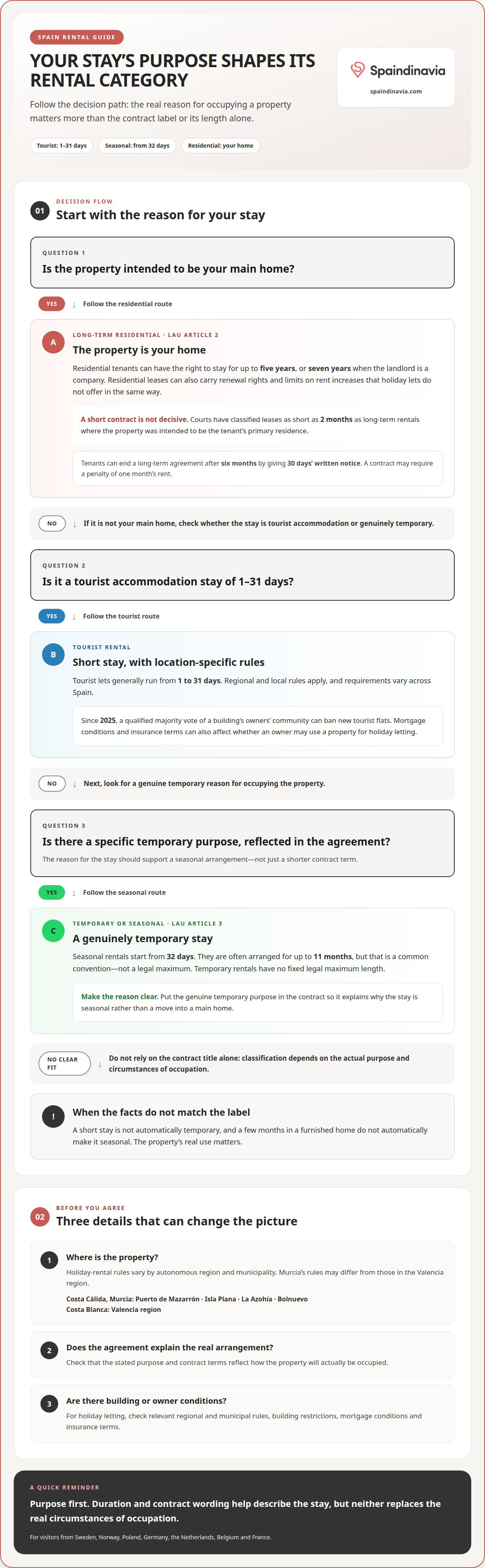
In Spain, a rental’s category depends on the purpose and legal classification of the stay, not just its length or the contract title. The LAU distinguishes temporary arrangements from residential leases, while tourist rentals are also subject to regional and local rules.
LAU Rules for Temporary and Residential Leases
The Urban Leasing Law (LAU) treats temporary rentals under article 3, for uses other than permanent housing. Residential leases fall under article 2, where the property serves as the tenant’s home. That distinction affects the protections attached to the agreement. A short contract does not automatically become temporary if the real purpose is to live there.
A stay linked to a specific temporary need differs from taking up a permanent home. The contract should reflect the genuine arrangement, rather than relying on a convenient label.
Legal Status of Medium-Term Leases
Medium-term rentals generally sit within the LAU category of rentals for use other than permanent housing. They’re often arranged for stays of up to 11 months, but that convention is not a legal maximum. Temporary rentals have no fixed legal maximum length, so the reason for occupation matters alongside the dates.
This differs from a tourist let, generally arranged for stays of 1 to 31 days, and from a residential lease governed by article 2. A few months in a furnished home may be a seasonal arrangement, but the purpose must support that classification.
Lease Terms and Primary Residence Status
Duration alone does not settle whether a Spanish rental is residential. Courts have classified leases as short as 2 months as long-term rentals when the property was intended to become the tenant’s primary residence. The agreement’s title therefore cannot replace the real circumstances of occupation.
Residential tenants have the right to extend their lease and stay for up to five years, or seven years when the landlord is a company. These protections distinguish a primary home from a genuinely temporary stay. The landlord’s obligations and tenant’s rights depend on the residential classification, not simply the number of months stated in the contract.
Regional and Municipal Holiday-Rental Rules
Holiday-rental requirements vary across Spain’s autonomous regions, so the rules in Murcia may differ from those in the Valencia region. Local restrictions can also affect whether a property may operate as a tourist flat. In a building, a qualified majority vote of the owners’ community can ban new tourist flats since 2025.
For a coastal stay, distinguish Puerto de Mazarrón, Isla Plana, La Azohía and Bolnuevo on the Costa Cálida in Murcia from destinations on the Costa Blanca in Valencia. Regional requirements apply alongside any relevant municipal or building restrictions, so the location can change the rules governing a holiday let.
| Rental type | LAU classification | Typical duration | Key distinction |
|---|---|---|---|
| Tourist rental | Tourist accommodation | 1 to 31 days | Regional and local rules apply |
| Temporary or seasonal | Article 3, use other than permanent housing | Often up to 11 months | Genuine temporary purpose |
| Long-term residential | Article 2, housing | Can extend up to five or seven years | Property is the tenant’s home |
Choose a rental category that reflects why you’ll occupy the property, then consider its duration and the rules that apply in its location.
How long is considered a holiday rental, seasonal rental or long-term rental?
Spain’s rental categories depend on both the duration and the real purpose of occupation. A contract’s title alone does not determine which rules apply.
Mortgage conditions and insurance terms can affect whether an owner may use a property for holiday letting, so review the relevant agreements before changing its use. Since 2025, a qualified majority of a building’s owners’ community can ban new tourist flats.
An owner switching from holiday letting to residential renting needs an agreement that reflects the new purpose. The property’s location matters too, because regional and municipal rules for holiday rentals vary.
Rental Categories and Contractual Rights
A holiday rental in Spain generally lasts from 1 to 31 days, while seasonal rentals start from 32 days. Seasonal arrangements have no fixed legal maximum, although landlords commonly set a limit of 11 months. Long-term residential contracts are different: the home is intended as the tenant’s main residence, bringing residential tenancy protections.
Rental categories are not interchangeable just because a contract uses a particular label. The actual purpose of occupation is central to how a tenancy is classified.
Contract Duration and Termination Rules
A long-term residential contract may be written for a year, but tenants can have the right to stay for up to five years, or seven when the landlord is a company. Tenants can end a long-term agreement after six months by giving 30 days’ written notice. A contract may also require a penalty of one month’s rent.
Leaving before a contract expires may have consequences, including owing rent through the end of the contract period. Read the termination terms alongside the legal category.
Seasonal Rental Contracts
A seasonal contract is for a temporary purpose, not simply a shorter stay. Its duration has no fixed legal maximum, even though landlords commonly choose a term of up to 11 months. A genuine temporary reason should be written into the contract, helping explain why the stay is seasonal rather than residential.
A defined temporary stay differs from moving into a property as your primary home. If a two-month contract is actually for a tenant’s main residence, judges have sometimes classified it as a long-term tenancy.
Before switching between holiday and residential letting, make sure the contract reflects the intended use and the tenant’s actual circumstances. Also account for local rules, mortgage conditions, insurance terms and any owners’ community restrictions. Changing the contract label alone does not change the property’s true rental category.
Temporary or seasonal rental eligibility and genuine reasons for stays
In Spain, the difference between holiday, seasonal and long-term letting affects who rents a home and why. A genuine temporary purpose supports a seasonal contract; using that label simply to avoid residential protections can create a mismatch.
A holiday stay is generally for up to 31 days. Seasonal rentals start from 32 days, with landlords commonly setting a maximum of 11 months, although the law sets no fixed maximum. A long-term residential rental is for a tenant’s home. The stay’s real purpose, rather than the contract heading, is central to its classification.
For a seasonal agreement, the temporary reason must be genuine and recorded in the contract. A time-limited work placement or a defined period of study can explain why someone needs temporary accommodation rather than a permanent home. The agreement should connect that reason to the planned stay. An end date alone does not establish a temporary purpose.
Consider someone relocating to Spain for a temporary work assignment. The contract can describe the assignment and explain why accommodation is needed for that period. By contrast, someone moving into a property as their main home may fall under residential tenancy rules, even if the agreement lasts only two months. Spanish judges have classified some such short agreements as long-term rentals.
For tenants, the distinction matters when choosing between a home for a defined stay and a place to settle. A furnished seasonal property may suit a temporary assignment; a residential home offers different renewal protections. Seasonal rent is generally charged monthly, and the accommodation is almost always furnished. Long-term homes may be unfurnished or partly furnished, with tenants usually arranging and paying for utilities themselves.
Owners should weigh rental income against occupancy patterns. Holiday lets can accommodate shorter stays, seasonal contracts suit a defined period, and residential leases provide longer occupancy. In tourist areas, holiday-rental income can vary with visitor demand and available booking periods. Utilities and incidental costs are generally included in holiday-rental rates, while long-term tenants usually manage utilities themselves.
These differences can shape an owner’s expected income and a tenant’s monthly outgoings. Someone staying seasonally for work may value a furnished home with utilities included, while a person making Spain their permanent home may prefer a residential lease. The contract should describe the actual arrangement, not an income strategy disguised as a temporary reason.
Before agreeing to a seasonal stay, identify its genuine purpose and make sure the contract records it clearly. If the property will become your main home, consider whether a residential arrangement reflects that reality. Owners should also weigh intended use, likely occupancy and which costs are included in the rent when choosing a rental model.
Long-term rental renewal rights and rent-increase limits
A Spanish residential tenancy offers more continuity than a holiday or seasonal agreement. Renewal rights, notice periods and limits on rent increases can shape housing costs over several years, so note the contract dates and applicable rules before signing.
Tenants can have the right to extend a residential lease and stay for up to five years, or seven years when the landlord is a company. This right is subject to the stated exception for landlord occupancy. If you’re planning a longer move to Spain, a short initial contract does not necessarily mean you must leave when its first term ends.
After the initial lease term, the agreement renews automatically for three years unless notice prevents renewal. A landlord must give four months’ notice; a tenant must give two months’ notice. Note the contract’s end date and both notice deadlines. If you’re considering leaving at the end of the initial term, giving notice only a few weeks beforehand will not meet the stated tenant deadline.
Landlord recovery of a home during the tenancy follows a separate rule. After the first 12 months, the landlord may terminate only if they, or a first-degree family member, will use the property within the next three months. This is a specific occupancy reason, not a general right to end a tenancy whenever plans change. A tenant should distinguish it from a routine decision not to renew.
Tenants can end a long-term contract after six months by giving 30 days’ written notice. The agreement may require a penalty of one month’s rent. Leaving before the contract expires may also mean paying rent through the end of the contract period. Read the early-exit wording before committing, and keep written notice and its date for your records.
Rent increases also have limits. Annual increases for long-term rentals are tied to a government index currently set at 3%, while a two per cent ceiling applies to annual increases on existing homes through 2027. Treat the applicable ceiling as a key part of your budget, rather than assuming an increase can match any figure in the contract. Rent increases for property improvements are capped overall at 20%.
For a practical check, note the lease classification, initial term, renewal dates, written-notice periods, early-exit conditions and rent-review wording together. If you’re choosing between a seasonal stay near Puerto de Mazarrón and a residential home on the Costa Blanca, compare the security of the residential renewal rules with your plans and expected length of stay. That comparison can help you avoid treating a temporary agreement as a substitute for long-term housing.
What taxes apply to holiday-let income versus long-term rental income in Spain?
Rental income from a Spanish property should be considered alongside how the property is used, who owns it and the owner’s tax residence. The distinction between a holiday let and a long-term tenancy can affect the tax position, but the available facts do not establish different rates for each category. Do not assume a short stay automatically means a particular tax treatment.
Start by keeping clear records for each rental period. Note the dates the property was let, the income received and any periods of personal use. If a home is rented to holiday guests for part of the year and used by its owner at other times, record those periods separately. This provides a clearer basis for determining the relevant reporting treatment.
Document rental income and property costs separately. Keep rental statements, invoices and records of bills connected with the property. A record of a cost does not prove it is deductible; eligibility depends on the applicable tax rules. Clear bookkeeping helps distinguish the costs of operating a holiday let from those associated with a long-term tenancy, without assuming every expense receives the same treatment.
The owner’s tax residence is another important part of the picture. A property owner living in Sweden, Norway, Poland, Germany, the Netherlands, Belgium or France should keep their residence details alongside Spanish rental records. The country where you live, ownership arrangements and the property’s actual use are relevant details when establishing the tax position. Don’t treat another owner’s outcome as a reliable guide to your own circumstances.
Spanish housing rules also include a possible incentive for qualifying landlords. Under the 2024 Spanish housing law, qualifying landlords may receive a tax exemption of up to 90%. This is not a blanket exemption for every owner or every rental. The qualification conditions matter, so the figure should not be treated as a guaranteed reduction in tax or applied automatically to holiday-let income.
Before choosing a rental model, prepare a simple record of the property’s location, rental category, occupancy dates, rent received, costs and owner’s tax residence. Compare the likely income pattern with the records each arrangement requires. A holiday let can involve changing guest stays, while a long-term tenancy has a different occupancy pattern. Neither label alone determines the owner’s tax result.
If you’re considering a property for holiday letting, explore holiday rental properties as part of your plans for Spain’s coast.
Spaindinavia: Holiday Rental Properties
Spaindinavia offers holiday rental properties for buyers considering a property in Spain for holiday use. After weighing rental duration, legal category and income considerations, the next step is to match your plans with the right type of property.
Explore the difference between the Costa Cálida in Murcia and the Costa Blanca in Valencia. On the Costa Cálida, compare Puerto de Mazarrón, Isla Plana, La Azohía and Bolnuevo; the Costa Blanca offers a different setting along Valencia’s coast. New Build Villas, Resale Apartments and Townhouses are also among the property options available.
Consider how you intend to use the property and which setting suits your plans. Contact Spaindinavia to discuss your property search.
Choose the Spanish stay that fits your next move
Choosing between holiday lets and long-term rentals in Spain starts with the life you want the property to support. Are you planning flexible visits, a temporary stay or a home base for settling into local routines? Your answer can help narrow down the location and property type that make sense for you.
Picture an ordinary week, not just your arrival. On the Costa Cálida, Puerto de Mazarrón, Isla Plana, La Azohía and Bolnuevo offer a different setting from the Costa Blanca in the Valencia region. Think about where you’d spend your time, how often you’d use the property and whether your plans may change. These priorities can make the next step clearer.
Spaindinavia can help you explore property options that align with your plans. If you’re ready to discuss your next move, contact Spaindinavia about renting. A thoughtful choice today can bring your plans for life in Spain closer.
Frequently Asked Questions
Making the Decision: Which is the Best for You?
The right option depends on how you’ll use the property and how much flexibility you need. A holiday let may suit shorter visits if you’re comfortable with changing guests and seasonal demand. Consider a long-term rental if you want a main home and greater residential continuity. Before deciding, compare expected occupancy, time spent managing bookings, personal-use plans and the contract’s legal category, not just the advertised rent.
What are the typical rental yields for holiday lets versus long-term rentals in Spain?
There is no single yield that applies across Spain. The result depends on rent collected, occupancy and running costs. Holiday lets may bring stronger income during busy booking periods, but empty weeks and frequent turnover affect annual returns. Long-term lets can provide a steadier stream of rent, with a different cost and management pattern. Compare annual net income after costs, not the highest advertised nightly rate.
What are the average holiday-let and long-term rental prices in Spain by region?
Rental prices vary by location, property type, condition, furnishings and season, so a regional average can hide important differences. Compare like with like: a furnished holiday apartment in Puerto de Mazarrón is not equivalent to an unfurnished long-term home elsewhere on the Costa Cálida. The Costa Blanca in the Valencia region has its own local market. Compare the same property type, contract purpose and rental period before judging value.
What licences and registration requirements apply to holiday lets in Spain?
Holiday-let requirements depend on the autonomous region and municipality where the property sits. Since July 2025, temporary rentals advertised on digital platforms must be entered in Spain’s Single Rental Registry, and covered owners must file an annual declaration each February. Since 2025, a qualified majority vote in an owners’ community can ban new tourist flats in a building. These requirements sit alongside regional and local rules.
What costs do Spanish holiday-let owners pay for cleaning, management, utilities and platform fees?
Owners should plan for operating costs as well as property expenses, but the total depends on how the let is run. Cleaning costs vary with guest turnover; management and platform charges depend on the arrangements. Utilities may be included in the guest’s rental rate, so record them carefully to avoid counting income or costs twice. Compare the expected costs per booking with ongoing expenses across the year.
How seasonal are holiday-let occupancy rates and income across Spain?
Holiday-let income can fluctuate with visitor demand, so a busy summer does not tell the whole story. Coastal properties may attract different booking patterns from homes in cities or inland areas. School holidays, local events, weather and travel preferences can all influence demand. For a realistic comparison, assess bookings across the full year and factor in quieter periods, rather than relying on peak-season rates alone.
What are the risks of owning a holiday let versus a long-term rental in Spain?
Holiday lets bring exposure to changing demand, vacant periods, guest turnover and local operating requirements. Long-term rentals can offer more continuity, but residential contracts bring tenant protections and formal renewal rules. For either option, a mismatch between the contract and the property’s actual use can create legal problems. Consider your preferred level of involvement, ability to handle income fluctuations and any restrictions that apply to the property’s location before choosing.


