

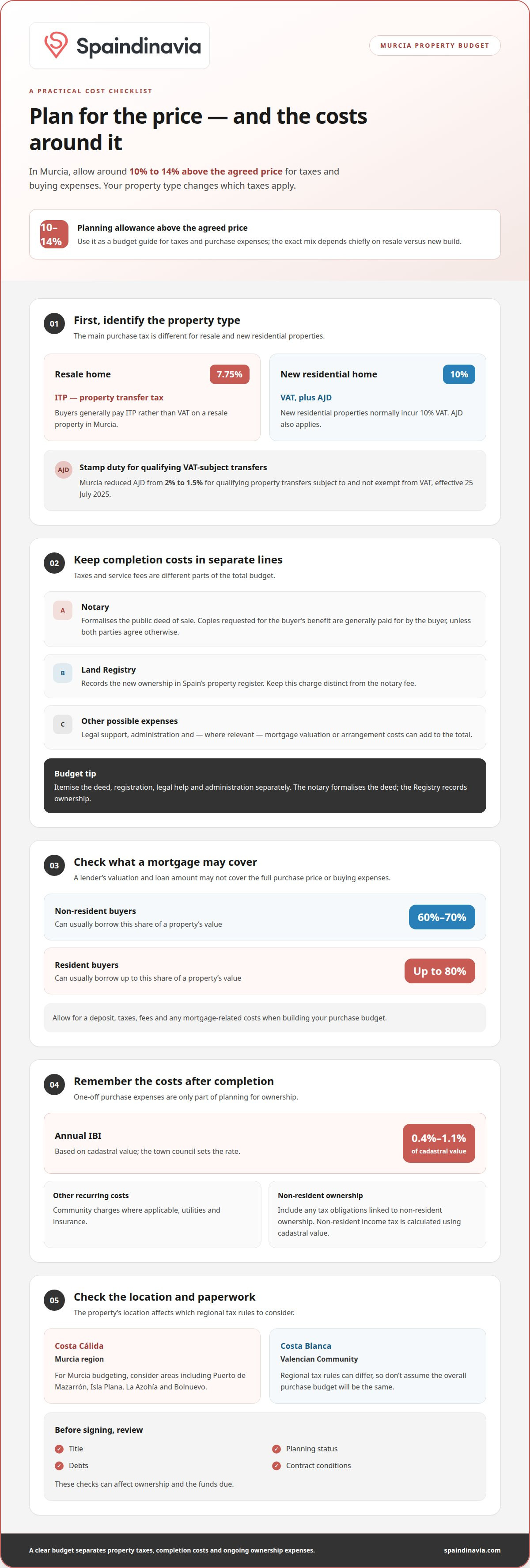
The cost of buying property in Murcia is commonly budgeted at around 10% to 14% above the agreed price, including taxes and purchase expenses. Resale homes are generally subject to 7.75% ITP, while new residential properties usually incur 10% VAT, with AJD and costs such as notary and land registry fees also affecting the total.
It’s easy to focus on the property price and underestimate the extra costs, especially when the taxes change depending on whether you’re buying a resale or a new build. The region offers fantastic potential, and understanding local regulations is essential since property tax rules can differ compared to neighbouring areas like the Valencian Community.
Here, you’ll find a clear breakdown of the charges involved in buying in Murcia, including the tax differences between resale and new homes, notary and registry expenses, and the costs that may apply if you use a mortgage. That way, you can plan your budget with greater confidence as you consider a home around Puerto de Mazarrón, Isla Plana, La Azohía or Bolnuevo.
Key Takeaways
- Separate the costs for resale and new-build homes: the tax applied depends on the type of property you buy.
- Build notary and land registry fees into your budget alongside the main property taxes.
- For a new home in Murcia, account for stamp duty as well as VAT when estimating your total outlay.
- Tax rates can differ between Murcia’s Costa Cálida and the Costa Blanca in the Valencian Community, so the property’s location matters.
- Use the breakdown in this guide to shape a realistic budget before choosing a home in areas such as Puerto de Mazarrón, Isla Plana, La Azohía or Bolnuevo.
What Are The Costs Of Buying Property In Spain?
In Murcia, budget around 10% to 14% above the purchase price for taxes and buying expenses. The exact mix depends chiefly on whether you choose a resale home or a new build.
New-build and resale purchase costs
Purchase costs differ because resale homes generally incur ITP, while new-build homes incur VAT and AJD. This distinction matters because the tax calculation can substantially change the cash you need alongside the agreed price. In Murcia, the general resale ITP rate is 7.75%; new residential properties normally have 10% VAT, with AJD also applicable.
For qualifying property transfers subject to and not exempt from VAT, Murcia reduced AJD from 2% to 1.5%, effective 25 July 2025. Your property type and its location in the region shape the relevant tax treatment.
Purchase taxes and expenses
Purchase taxes are government charges, while expenses cover services and registration needed to complete the transaction. Allow for both when planning, rather than treating the purchase price as your full budget. Notary and land registry costs, legal support and, where relevant, mortgage valuation can add to the total.
For a new-build home in Murcia, the main purchase taxes are 10% VAT and AJD, illustrated at 1.5% for qualifying VAT-subject transfers. Resale buyers instead generally pay 7.75% ITP. A planning allowance of around 10% to 14% above the agreed price can help account for taxes and expenses, though the property type changes the breakdown.
Purchase budgets and mortgage estimates
A purchase budget combines your deposit, taxes, fees and any mortgage-related costs. This matters because a lender’s valuation and loan amount may not cover the full purchase price or buying expenses. Non-resident buyers in Spain can usually borrow 60% to 70% of a property’s value; resident buyers can usually borrow up to 80%.
A Spanish mortgage may also involve valuation and arrangement costs. US citizens do not need Spanish residency to buy, but need an NIE for property-related tax and legal transactions; a Spanish bank account is useful for payments, though not a condition of ownership.
For foreign buyers, the broad process is to agree terms, sign a private contract, arrange the deposit, complete before a notary, then register the deed and settle applicable taxes. Before signing, review title, planning status, debts and contract conditions, as these can affect ownership and the funds due.
Ongoing ownership costs
After completion, budget for annual IBI, community charges where applicable, utilities, insurance and any tax obligations linked to non-resident ownership. These recurring costs matter because they continue beyond the one-off purchase. Murcia’s IBI is based on cadastral value, with the town council setting the rate; the typical range is 0.4% to 1.1% of that value.
Non-resident income tax is calculated using the property’s cadastral value. Include these ongoing obligations when comparing a home in Murcia’s Costa Cálida with one on the Costa Blanca in the Valencian Community, where regional tax rules can differ.
Notary and land registry fees
Notary and land registry fees are separate from property taxes. They cover the formalisation and registration of the purchase, and should be included alongside legal and administrative costs in your completion budget.
Notary fees
The notary formalises the public deed of sale, which records the transfer of ownership. Include this fee in your budget so you account for the funds needed to complete, not just the purchase price and taxes.
The deed records the agreed sale and identifies the property and parties. Copies requested for the buyer’s benefit are generally paid for by the buyer, unless both parties agree otherwise. Ask for copies you need for your records or the registration process to be reflected in the completion account.
Land Registry costs
Land Registry fees cover recording the new ownership in Spain’s property register. Registration creates an official record of the transfer, so include the charge when calculating the full amount required to complete your purchase.
After the public deed is signed, it can be submitted with supporting paperwork to register the change of ownership. Keep the land registry fee separate from notary fees: one covers recording ownership, while the other relates to formalising the deed.
This is a combined estimate of those two charges only, not a complete purchase-cost total. A resale purchase and a new-build purchase can have different tax bills, so keep taxes in a separate budget line.
Legal and administrative expenses are part of the overall purchase costs, but cover different work from the notary and land registry fees. Keep these items distinct when reviewing your budget.
Keep an itemised completion estimate, with separate entries for the deed, registration, legal help and administration. This makes it easier to see which costs are one-off and which relate to other parts of the transaction. If you’re considering a resale apartment in Murcia, allow for these formal purchase expenses alongside the applicable resale taxes.
The notary and Land Registry charges apply to purchases in Murcia’s Costa Cálida, including Puerto de Mazarrón, Isla Plana, La Azohía and Bolnuevo. The Costa Blanca is in the Valencian Community, where regional taxes can differ, so don’t assume that a property there has the same overall purchase budget.
Resale property transfer tax
For a resale home in Murcia, buyers generally pay ITP, the property transfer tax, rather than VAT. The general ITP rate is 7.75%; VAT at 10% normally applies to new residential properties instead. This distinction helps you identify the main purchase tax before comparing resale homes in Puerto de Mazarrón, Isla Plana, La Azohía or Bolnuevo.
Treat this as a tax estimate based on that example’s taxable value, not as the complete cost of purchasing the home. Notary, land registry and other transaction expenses are separate budget items.
Buyers in Murcia must pay transfer tax within 30 working days after completion. The completion date therefore matters for organising the funds and paperwork that follow the sale. Keep the tax payment separate from the deposit and final balance in your budget, so the amount due after signing doesn’t come as a surprise.
Some purchases may qualify for reduced ITP rates, including certain cases involving younger buyers, large families, protected housing or buyers with qualifying disabilities. Eligibility depends on the relevant conditions for the buyer and property. If you’re comparing properties, include the general rate in your initial estimate, then account for any qualifying reduction when the applicable criteria are met.
For buyers sending funds from Sweden, Norway, Poland, Germany, the Netherlands, Belgium, France or the United States, currency exchange can affect the sterling or foreign-currency amount needed to pay a euro-denominated tax. Exchange rates move, and banks or transfer services may charge for converting and sending money. Allow for both the conversion and transfer process when arranging the payment, rather than budgeting only for the ITP figure.
Administrative and translation expenses are separate from property transfer tax. A gestor can help handle transaction paperwork, while translation support can make Spanish documents clearer for buyers who prefer to work in another language. The amount involved depends on the work and documents required; keep these items distinct from ITP, legal costs and charges for registering the deed.
The Costa Cálida is in Murcia, while the Costa Blanca is in the Valencian Community, where property tax rates can differ. A Murcia resale purchase follows the regional ITP treatment described here, so don’t carry this rate across to a home on the Costa Blanca. For a resale villa or apartment, separating ITP, currency conversion and administrative expenses gives you a clearer view of the cash needed around completion.
Taxes and fees when buying property in Spain
The costs of buying a Spanish property extend beyond its purchase tax. For a useful budget, separate taxes from legal, estate agency and practical changeover expenses.
Lawyer and adviser fees
Legal and adviser fees cover professional support with the purchase, and matter because they sit outside the tax bill. Spanish property legal fees are often estimated at 1% to 2% of the property price, including VAT.
Costs relate to different parts of the purchase, so review them as separate items rather than assuming they cover the same work. Spaindinavia can connect you with independent lawyers and support you through the buying process.
Real estate agent fees
Estate agency fees relate to the service of marketing and arranging a property sale. In Spain, agents commonly charge 3-5% of the sale price, although the seller sometimes pays. Buyers don’t normally pay estate agent fees directly, so don’t automatically add this percentage to your own costs of buying.
For example, if you’re considering a resale home, distinguish the seller’s agency charge from your ITP, legal fees and completion expenses. Who pays the agency fee depends on the sale arrangement; it isn’t the same charge as property transfer tax.
Tax rates also vary by region in Spain. Resale property transfer tax ranges from 6% to 10% across autonomous communities. For comparison, Andalusia’s rate is 7%, while the Valencian Community’s is 9%, rising to 11% for amounts over €1,000,000. Murcia has its own regional treatment, so a Costa Cálida purchase and a Costa Blanca purchase shouldn’t be budgeted using the same assumed rate.
New-build purchases have a different tax structure from resale transactions. Spain’s standard VAT rate for new residential property is 10%, with stamp duty also applying according to the autonomous community. Keep the tax lines separate in your estimate: the applicable purchase tax, legal fees, notary and registration charges each cover a different part of the transaction.
Utility contract changeover costs depend on what happens to each service at the property. For electricity, water and broadband, establish whether an existing contract needs a change of account holder, a new contract or a fresh connection. The provider’s process and the property’s current connection status determine which administrative steps and charges apply.
For a clear estimate, group expenses into taxes, professional fees, transaction charges and utilities. That makes it easier to see which costs arise from the purchase itself and which relate to setting up the home. Buyers comparing Murcia’s Costa Cálida with the Costa Blanca in the Valencian Community should keep regional tax differences visible, rather than relying on one nationwide total.
Stamp duty on new properties in Murcia
New-build buyers in Murcia should budget for stamp duty, known as AJD, alongside VAT. The key detail is that Murcia’s reduced AJD rate is 1.5% for qualifying property transfers subject to and not exempt from VAT, effective 25 July 2025. This makes AJD a major part of estimating the expenses for a new-home purchase.
AJD is a tax on the public deed recording the property purchase. It is separate from VAT, which is normally 10% for a new residential property in Spain. A resale purchase follows a different tax route, generally involving transfer tax instead of new-home VAT. So, identify the property type first, then calculate the relevant taxes separately.
This example shows why adding VAT alone won’t give you the full tax figure for a qualifying new build.
Don’t assume the reduced rate applies to every deed automatically. The stated 1.5% AJD rate concerns transfers subject to and not exempt from VAT, so the tax treatment of the transaction matters. For budgeting, keep the purchase price, VAT and AJD as separate entries. This also makes it easier to compare a new property in Murcia with a resale home.
The Costa Cálida is in Murcia, while the Costa Blanca is in the Valencian Community. Regional rules can differ, so a new-build purchase on the Costa Blanca shouldn’t be budgeted using Murcia’s AJD rate. A resident or overseas buyer should also distinguish residency from the property’s location and the transaction’s tax treatment; the cited Murcia rate is defined by the VAT status of the transfer.
After calculating VAT and AJD, add the other expenses for the property purchase, including notary and registry fees, legal support and any mortgage valuation. Separating each cost prevents the tax total from being mistaken for the full cash needed to complete.
If you’re considering a new-build home as an investment, include both purchase taxes in your initial comparison. Then weigh the property’s location, intended use and ongoing ownership costs before deciding. Explore investment properties in Murcia as you shape your shortlist.
Spaindinavia
Spaindinavia can help you explore property options as you turn your Murcia budget into a shortlist. Consider how the purchase taxes and ongoing expenses fit alongside the type of home you want, whether that’s a new-build villa, resale apartment, townhouse or bungalow.
For a coastal search, the Costa Cálida is in the Murcia region, with Puerto de Mazarrón, Isla Plana, La Azohía and Bolnuevo among the areas to explore. The Costa Blanca is in the Valencian Community, where regional property tax rates can differ. Keeping location and property type in view helps you compare the likely purchase costs more clearly.
When you’re ready to explore homes in Murcia, contact Spaindinavia.
Shape your next move in Murcia
Let your budget guide your search, but also consider how you want the property to fit your life. A holiday home, permanent residence or investment property may call for different priorities. Being clear about your intended use and preferred setting can help focus your search.
The cost of buying property in Murcia is one part of the decision. The Costa Cálida is in the Murcia region, while the Costa Blanca is in the Valencian Community, so consider which setting suits your plans. You might, for example, picture life around Puerto de Mazarrón, Isla Plana, La Azohía or Bolnuevo.
When you’re ready to discuss buying in Murcia, contact Spaindinavia about your property search. Your next chapter in the sun can begin with a thoughtful first step.
Frequently Asked Questions
How Much Extra Should You Budget?
Plan for roughly 10%-15% above the property price for taxes and purchase fees. The cost of buying property in Murcia depends partly on whether you choose a resale home or a new build, so avoid treating the extra amount as one fixed charge. For a practical estimate, calculate your likely tax first, then allow for transaction expenses and keep funds available for payments due at different stages.
What is the average property price per square metre in Murcia, Spain?
The average property price in Murcia was €1,330 per square metre in Q1 2026. Use this as a regional benchmark, not a quote for a particular home: a property’s location, condition and type all affect its asking price. For example, comparing two homes by floor area alone won’t account for differences such as outdoor space, views or proximity to local services.
How do property prices in Murcia city compare with coastal towns and rural areas in the Region of Murcia?
There isn’t one price ranking that applies to every Murcia city, coastal or rural property. Location, property condition, amenities and proximity to the coast all shape asking prices. Compare similar homes by size and condition, then weigh the lifestyle differences: Puerto de Mazarrón, Isla Plana, La Azohía and Bolnuevo offer coastal settings, while Murcia city and inland areas have different surroundings. The Costa Blanca is in Valencia, a separate region.
What other purchase costs apply, including notary, land registry, legal, and mortgage fees?
Legal support and administration are separate expenses. If you use a mortgage, a valuation may also be needed; mortgage-related charges depend on the lender and loan terms. Keep each item in a separate budget line, so you can distinguish completion costs from charges linked to financing.
How much deposit and mortgage financing do buyers typically need in Murcia?
A private purchase contract deposit is usually around 10% of the purchase price. Non-resident buyers can usually borrow 60%-70% of the property’s value, while resident buyers can usually borrow up to 80%. For example, estimate your available cash against the likely loan, then reserve separate funds for taxes and fees. A lender’s valuation and assessment affect the financing offered, so don’t base your plan on the asking price alone.


