

What if the best beach isn’t the one with the most awards, but the one that suits your day? Spain’s Mediterranean coast offers a range of settings, from open shorelines to sheltered coves. Choosing among the best beaches mazarron has to offer starts with what matters to you, whether that’s scenery, convenience or a relaxed day with family.
With so many options, it can be hard to know where to start. Decide what you want from the day, check the forecast and plan how you’ll get there before setting off. This guide will help you compare beaches, prepare for a comfortable visit and account for the practical details that can shape your time by the sea.
You’ll also find ways to think beyond a single visit. The beaches you return to can offer a useful glimpse of the coastal lifestyle you might want from a future home.
Key Takeaways
- Choose a beach around the day you want, balancing scenery, convenience, facilities and atmosphere.
- Compare different beach settings by their likely appeal and trade-offs, then check practical details before you go.
- Use a consistent checklist for access, facilities, surroundings and planned activities instead of relying on rankings alone.
- Plan ahead by checking the forecast and official local guidance before travelling or swimming.
- Let your favourite beach experiences help you explore the best beaches mazarron and consider which coastal lifestyle could suit you longer term.
What makes the best beach the right choice for your kind of day?
The best beach is the one that fits your priorities, not necessarily the one with the strongest reputation. You might be looking for striking scenery and space to take photographs, or you may care more about straightforward access, useful facilities or a lively atmosphere. If you’re comparing the best beaches mazarron has to offer, start with the day you want rather than a ranking.
A scenic beach delights the eye; a practical beach makes the day easier. Sometimes one place offers both, but deciding which matters most will make your choice clearer. Start by naming your main activity, considering who’s coming with you, then ranking convenience, scenery and the level of quiet you’d enjoy.
For general background on the coastline, you can consult the local coastline overview. Use it as a starting point, then look for current, beach-specific details before making plans.
Which beach-day priorities should you decide first?
Pick the main purpose of your visit: swimming, relaxing, walking, family time or photography. You can enjoy more than one, of course, but naming your first priority makes comparisons easier. A beach that suits a slow afternoon may not be the most convenient choice for a short swim or a walk along the shore.
Think about your companions, too. Children’s ages, anyone’s mobility and the group’s different interests can all affect what feels comfortable. Before leaving, agree on your top priorities and rank convenience, scenery and quieter surroundings. That quick conversation can help you avoid choosing a place that works for only part of the group.
What makes beach descriptions useful rather than vague?
Look for details you can act on, not broad promises such as “perfect for everyone”. A useful description gives specific information about facilities or access, and separates those facts from general impressions, such as a place feeling peaceful. It should also help you judge whether the information is relevant to the season and date of your visit.
Be precise about what you still need to know. Is the route suitable for everyone in your group? Are the services you want available on the day you plan to go? Don’t treat an old description or a general impression as a guarantee. Check current official information for access arrangements and services that could change, then check conditions again before departure.
- Choose: Name your main activity.
- Consider: Account for your companions’ needs and interests.
- Rank: Decide how you balance convenience, scenery and quiet.
- Verify: Look for current, specific information before you travel.
How do beach types shape the experience you can expect?
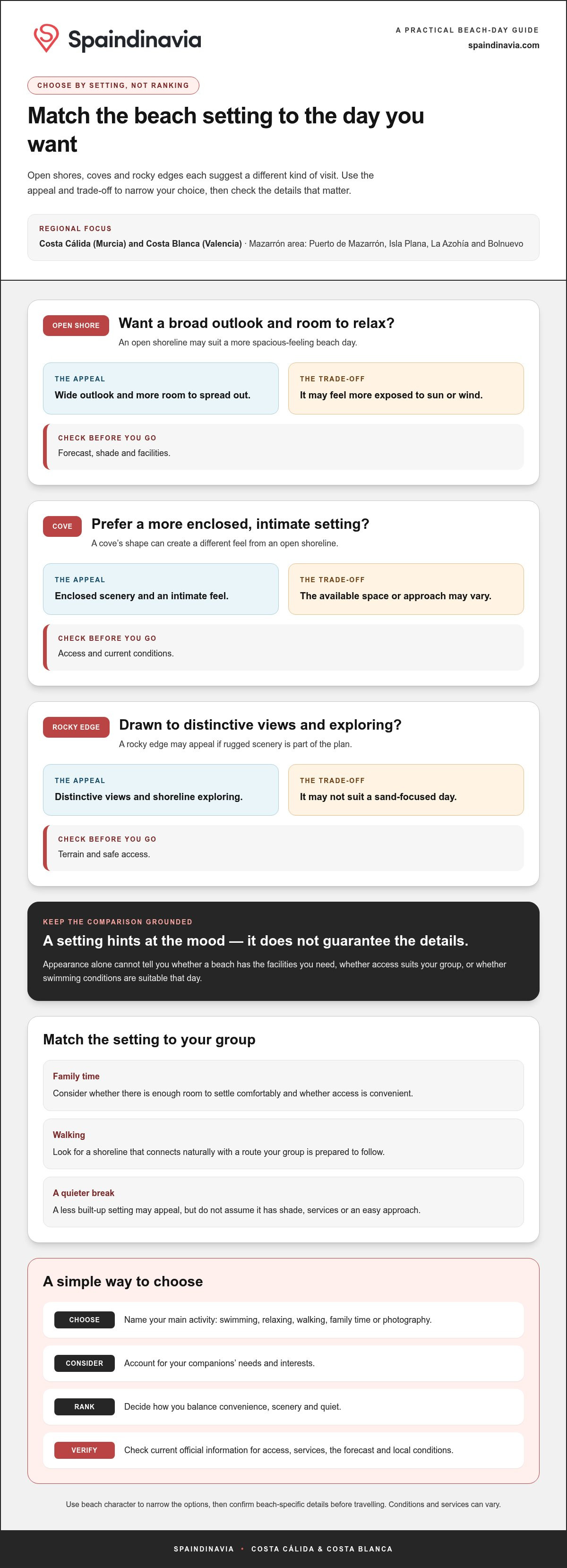
Beach settings offer useful clues about the kind of visit you might enjoy, but they’re a starting point, not a promise. An open shoreline may feel spacious and exposed, a cove can create a more enclosed setting, and a rocky edge may appeal to visitors drawn to rugged scenery. Access, facilities and conditions vary, so don’t infer them from appearance alone.
Beach character can suggest the mood of a visit, but it doesn’t guarantee particular facilities. Treat scenery and convenience as separate choices. A dramatic view may be exactly what you want, while a more practical location may better suit a longer family day. When comparing the best beaches mazarron, look for current, specific information alongside descriptions of the landscape.
How do open shores, sheltered coves and rocky edges differ?
Open shores often provide a broader outlook and more room to spread out, but may offer less shelter from sun or wind. A cove’s enclosed shape can create a more intimate setting, though the usable space and approach can vary. Rocky edges tend to offer visual interest and places to explore from shore, but may be less suited to a simple sand-and-towel visit. None of these descriptions tells you whether swimming conditions are suitable on a particular day.
Before setting out, check the forecast and official local guidance for current conditions, access and any services you need. The Official Murcia Region Beaches Guide can help you find beach information; use the relevant details to guide your comparison, then check for updates before travelling.
Which beach setting suits families, walkers or quiet breaks?
Match the setting to the practical needs of your group. Families may value enough room to settle comfortably and convenient access, while walkers may prefer a shoreline that connects naturally with a route they’re prepared to follow. For a quieter break, a less built-up setting may appeal, but don’t assume it has shade, services or an easy approach. Check each point against current local information.
Use this comparison to narrow your options, not to make assumptions about a specific beach:
| Setting | Likely appeal | Possible trade-off | What to check |
|---|---|---|---|
| Open shore | Wide outlook, room to relax | More exposure | Forecast, shade and facilities |
| Cove | Enclosed scenery, intimate feel | Space or approach may vary | Access and current conditions |
| Rocky edge | Distinctive views, shoreline exploring | May not suit a sand-focused day | Terrain and safe access |
As you compare settings, notice which surroundings you’d enjoy returning to regularly. That can help you picture a coastal home and everyday routine that fit your preferences. You can explore coastal property options as one way to consider that lifestyle.
How can you compare beaches without relying on rankings alone?
A high position in a ranking can point you towards a beach worth exploring, but it can’t tell you whether it suits your plans, companions or travel date. Popularity reflects other people’s preferences, not a universal measure of comfort or convenience. For the best beaches mazarron, use rankings as a starting point, then compare practical details against what you need from the day.
Keep your comparison consistent. Check the same factors for each option, and note whether the information is current, specific and relevant to your visit. This makes it easier to find a beach that fits your priorities rather than choosing one simply because it attracts attention.
What should you check before choosing a beach?
Start with current information about access and facilities, including seasonal updates that could affect your plans. Estimate the journey and check reliable, up-to-date sources for parking or public transport. Then compare what you find with your priorities: a short journey, a particular activity or a convenient set-up for your companions may matter more than a striking description.
- Access: Is the route and approach suitable for everyone in your group?
- Facilities: Are the services you need available at the time of your visit?
- Journey: How will you get there, and what are the current transport or parking options?
- Setting and plans: Does the beach suit your activity and preferred surroundings?
Check official local information close to your travel date, especially if access or services could change. For a wider perspective on coastal planning and climate adaptation, MITECO outlines the Spanish Strategy of Coast Adaptation to Climate Change. It provides broader context, while day-to-day beach decisions still depend on current local guidance.
Can visitor reviews help you find the right beach?
They can, if you look for recent, specific observations rather than treating a score as a promise. Prioritise comments that describe details relevant to you, such as the approach, how busy it felt or whether a visit suited a particular activity. Check when the reviewer went, since conditions and seasonal services may differ from your planned date.
Look for recurring practical details across separate accounts, but keep your own needs in view. One visitor’s complaint about a long walk may matter greatly to your group, while another’s preference for a lively atmosphere may not match yours. Treat isolated opinions and old descriptions cautiously, not as proof that a beach will be the same on your visit.
Before deciding, write down your non-negotiables and compare each option against them. If one detail remains unclear, seek a current official source rather than filling the gap with an assumption. The result won’t be a universal winner; it will be a choice you can make with clearer expectations and greater confidence.
How do you plan a comfortable and responsible beach day?
A relaxed day by the sea starts before you leave home. Choosing a beach is only the first step; weather, access, transport and the needs of your group can all affect how the visit unfolds. Conditions and facilities can change, so check current information before you go.
What should you prepare before leaving?
Use this simple sequence to turn your beach choice into a practical plan:
- Choose for the day’s conditions. Match the beach and planned activity to the forecast, then check official local guidance before travelling or swimming. If conditions don’t suit your plans, choose another activity or postpone the visit.
- Confirm the practical details. Check current access information, available facilities and seasonal updates. Use reliable, up-to-date sources for journey times, parking or public transport, and note any opening details relevant to the services you plan to use.
- Pack for your group. Bring drinking water, sun protection and suitable footwear for the route and shore. Add what your plans call for, such as a towel and swimming kit for a swim, or comfortable walking shoes for a coastal stroll. Consider what children or anyone with particular mobility needs may require.
- Have a back-up plan. Identify an alternative in case the weather turns, access is unsuitable or a facility you were counting on isn’t available. A flexible plan helps you avoid rushing into a choice that doesn’t feel right.
Keep the day comfortable rather than overpacked. A few essentials and a clear idea of how you’ll get home can make the outing easier, especially if you’re travelling with others whose needs differ.
How can you enjoy the coast responsibly?
Follow posted guidance at the beach and respect signs or directions from local authorities. Where natural surroundings are sensitive, keep to appropriate paths and avoid disturbing plants, wildlife or the shoreline. If you’re unsure how to behave in a particular area, look for current official local advice rather than assuming the same guidance applies everywhere.
Small habits make a difference. Take your rubbish with you if there isn’t a suitable disposal point, and leave the place as you found it. Keep food packaging secure, avoid leaving belongings behind and be considerate of other visitors sharing the space. Responsible choices help protect the coast and preserve the experience for others.
As you spend time by the sea, notice which surroundings and everyday routines you’d enjoy beyond a holiday. If that visit has you considering a longer-term coastal lifestyle, explore coastal property options and reflect on what would make a home suit the way you want to live.
How can a beach preference help shape your longer-term coastal lifestyle?
A day by the sea can reveal more than which stretch of coast you enjoy. Notice what you value around it: a peaceful outlook, a walkable daily routine, convenient local services or the chance to spend time outdoors. Your impressions of the best beaches mazarron offers can help clarify the lifestyle you’re drawn to, but they’re one part of a much bigger decision.
Try picturing an ordinary week, not just a holiday. Would you visit the coast regularly, or only when friends and family come to stay? How important are practicalities such as getting around, managing a home when you’re away and finding community facilities you’ll use throughout the year? Jot down what you notice during your visit, then separate the features you loved for a day from the things you’d want in everyday life.
What should you notice if you are considering a coastal home?
Pay attention to your routines as well as your surroundings. Think about how often you’d go to the beach, what you’d want nearby and how the home would work outside the busiest holiday periods. Consider access for your household, ongoing maintenance and whether local facilities fit your year-round needs. A memorable beach visit can inspire a search, but it can’t determine whether a particular home or location is right for you.
Be clear about how you expect to use the property. Is it primarily for your own stays, intended as a holiday rental, or would you like to combine personal use with renting it out? That choice can shape what you prioritise in your search, from the type of home to how you’ll manage it when you’re not there.
How can you take the next step towards coastal living?
Turn your reflections into a short list of property-search priorities. You might note the kind of surroundings you prefer, how you plan to use the home, the practical access you need and the maintenance you’re comfortable managing. Then compare those priorities with the realities of different property types. A villa, apartment, townhouse or bungalow may each suit different preferences, so focus on how the home supports your intended routine rather than choosing on holiday impressions alone.
If you plan to rent the property at times, include that in your thinking from the outset. Rental management is another consideration alongside personal use, ongoing care and the time you expect to spend there. Spaindinavia supports buyers throughout the property process and offers rental-management support for owners, helping you consider practicalities as well as the lifestyle you’re seeking.
Take the next step at your own pace. Explore property opportunities with Spaindinavia and begin shaping a search around the coastal life you want to make your own.
Let your coastal plans take shape
Let your time by the sea become a starting point for a more personal vision of coastal living. As you think about the best beaches mazarron, note what you’d want to carry into everyday life, whether that’s a familiar morning walk, open views or the ease of having the coast nearby. Then turn those impressions into a short list of home-search priorities, separating must-haves from features you simply enjoyed on holiday.
Give yourself room to explore. The right choice isn’t only about a beautiful setting; it’s about finding a place that fits how you plan to live and use your home. Spaindinavia is an independent agency with local property expertise, helping buyers through the process and supporting owners with property management and rentals.
Explore property opportunities with Spaindinavia and take a considered first step towards a coastal lifestyle that feels right for you.
Frequently Asked Questions
How do I choose the best beach for a family day out?
Choose a beach around your family’s practical needs, not just its appearance. Think about how far children can comfortably walk, whether anyone needs step-free access and how long you plan to stay. For a half-day visit, a straightforward journey and a suitable place to take breaks may matter more than a dramatic setting. Check current local information for facilities and access, then agree a back-up plan in case conditions change.
Are beaches suitable for swimming all year round?
Not necessarily. Swimming suitability depends on conditions on the day, including weather, water and any local safety guidance. Don’t assume that a beach suitable for swimming during one visit will be suitable another time, or that a particular season guarantees safe conditions. Before entering the water, check official local advice and observe any posted guidance. If conditions seem unsuitable or you’re unsure, stay out and choose another way to enjoy the coast.
Can I find a beach with accessible facilities?
Accessible facilities may be available at some beaches, but provision and access arrangements vary. Before travelling, check current official information for the specific beach and look for details that match your needs, such as the route from transport or parking, the surface underfoot and access to facilities. If you’re travelling with someone who uses a mobility aid, consider the whole journey from arrival to the shoreline, not just whether a facility is mentioned.
What should I check before visiting a beach?
Check the local forecast, official beach guidance and travel information before setting off. Look for updates that could affect your plans, such as changes to access or services, and make sure the beach suits the activity you have in mind. If you’re planning to swim, check current water and safety advice. Save useful information on your phone before you leave, especially if you’ll be relying on it while travelling.
How can I tell whether a beach will be busy?
You can’t know for certain, but recent visitor comments and local updates may offer clues. Look for observations from a similar day of the week and time of year, and note whether people mention crowding, parking or queues. Treat these as indications, not guarantees. If avoiding crowds matters, keep your plans flexible: consider a less popular time or have another beach in mind, then check current travel information before choosing.
Is it better to visit a beach in the morning or afternoon?
The better time depends on the weather, your plans and the kind of atmosphere you prefer. A morning visit may suit an active start to the day, while an afternoon trip can leave room for a slower morning or other plans. Check the forecast for the hours you expect to be outside, and think about shade, travel and how long your group will want to stay. Conditions and visitor numbers can vary, so stay flexible.
What should I pack for a day at the beach?
Pack for the activities and the people in your group. Alongside water and sun protection, consider any personal medication, a charged phone, a small first-aid kit and a bag to keep valuables dry. A light extra layer can be useful if you’ll stay into the evening, while a spare change of clothes may help after swimming. Check the forecast first, then leave out anything you’re unlikely to need.
Can a beach visit help me decide where to look for a home?
Yes, it can help you identify the surroundings and routines you enjoy, but one visit is only a snapshot. Notice how the journey feels, what you’d use nearby and whether you’d want to return outside holiday periods. The best beaches mazarron may inspire your search, but a home decision also involves everyday access, upkeep and how you intend to use the property. Treat the visit as a prompt for questions, not a verdict.


