

What if the Land Registry entry for a Spanish property doesn’t prove that every extension, terrace or pool was approved? It’s an easy assumption to make when you’re excited about a new home, but registration and planning permission are different checks. Knowing how to verify planning permission for a spanish property means comparing the approved works with the property as it stands, rather than relying on one document.
Start by gathering the available paperwork and checking that each document relates to the right property and the right work. A Nota Simple can show ownership, the property description and registered charges, but it isn’t confirmation that building work has planning approval. Spanish document names can also be confusing, especially when records relate to different stages of a property’s history.
This guide explains which authorities and records to check, including licences for occupation and documents relating to possible planning infringements. You’ll learn how to spot missing paperwork or inconsistencies, and when to have a qualified Spanish property lawyer review the evidence. Spaindinavia supports buyers throughout the purchase process, working alongside independent solicitors and local experts so you can move forward with a clearer picture of your decision.
Key Takeaways
- Learn how to verify planning permission for a spanish property by comparing approved works with the property’s records, rather than relying on one document alone.
- Identify which documents to request and what each may help you check before committing to a purchase.
- Compare information from the Ayuntamiento, Registro de la Propiedad and Catastro, whilst keeping in mind what each record cannot confirm by itself.
- Record missing documents or mismatches and request clarification through the appropriate channels rather than assuming what they mean.
- Separate checks you’ve resolved from outstanding questions, and ask your solicitor for written advice where legal review is needed.
What planning permission means for a Spanish property buyer
Checking planning permission means comparing documents and records, not relying on a single yes-or-no search. You’re looking for evidence that the work carried out matches what was authorised and that the paperwork relates to the property you’re considering. Procedures and records can vary between municipalities, so checks need to be relevant to the property’s location.
In plain English, planning permission is approval from the relevant authority for specified building work or development. The Spanish terms used can vary according to the type of work and local procedure. For example, licencia de obra refers to a works licence. A qualified Spanish property lawyer can confirm which documents apply to a particular home.
What does planning permission cover?
An approval relates to the project or works it describes. It doesn’t automatically cover every feature now visible at the property or any changes made later. An original approval might relate to a house as built, while a subsequent extension, enclosed terrace or other alteration may need its own supporting evidence. Compare the approved plans or written description with the property as it stands.
A sale listing, photographs or a viewing can help you identify features to check, but they don’t establish that those features were authorised. If something appears different from the paperwork, note the specific difference and ask for it to be clarified during the purchase process.
Why registration is not proof of planning approval
The Registro de la Propiedad, or Property Registry, records information about property ownership and registered rights or charges. Its entry can help you check how a property is described in the registry, but it answers a different question from whether particular building work received planning approval.
The Catastro is a separate source of property information, including descriptive and cadastral details. Comparing its information with other documents may reveal points that need explaining, but a cadastral record alone doesn’t confirm that all construction complies with planning requirements.
Don’t treat an entry in either record as a complete planning check. A mismatch, by itself, doesn’t establish what happened or whether work is authorised. Local processes can differ, so have a qualified lawyer review the relevant evidence before you proceed.
How to verify planning permission for a Spanish property step by step
A clear sequence helps you connect the paperwork to the home you’re considering. Use these steps to organise your checks, then ask an independent Spanish property solicitor to assess anything that needs legal interpretation. Local records and procedures can vary, so focus your checks on the relevant municipality.
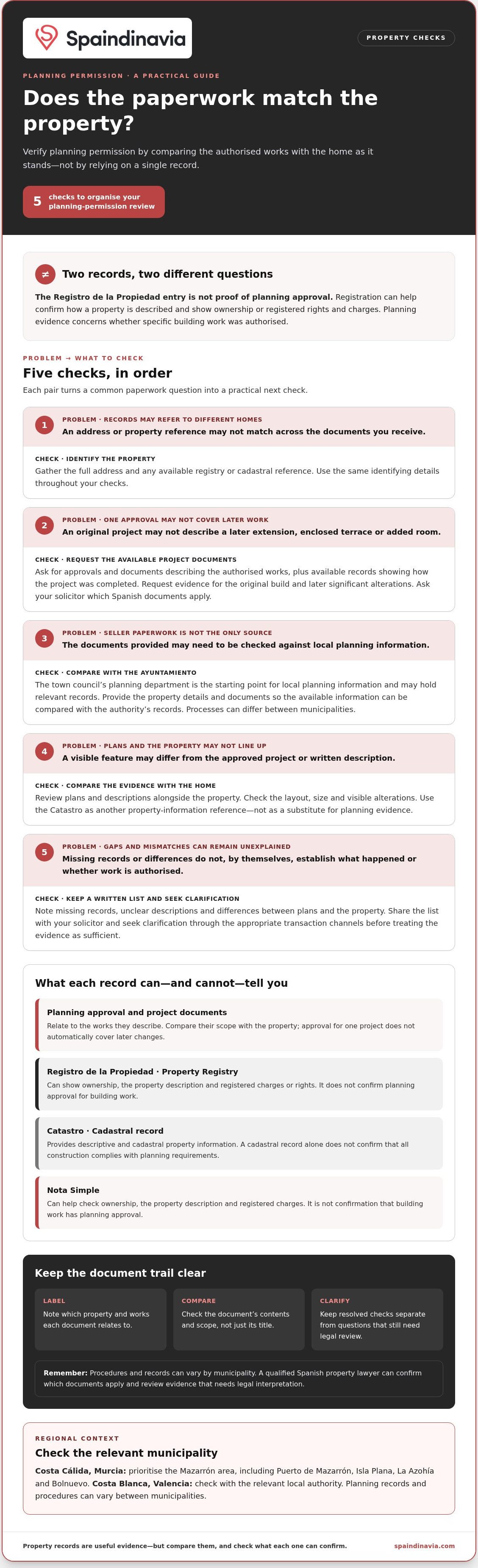
- Identify the property. Gather its full address and any available registry or cadastral reference. Use the same identifying details throughout your checks so you can see whether each document relates to the right home.
- Request the available documents. Ask the seller or their representative for planning approvals and project documents describing the authorised works, along with available records showing how the project was completed. Request documents for the original build and later extensions or significant alterations, such as an enclosed terrace or added room. Spanish document names and requirements can vary; ask your solicitor which apply.
- Check municipal information. The Ayuntamiento, or town council, is the starting point for local planning information. Its planning department may hold relevant records. Provide the property details and documents so the available information can be compared with the authority’s records. The applicable process may differ between municipalities.
- Compare the evidence with the property. Review plans and written descriptions alongside the home itself. Check the layout, size and visible alterations, and note any feature that appears absent from the approved project or differs from its description. The official Spanish Cadastre (Catastro) is another property-information reference to compare with other records, not a substitute for planning evidence.
- Resolve questions before relying on the paperwork. Keep a written list of missing records, unclear descriptions and differences between plans and the property. Share it with your solicitor and seek clarification through the appropriate transaction channels before treating the evidence as sufficient.
Keep your document trail organised
Save each document with a clear label, noting which property and works it relates to. This makes it easier to see whether an approval concerns the original build but leaves a later change unaddressed. Don’t assume the document title alone explains its scope; check its contents and connection to the property.
This sequence is a practical starting point, not a complete checklist for every municipality. Organised due diligence can make discussions with your solicitor more focused. Support throughout your property purchase can help you keep the wider buying process on track whilst your solicitor reviews the legal questions.
Which Spanish property records answer which planning questions?
Each record answers a different question. The Ayuntamiento may hold local planning information; the Property Registry and Catastro provide other kinds of property details. Comparing them can reveal useful clues, but consistent details across records aren’t formal confirmation that all building work complies with planning requirements. Local procedures and the scope of documents can vary, so ask your Spanish property solicitor to confirm what applies to the property you’re buying.
| Record | What it may help you check | What it can’t establish by itself |
|---|---|---|
| Ayuntamiento (town council) | Available municipal planning information, such as records relating to a planning approval or specified works. | One document or search may not provide a complete picture of the property’s planning history or confirm that every alteration was authorised. |
| Registro de la Propiedad (Property Registry) | Registered title information. A Nota Simple, an informational registry extract, may show the registered owner, property description and charges recorded when it is issued. | A Nota Simple is not a planning approval and doesn’t, on its own, establish that the property or its alterations comply with planning requirements. |
| Catastro (Cadastre) | Cadastral information describing the property. Comparing it with plans and other records may help identify details that need clarification. | A cadastral description is not, by itself, evidence that building work received planning approval. |
Ayuntamiento records and the Property Registry
For questions about local planning approvals, the Ayuntamiento is the starting point. Its planning department may hold relevant records, subject to its procedures and the information available for the property. The Registro de la Propiedad serves a separate purpose: it records registered property and title information. If the two sources describe the property differently, treat that as a prompt to investigate, not as a conclusion about whether work is authorised.
Catastro and the Nota Simple
Use the Catastro as another reference point, not a substitute for municipal planning evidence. The Nota Simple can be useful during purchase checks, but its scope is registry information rather than a complete planning history. Document names, coverage and procedures can depend on the circumstances and location. To understand how to verify planning permission for a Spanish property, keep these sources distinct, compare their details and have your solicitor assess any uncertainty before you rely on the paperwork.
What to do if planning documents are missing or do not match
A missing document doesn’t, by itself, establish whether work was authorised. It does leave a question unanswered. Likewise, a difference between a plan and the property is a reason to investigate, not enough information to diagnose a planning breach. Keep that distinction clear whilst you gather evidence and arrange a legal review.
When checking how to verify planning permission for a Spanish property, treat gaps and inconsistencies as items to resolve before relying on assurances or moving ahead on the assumption that everything is in order.
Warning signs that need clarification
Compare plans and written descriptions with the home as it stands. An extension visible at the property but absent from the paperwork, or a layout that differs from the available plans, needs an explanation. So does a property description that changes between documents. These are prompts for further checks, not proof of a problem.
Record what you can see and which document appears inconsistent. Verbal assurances may help explain the history, but without supporting records they remain unverified. Don’t treat them as confirmation or as evidence that the work was unauthorised.
How to resolve gaps before committing
Put each open question in writing and identify the document or clarification that could address it. Share the list and available paperwork with your independent solicitor, who can assess the evidence and explain any possible implications for the purchase. If clarification is sought through the seller or the relevant transaction channels, keep the response and any supporting documents together.
Until your solicitor has reviewed an unresolved point, avoid relying on claims about the property’s planning status. Ask for advice on how the issue affects your next steps and whether any agreed conditions should be recorded through the appropriate purchase process. Keep a simple written record of what has been resolved, what remains outstanding and who is following it up.
Clear records make it easier to discuss concerns and reach an informed decision. Get support with your property purchase whilst you organise the documents and coordinate the next steps with your solicitor.
A buyer’s final planning-permission check before proceeding
Before you move forward, bring the documents and questions together in one place. A tidy evidence record helps you and your solicitor see what has been checked, what remains unclear and where further advice is needed. It’s a practical preparation step, not a guarantee that a property is legally compliant.
Use a clear evidence checklist
For each item, note its source, the property detail or works it relates to, and any date shown. Include the property’s identifying details, available planning approvals, documents describing authorised works, relevant municipal information and any differences you’ve noticed between the paperwork and the property.
- Reviewed: you’ve gathered and compared the document, but don’t treat this status alone as legal confirmation.
- Outstanding: the document or clarification is still needed.
- Solicitor’s advice needed: the point requires legal interpretation or written guidance before you rely on it.
Keep resolved checks separate from open questions. If you want to organise the wider purchase checks alongside your planning documents, use this Spanish property buying checklist as a companion resource.
Move forward with informed support
As you consider how to verify planning permission for a Spanish property, remember that gathering and comparing records is only part of the process. Your solicitor should review the evidence and provide written advice on questions that could affect your decision. An estate agency can help keep transaction communication organised and support you through the buying journey, but that guidance doesn’t replace legal advice.
Spaindinavia supports buyers throughout the purchase process and works with independent solicitors and local experts. With the paperwork organised and open questions clearly recorded, you can discuss the next steps with greater confidence. Explore Spaindinavia’s property services for support with your purchase.
Take your next steps with confidence
Planning permission checks work best when you compare the property with the documents and records available, rather than relying on a single entry or assurance. The Registro de la Propiedad, Catastro and municipal records each provide different information, so keep their roles distinct and ask a qualified Spanish solicitor to review unresolved questions.
This practical approach to how to verify planning permission for a spanish property can help you organise the evidence, spot differences that need explaining and understand which points still require legal advice. A missing document isn’t, by itself, a verdict, but you should get clarity before relying on claims about the property.
Spaindinavia supports buyers throughout the purchase process and collaborates with independent solicitors, banks and local experts. For support as you take the next steps in your property journey, explore Spaindinavia’s property services. With the right support and a clear record of your checks, you can move towards your purchase with greater confidence.
Frequently Asked Questions
How can I check whether a Spanish property has planning permission?
Request the available planning approvals and documents describing the authorised works, then check relevant records held by the Ayuntamiento, or town council. Compare the paperwork with the property’s current layout, size and visible alterations. A registry entry or seller’s statement alone isn’t conclusive. Ask an independent Spanish property solicitor to review the documents, investigate gaps and explain what they mean before you rely on them.
Does the Spanish Land Registry prove that a property has planning permission?
No. The Registro de la Propiedad, or Property Registry, provides information about registered title and property details. Planning approval is a separate question, investigated through relevant municipal processes and supporting documents. Registration alone shouldn’t be treated as proof that the original building or every later alteration has planning permission. Have a Spanish property solicitor review the specific records and compare them with available approvals before drawing conclusions about the property.
What is the difference between the Registro de la Propiedad and Catastro?
The Registro de la Propiedad records title-related information, including registered ownership and charges. The Catastro is a separate source of property information, including cadastral descriptions. They serve different purposes, and neither independently certifies planning compliance. Compare relevant details, such as the property description, with the available plans and approvals. If information doesn’t match, ask a qualified Spanish property solicitor to review the discrepancy and advise on its significance.
Can I buy a Spanish property if planning documents are missing?
Missing paperwork leaves a question unresolved; it doesn’t, by itself, determine whether work was authorised or establish the property’s legal status. Request the available records and have a Spanish property solicitor review them before relying on assurances or deciding how to proceed. The implications depend on the property and the rules that apply to it. Seek advice on the specific evidence and any outstanding questions before committing to the purchase.
What documents should I request to verify planning permission in Spain?
Request available planning approvals, project or works documents describing what was authorised, and relevant records showing how the works were completed. Ask about documentation for the original build and any later extensions or significant changes. Exact document names and procedures can vary, so ask your solicitor which records apply to the property. They can compare the paperwork with available municipal information and the building as it stands, identifying gaps that need clarification.
What happens if an extension does not match the approved plans?
A difference between an extension and the approved plans needs investigation, but it doesn’t, by itself, establish the extension’s legal status. Record the specific mismatch, such as a changed layout or an addition not shown on the plans, and request any supporting documents. Ask your solicitor to assess the available municipal records and explain possible implications for the transaction before you rely on the seller’s explanation or decide how to proceed.
Should a solicitor check planning permission before I buy a property in Spain?
Yes, ask a Spanish property solicitor to review the relevant documents and records before you commit. They can identify inconsistencies, assess gaps and advise on possible implications for your transaction. An estate agent may help coordinate communication during the purchase, but that support doesn’t replace legal advice. Raise unanswered questions early and request written guidance on points that remain unclear, so you can make decisions with a better understanding of the evidence.


