

Imagine standing on the terrace of your new villa in Bolnuevo, the sun warming your face, only to find your property purchase stalled because of a missing IBAN. It's a frustrating reality for many who assume their UK bank will suffice, but opening a spanish bank account for non residents is a vital step for any successful transaction. You're likely worried about hidden fees or the confusing paperwork involved in getting a non-resident certificate. It's completely natural to feel overwhelmed by the banking landscape in a different country, but it shouldn't stand in the way of your dream.
We're here to ensure the process is a smooth, secure transition toward your new lifestyle. This 2026 guide breaks down the exact documents you need, the realistic costs you'll face, and how to navigate the process in the Costa Cálida and Costa Blanca with confidence. Whether you're looking at properties in Puerto de Mazarrón, Isla Plana, or La Azohia, we'll help you build the financial foundation you need. From understanding transparency regulations to finding English-speaking support, you'll gain the clarity required to move forward with peace of mind.
Key Takeaways
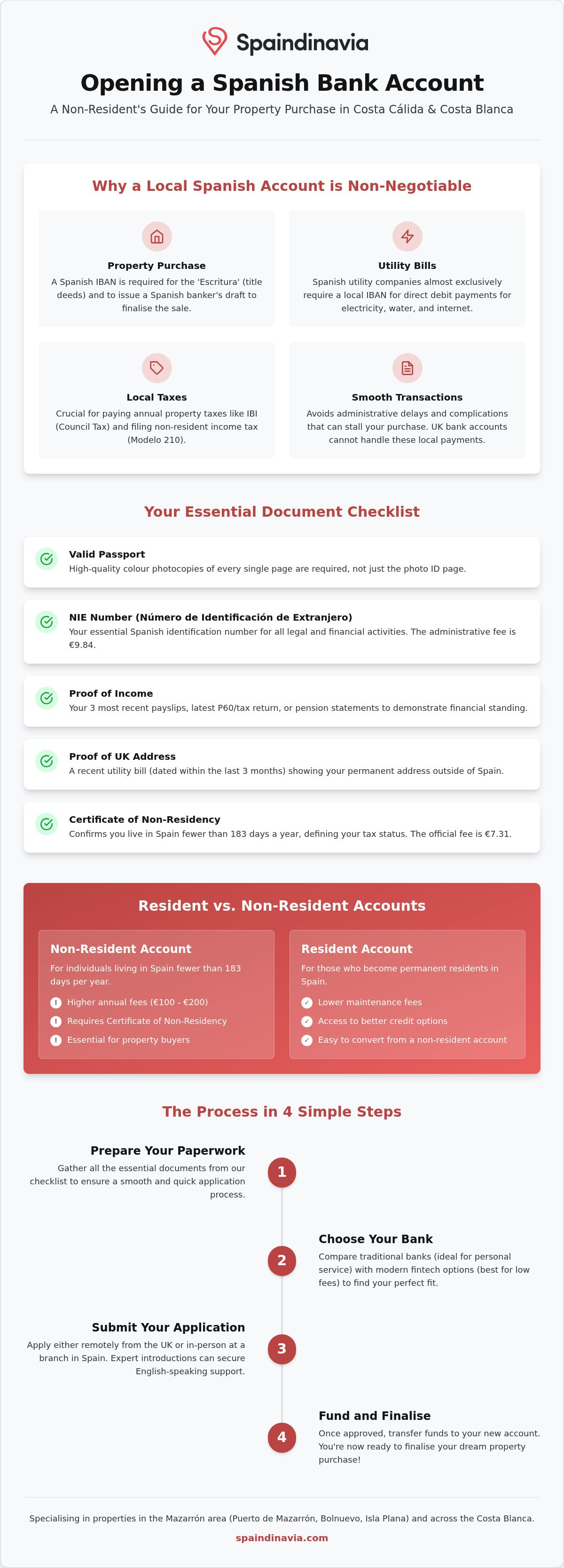
- Learn why a local account is essential for buying property in the Costa Cálida (Murcia) and Costa Blanca (Valencia), as UK banks often cannot handle Spanish utility or tax payments.
- Master the process of opening a spanish bank account for non residents by organising your NIE and passport colour copies before you begin your property journey.
- Compare traditional Spanish banks with modern fintech options to find the most cost-effective solution for your lifestyle in Bolnuevo or the Costa Blanca.
- Discover the simple steps to apply for your account either remotely or in person, ensuring your funds are ready for a villa purchase in Puerto de Mazarrón or the Costa Blanca.
- Understand how expert introductions to English-speaking bank managers in Isla Plana or the Costa Blanca can simplify your transaction and provide long-term security.
Why Opening a Spanish Bank Account is Vital for Non-Residents
Securing your dream home in the sun is an exhilarating journey, yet it requires a solid financial foundation. A non-resident account, known locally as a Cuenta para no residentes, is a specific banking product designed for individuals who live in Spain for fewer than 183 days per year. It's more than just a place to store your Euros; it's a regulated tool overseen by the Bank of Spain to ensure your transactions are transparent and secure. Whilst you might have a reliable bank in the UK, opening a spanish bank account for non residents is a practical necessity for anyone serious about property ownership in the Costa Cálida or the Costa Blanca.
International accounts often lack the specific features required to manage a Spanish property. From the initial deposit to the final completion of a new build villa in Bolnuevo, having a local presence simplifies every step. It's the only way to guarantee that your purchase proceeds without administrative hiccups that could delay your move to the Mediterranean coast.
The Necessity of a Spanish IBAN
Spanish utility companies are notoriously specific about how they collect payments. Whether you're setting up electricity for a villa in Isla Plana or water for an apartment on the Costa Blanca, providers almost exclusively require a Spanish IBAN for direct debits. Without one, you'll struggle to keep the lights on or the water running. Beyond utilities, your account is essential for the "Escritura" (title deeds) signing at the notary. Most transactions require a Spanish banker's draft to finalise the sale. Additionally, you'll need this account to pay your annual IBI (Council Tax) and manage Modelo 210, which is the non-resident income tax all foreign owners must file. Opening a spanish bank account for non residents ensures these recurring costs are handled automatically, leaving you free to enjoy the beaches of La Azohia.
Resident vs. Non-Resident Accounts: The Key Differences
There are distinct differences between these account types that you should understand before you begin. Non-resident accounts typically carry higher maintenance fees than resident ones, often ranging between €100 and €200 annually at traditional banks. This is partly due to the extra administrative oversight required. Banks will also ask for a "Certificate of Non-Residency" to verify your status, which is usually valid for two years. If you eventually decide to make Puerto de Mazarrón or the Costa Blanca your permanent home, you can easily convert your account to a resident status. This change often unlocks lower fees and better credit options as you become a more integrated part of the local Murcia or Valencia community.
Essential Documentation: What You Need to Organise
Organising your paperwork is the most critical step in bridging the gap between your current life and a new build villa in Isla Plana or the Costa Blanca. The process of opening a spanish bank account for non residents requires a specific set of documents that prove both your identity and your financial standing. Spanish banks have become increasingly diligent in 2026, so arriving prepared will save you significant time and stress.
Your first priority is a valid passport. Banks require high-quality colour photocopies of every page, not just the photo ID. Alongside this, your NIE (Número de Identificación de Extranjero) is your golden key. This foreigner's identification number is essential for all financial and legal activities in Spain; you cannot complete a property purchase in Bolnuevo or La Azohia without it. As of May 2026, the administrative fee for an NIE is €9.84, and it's best to secure this as early as possible.
To satisfy anti-money laundering regulations, you must also provide proof of income. This typically includes your three most recent payslips, your latest P60 or tax return, or pension statements if you are retired. Banks also require a recent utility bill from your UK home, dated within the last three months, to verify your permanent address. If you're feeling unsure about where to start, our team at Spaindinavia can provide the local expertise needed to get your files in order.
The Certificate of Non-Residency
A specific requirement for these accounts is the Certificado de No Residente. This document confirms to the bank that you don't live in Spain for more than 183 days a year, which dictates your tax status. The official fee for this certificate is €7.31. Whilst you can apply for this at a police station, many banks in the Mazarrón area will organise this on your behalf for a small administrative fee. Most banks require a fresh certificate every two years to maintain your account status. When researching the best banks for non-residents in Spain, you'll find that this requirement is a standard safeguard across the industry.
Preparing Your Paperwork for 2026 Standards
Whilst opening a spanish bank account for non residents is straightforward when prepared, you must ensure your documents meet current standards. Most banks now prefer digital PDF copies for their initial review, but they will still insist on seeing original documents during an in-person visit. If your documents are only in English, some banks may request a sworn translation into Spanish. Using our Buying Property in Spain Guide will help you align these banking requirements with the rest of your purchase timeline, ensuring nothing is left to chance in the Costa Cálida or the Costa Blanca.
Traditional Banks vs Fintech: Choosing the Right Fit
Deciding where to place your funds is a pivotal choice when opening a spanish bank account for non residents. Spain's banking sector is led by giants like Banco Santander, CaixaBank, and Banco Sabadell, all of which have a significant presence across both the Costa Cálida and the Costa Blanca. Whilst digital-first fintech options like Wise or Revolut have grown in popularity for their ease of use, traditional banks still provide the specific financial tools required for high-value property transactions. Finding a balance between modern convenience and traditional reliability is key to a stress-free purchase.
Fees vary significantly amongst these institutions, so it's vital to compare the costs of maintenance and transfers. For instance, the Sabadell Key Account for non-residents carries a maintenance fee of €13.33 per month, whilst CaixaBank's HolaBank account is priced at €11.67 per month. In contrast, Santander offers a non-resident account with no monthly maintenance fees that can even be opened online. Choosing a bank with a physical branch in Puerto de Mazarrón or your chosen town on the Costa Blanca ensures you have a local point of contact for more complex financial queries.
Why Traditional Banks Win for Property Buyers
Traditional institutions remain the gold standard for anyone purchasing a new build villa or a resale apartment. The primary reason is the "Banker’s Draft". In Spain, the final signing of the deeds at the Notary almost always requires a physical, guaranteed cheque issued by a Spanish bank. Most fintech platforms simply cannot provide this essential document. Additionally, if you're seeking a mortgage for your property in Bolnuevo or Isla Plana, traditional banks are your only realistic route. They offer dedicated, English-speaking managers who understand the nuances of non-resident lending, providing a layer of security and personal service that an automated app cannot match.
Fintech as a Supporting Tool
Fintech platforms are excellent companions to a traditional account. They're perfect for day-to-day spending whilst you're exploring the local coast or dining in La Azohia. Using these services allows you to avoid the less favourable exchange rates often found at high-street banks when transferring your initial funds from the UK. However, these tools have clear limitations. They're often not accepted for certain local tax payments or by Notaries during the final stages of property completions. A "two-layer" strategy is often the smartest approach; use a traditional bank for your property purchase and utility direct debits, and a fintech account for your daily holiday expenses and smaller transfers.
Step-by-Step: How to Open Your Account in 2026
Opening a spanish bank account for non residents in 2026 is a structured process that rewards the well-prepared. Whilst digital tools have improved, the journey still requires a blend of modern tech and traditional verification. Whether you're exploring the rugged beauty of Bolnuevo or the vibrant residential hubs of the Costa Blanca, following these steps ensures your funds are ready when your dream property is.
- Step 1: Select your branch. Look for banks with a strong presence in the Murcia or Valencia regions to ensure local support.
- Step 2: Choose your application method. Decide if you'll visit a branch in person or apply remotely through your legal representative.
- Step 3: Complete compliance checks. Submit your NIE and proof of income for "Know Your Customer" (KYC) verification.
- Step 4: Activate your digital access. Sign your contract and set up online banking to manage your funds from the UK.
- Step 5: Initial funding. Transfer enough to cover your first maintenance fees and the initial property deposit.
Opening Your Account in Person
Visiting a branch in Puerto de Mazarrón or along the Costa Blanca is often the most efficient route. It allows you to build a personal relationship with your bank manager, which is invaluable for future mortgage applications. You should always book a Cita Previa (appointment) in advance; this guarantees that an English-speaking clerk is available to assist you. In-person activation is usually instant, meaning you walk out with your IBAN ready to use. If you're currently planning a viewing trip, contact us at Spaindinavia to arrange introductions with local bank managers in the Mazarrón area.
Remote Applications from the UK
If you can't travel to Spain immediately, you can still manage the process of opening a spanish bank account for non residents from home. Many buyers choose to grant a Power of Attorney (Poder) to their solicitor, allowing them to sign the banking contracts on their behalf. Whilst some banks like Santander now offer digital onboarding, be aware that these systems sometimes struggle with non-Spanish phone numbers or a lack of a digital signature. In these cases, your solicitor becomes your most vital asset; they ensure your paperwork is physically submitted and verified without you needing to leave the UK.
Beyond the Bank: Securing Your Dream Home in Spain
Once you've handled the logistics of opening a spanish bank account for non residents, the real excitement begins. Your account is the engine room of your property purchase. Whether you're eyeing a new build villa in Bolnuevo or a resale apartment on the Costa Blanca, having your finances in order makes you a "preferred buyer". Developers and sellers prioritise those who can move quickly. It shows you're serious. It proves you've done the groundwork. Having your IBAN ready means you can secure a property the moment you find "the one" during a viewing trip.
At Spaindinavia, we act as the bridge between you, your bank, and your solicitor. We don't just find you a bungalow or townhouse; we coordinate the entire journey. Our expertise in the Mazarrón area means we know the local bank managers and solicitors who speak your language. We ensure the transaction is secure and transparent. We'll introduce you to the right people in Puerto de Mazarrón to ensure your mortgage or transfers are handled with care, providing the peace of mind you need when making such a significant life decision.
Life in the Costa Cálida and Costa Blanca
Life in the Mediterranean is about ease. With your local account, managing your holiday home whilst you're back in the UK is effortless. You can automate payments for high-speed internet, garden maintenance, or pool cleaning. Imagine returning to your villa in La Azohia or Isla Plana, knowing everything is ready for you. You get to enjoy those 320 days of annual sunshine without chasing administrative loose ends. The difference between the Costa Cálida and the Costa Blanca often comes down to the pace of life; both offer incredible beauty, but our heart remains in the tranquil bays of Murcia.
Your Professional Partners at Spaindinavia
Our commitment is to a transparent and stress-free buying process. We've spent years building a hand-picked portfolio of luxury new builds and resale properties that meet our high standards. By choosing to work with Spaindinavia, you're gaining a partner who cares about your whole journey. We help you navigate the paperwork so you can focus on the lifestyle. We're here to guide you through every step, from the first inspiration to the moment you turn the key in your new home. Your Mediterranean lifestyle is closer than you think. Let's make it a reality together.
Take the First Step Toward Your Mediterranean Lifestyle
Your path to owning a stunning new build villa in Bolnuevo or a modern apartment on the Costa Blanca is now clear. By successfully opening a spanish bank account for non residents, you've secured the financial foundation required for a seamless property purchase. You now understand that whilst fintech offers convenience for daily spending in Puerto de Mazarrón, a traditional Spanish bank provides the essential security and specific tools, such as banker's drafts, needed for a successful completion.
Organising your NIE and income proof early ensures you're treated as a preferred buyer by developers across the Murcia and Valencia regions. At Spaindinavia, we're proud to be your local experts, offering a trusted network of bank managers and solicitors to guide you through every legal and financial step. We don't just find you a property; we ensure your entire transition to the sun is handled with care and professional expertise.
Find your dream new build villa in the Costa Cálida with Spaindinavia and take the first step towards your new lifestyle today. The 320 days of annual sunshine are waiting for you.
Frequently Asked Questions
Can I open a Spanish bank account for non-residents online?
Yes, several major banks like Santander and Sabadell allow you to start the process of opening a spanish bank account for non residents online in 2026. However, you should be prepared for potential digital hurdles, such as requiring a Spanish mobile number for SMS verification. Whilst the initial application is digital, many traditional branches in the Costa Cálida or Costa Blanca may still require a physical signature to fully activate the account.
How much does it cost to maintain a non-resident bank account in Spain?
Maintenance fees for non-resident accounts typically range from €100 to €200 per year at traditional institutions. In 2026, Sabadell’s Key Account costs €13.33 monthly, whilst CaixaBank’s HolaBank account is €11.67 per month. Santander currently offers a non-resident account with no monthly maintenance fees. It's vital to check the specific terms for accounts in the Mazarrón area, as fees can vary based on the bundled services or insurance products you choose.
Do I need a Spanish NIE number to open a bank account?
Whilst some banks may technically allow you to open an account with just a passport, a Spanish NIE number is practically essential for any property buyer. You'll need this identification number for almost every financial transaction in Puerto de Mazarrón or the Costa Blanca, including paying taxes and signing deeds. Most banks will ask for your NIE within a few weeks of opening the account to ensure compliance with national financial regulations.
Which Spanish banks are best for British expats in 2026?
Sabadell and CaixaBank remain popular choices for British expats due to their extensive branch networks and dedicated English-speaking staff in coastal regions. Santander is also a strong contender with its digital-friendly, low-fee options. For those buying in Isla Plana or Bolnuevo, Sabadell is often favoured for its specialised "Key Account" designed for international residents. Always look for a bank with a physical branch near your property to ensure easy access to banker's drafts.
Is my money safe in a Spanish bank account?
Yes, your funds are highly secure. Spanish banks are regulated by the Bank of Spain and are part of the European Union's deposit guarantee scheme. This means that in the unlikely event of a bank failure, your deposits are protected up to €100,000 per person, per institution. This level of protection provides peace of mind for buyers transferring large sums for new build villas in La Azohia or properties across the wider Costa Blanca.
Can I use my UK bank account to pay Spanish property taxes?
It's rarely possible to use a UK bank account for recurring Spanish property taxes like IBI or utility bills. Most Spanish service providers and local town halls in the Murcia and Valencia regions require a Spanish IBAN for SEPA direct debit mandates. Opening a spanish bank account for non residents ensures these essential payments are automated, preventing service disconnections or late payment penalties whilst you are away from your home in Mazarrón.
How long does it take to open a non-resident account?
If you visit a branch in person in Puerto de Mazarrón or the Costa Blanca, you can often walk out with an active IBAN on the same day. However, if you are applying remotely from the UK using a Power of Attorney, the process typically takes between one and four weeks. This timeline accounts for document verification, compliance checks, and the physical mailing of contracts if a digital signature isn't available at that specific branch.
What is a Certificate of Non-Residency and how do I get one?
A Certificate of Non-Residency is an official document confirming you don't reside in Spain for more than 183 days a year. It's required by banks to determine your tax status and account type. You can obtain one from a National Police station for a fee of €7.31, but most banks in the Costa Cálida and Costa Blanca will conveniently organise this for you. They usually require a fresh certificate every two years to maintain your status.


