

A holiday can make every Spanish town feel like the right place to buy. To learn how to test-drive living in Spain before buying, spend time in your shortlisted areas and experience ordinary routines, not just the sunshine and seafront. If you’re visiting from outside the Schengen Area, including the USA, standard tourist rules generally allow a stay of up to 90 days within any 180-day period. Visitors from Sweden, Norway, Poland, Germany, the Netherlands, Belgium and France can also plan a trial stay to experience daily life before buying.
It’s sensible to compare the feel of a place in daily life before making a property decision. Look at transport, local facilities, the pace of the neighbourhood and how it feels outside the holiday season. On the Costa Cálida in the Murcia region, focus your visit on the Mazarrón area, including Puerto de Mazarrón, Isla Plana, La Azohía and Bolnuevo. Compare it with the Costa Blanca in the Valencia region to see which setting better suits your routines and plans.
This guide explains how to plan a realistic trial stay, compare locations and understand permitted stays and residency considerations before buying. You’ll have a clearer framework for assessing where you could feel at home and what to consider before moving from a visit to a property search.
Key Takeaways
- Compare everyday life in the Costa Cálida, in the Murcia region, with the Costa Blanca, in the Valencia region. On the Costa Cálida, explore Puerto de Mazarrón, Isla Plana, La Azohía and Bolnuevo.
- Plan a trial stay around ordinary routines, such as getting about, finding local services and experiencing different neighbourhoods beyond a holiday setting.
- For Americans and visitors from Sweden, Norway, Poland, Germany, the Netherlands, Belgium and France without Spanish residency, standard tourist rules allow a stay of up to 90 days within any 180-day period, according to Spain’s Ministry of Foreign Affairs, European Union and Cooperation.
- Compare the costs and practicalities of a furnished rental with the ongoing considerations of buying before deciding which option suits your plans.
- Consider how your daily needs, transport choices and plans for a longer stay could shape where you look for a home.
Property search and choosing a location
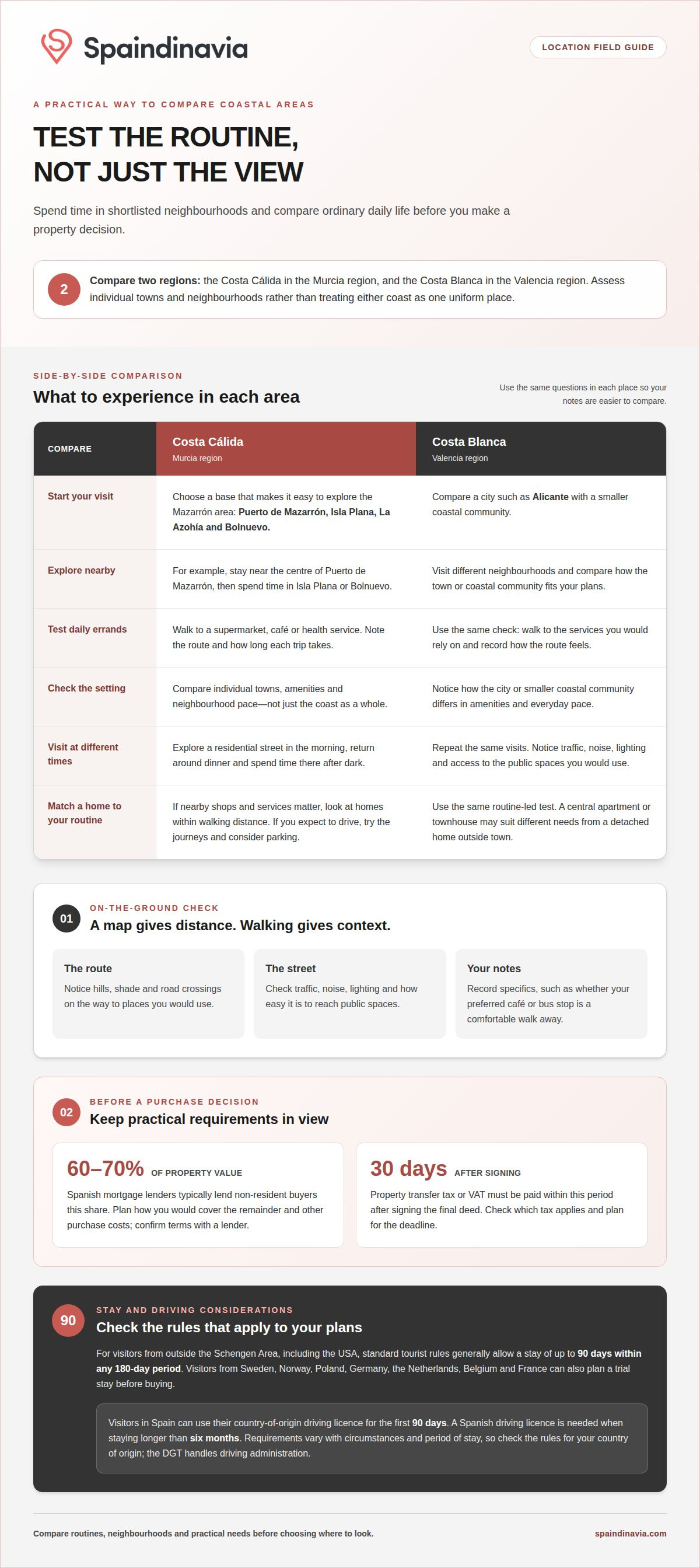
- Start with the daily life you want, then compare two coastal regions. The Costa Cálida is in the Murcia region; focus your visit around Mazarrón, including Puerto de Mazarrón, Isla Plana, La Azohía and Bolnuevo. Compare these with the Costa Blanca in the Valencia region. Rather than treating either coast as one uniform place, note differences between individual towns, their amenities and their pace. Your shortlist should reflect how you want to spend an ordinary weekday.
- Choose a base in each area that makes it easy to explore nearby neighbourhoods. For example, stay near the centre of Puerto de Mazarrón, then spend time in Isla Plana or Bolnuevo. On the Costa Blanca, compare a city such as Alicante with a smaller coastal community. Walk to a supermarket, café or health service and note how long each trip takes. A map shows distance, but walking the route reveals hills, shade and road crossings.
- Visit each neighbourhood at different times of day. Explore a residential street in the morning, return around dinner and spend time there after dark. Notice traffic, noise, lighting and how easily you can reach the public spaces you’d use. A street close to a lively seafront may feel very different from one a few blocks inland. Record specific details, such as whether your preferred café or bus stop is within a comfortable walk.
- Match your property search to the routines you’ve experienced. If you rely on nearby shops and services, prioritise homes within walking distance. If you expect to drive, try the journeys to your usual destinations and consider parking. A townhouse or apartment in a central area may suit different routines from a detached home outside town. Treat these as questions to assess during your stay, not assumptions about every Spanish property.
- Include transport documents and permitted stays in your location decision. Visitors in Spain can use their country-of-origin driving licence for the first 90 days. A Spanish driving licence is needed when staying longer than six months. Rules vary with your circumstances and period of stay, so research the relevant requirements before relying on a car. The Dirección General de Tráfico (DGT) handles driving administration; a required certificate or document can affect your plans. Check the driving-licence rules that apply to your country of origin and circumstances.
Before settling on a home, check that its likely purchase price fits your available funds and the financing you may qualify for. Mortgage lenders in Spain typically lend non-resident buyers 60-70% of the property value, so consider how you would cover the remainder as well as other purchase costs. Treat this as a planning point, not a promise of a particular offer: confirm the terms with a lender before making your location choice depend on borrowing. Comparing the costs of homes in different neighbourhoods can help you keep your shortlist realistic.
Allow for the payment deadline as part of your purchase planning. In Spain, property transfer tax or VAT must be paid within 30 days of signing the final deed. Make sure you understand which tax applies to the property you are considering and have funds available for the deadline. Include this timing in your decision about when to proceed, so that choosing a preferred area and property is supported by a workable budget and payment plan.
Cost to rent a furnished flat in Spain for 1-3 months
- Build a like-for-like budget before comparing rentals. A furnished flat’s total cost can depend on its location, size, booking dates, length of stay and included services. Compare a one-bedroom flat near the centre of Puerto de Mazarrón with one further inland, then repeat the exercise in a Costa Blanca town. Keep the dates and household needs consistent. That makes differences between options easier to understand than comparing unrelated listings.
- Check what the quoted rent includes. For each flat, note whether electricity, water, internet, cleaning or other charges are covered, and whether any costs are calculated separately. A lower headline rent may not mean a lower total if essentials are billed in addition. Ask for the full amount payable for your chosen period and record any separate charges alongside it. This gives you a clearer basis for comparing furnished stays.
- Compare the actual dates, not just the town names. A flat in Bolnuevo during a popular holiday period may have different rental terms from the same area at another time. Compare the same dates across Puerto de Mazarrón, Isla Plana and La Azohía, then contrast those options with a Costa Blanca location. Record the stay’s start and end dates, total charge and inclusions. Keep the booking conditions beside each figure.
- Choose a property that lets you test the routines you care about. A compact flat near shops can help you assess life without frequent car journeys, while a home outside the centre shows how practical that location feels. Note how many bedrooms, storage, kitchen facilities and workspace you need. For example, someone working remotely may value a separate desk area more than a larger balcony. Compare furnished apartments against these priorities, not appearance alone.
- Set a spending limit for the whole trial stay, not only accommodation. Add your chosen rental total to everyday expenses such as food, local transport and activities, using your own expected routine. If the experience strengthens your plans, compare the type of home that suits you with available resale and new-build apartments. A short stay can clarify which features matter before you begin considering a purchase.
What practical steps help test daily life in Spain, such as public transport, neighbourhoods, and local services?
- Plan an ordinary weekday in Puerto de Mazarrón without relying on holiday activities. Walk from your accommodation to a supermarket, pharmacy and café, noting the route, shade and crossings. Repeat the routine in Isla Plana, La Azohía or Bolnuevo if you’re considering those parts of the Costa Cálida. These everyday errands help you understand how to test drive living in Spain before buying, beyond your first impression of a place.
- Try the public transport you’d genuinely use in your shortlisted area. Find a route to a regular destination, such as a shopping area or local service, and travel at the time you expect to go. Note where you board, how easy it is to find the stop, and how the journey fits your day. Then compare with a Costa Blanca town in the Valencia region, where your location and routine may make different transport options more practical.
- Visit a neighbourhood at different times of day. Explore a residential street near the coast in the morning, return in the evening and see how it feels after dark. Notice traffic, lighting, noise and activity around cafés or public spaces. In Puerto de Mazarrón, a street close to the seafront may have a different daily rhythm from one farther inland. Write down specific observations rather than relying only on a first impression.
- Practise the errands that shape your week. Find a grocery shop, pharmacy, healthcare facility and post office near your accommodation, then try reaching each one. If you work remotely, spend a normal working day assessing your workspace, internet connection and background noise. If you have children, consider the routes you’d need for school and activities. These practical tests help you understand how to test drive living in Spain before buying in a way that reflects your household’s needs.
- Keep a simple daily log for each area you visit. Record where you went, how you travelled, what felt convenient and what required extra planning. Compare Puerto de Mazarrón, Isla Plana, La Azohía and Bolnuevo with Costa Blanca locations. Include details such as carrying shopping uphill or having services within an easy walk. Reviewing your notes after the visits can help distinguish a place suited to everyday life from one that mainly appealed as a holiday destination.
Renting vs buying costs in popular Spanish cities
- Compare similar homes in the same city before weighing rent against buying. These figures give a city-centre comparison, not a complete budget for every neighbourhood. Property type, condition and exact location also shape the options you consider.
- Use a trial rental to understand the lifestyle behind the figures. Compare its urban setting with Alicante on the Costa Blanca, in the Valencia region, and the Mazarrón area on the Costa Cálida, in the Murcia region. Rental costs depend on the property, dates, length of stay and included expenses. Record the total for your intended stay alongside the location and home features.
- Include purchase taxes and transaction costs when estimating a buying budget. Spain’s property transfer tax on resale properties ranges from 6% to 10%. New-construction purchases have 10% VAT and stamp duty ranging from 1.2% to 1.5%. Legal fees and notary costs are listed at 1% to 2%. These costs sit alongside the property price, so compare the complete purchase budget with your rental plan.
- Compare like with like across different Spanish locations. A city-centre figure won’t tell you what a coastal home costs in Puerto de Mazarrón, Isla Plana, La Azohía or Bolnuevo. Compare properties with similar size, condition and access to services.
- Use your trial stay to decide which costs fit your plans. Renting lets you experience a location without committing to a purchase, while buying adds purchase taxes and transaction costs to the budget. List your expected stay, preferred property features and likely use of local services. Then compare rental totals with the full cost of buying in your shortlisted area. A town-centre apartment and a home outside town support different routines, even within the same region.
What should Americans know about opening a bank account, getting a SIM card, and driving in Spain during a trial stay?
- Plan how you’ll manage everyday payments during your stay in Spain. List planned expenses, such as accommodation, groceries and transport, then decide which you’ll pay by card and which may need another method. Review your US bank’s guidance on using your card abroad, including any charges and security steps it describes. Keep a record of transactions in one place. This gives you a realistic picture of routine spending in Puerto de Mazarrón or Alicante.
- Choose a SIM approach based on the places you’ll visit. Before travelling, compare options for your US phone and consider how you’ll use calls, messages and mobile data. During your stay, test reception at your accommodation, along your usual routes and in places such as Bolnuevo or Isla Plana. A connection that works in central Alicante may feel different at a coastal address. Remember to maintain access to your US number for account sign-ins.
- Plan a full day using your phone as you would at home. Use maps to find a pharmacy, grocery shop and transport stop near your accommodation, then check whether mobile data works where you need it. Save essential addresses and booking details somewhere accessible. If you’re staying around La Azohía, compare the signal and route information there with Puerto de Mazarrón. These small tests reveal whether your communication setup suits your intended location.
- Check your driving documents against the length and purpose of your visit. Visitors in Spain can use their country-of-origin driving licence for the first 90 days. It also says a Spanish driving licence is needed when staying longer than six months. For Americans planning a longer stay, understand the requirements that apply to their circumstances before relying on a US licence. Keep the dates of your visit and relevant documents together.
- Make insurance a condition of any drive, including a test drive. Drivers in Spain must have valid insurance before driving a car on public roads, including during a test drive. If you use a hired or borrowed vehicle, establish that the cover applies to you and the journey before setting off. Plan a familiar route first, such as between Puerto de Mazarrón and a nearby service. Once daily life and location feel clearer, explore property options for your next step.
The author also said Spain did not recognise U.S. driver’s licenses at the time she described obtaining a Spanish license. Treat this as an account of her experience, not as a substitute for checking what applies to your own visit.
Before making driving part of a trial stay, list the licence documents you hold and the questions you need answered, then verify the applicable process before planning to drive. Include the assessment cost in your planning notes, alongside insurance confirmation and your visit dates. This separates a licensing step from the decision to test a route.
Spaindinavia
Spaindinavia can help you move from exploring Spanish locations to considering homes that suit your plans. Once you’ve compared daily life in the Costa Cálida, in the Murcia region, and the Costa Blanca, in the Valencia region, your observations can guide a more focused property search. Around Mazarrón, include Puerto de Mazarrón, Isla Plana, La Azohía and Bolnuevo in your location notes.
Consider how your preferred setting and routines fit different property types. Spaindinavia offers new-build villas, resale apartments, townhouses and bungalows. Your trial stay can help you clarify which features matter, from the feel of the neighbourhood to the kind of home you have in mind.
When you’re ready to discuss your property search, contact Spaindinavia.
Turn your Spanish plans into a confident next step
Use your next visit to answer a personal question: which place supports the life you want, not just the holiday you enjoyed? The most useful way to learn how to test-drive living in Spain before buying is to arrive with a few priorities and leave room for unexpected discoveries. You might value a quieter setting, a lively town centre or easy access to everyday services. Let those preferences guide your shortlist rather than feeling you need to decide everything at once.
Once your preferred area and home style are clearer, you can start a focused property conversation. Spaindinavia can help you explore suitable homes and take the next step at a pace that feels right for you. Whether Spain is a long-held dream or a newer idea, a considered plan can turn inspiration into a practical path forward.
Contact Spaindinavia to plan your move and take your next step towards life in Spain.
Frequently Asked Questions
Which Spanish cities and regions are best for a trial stay based on climate, cost, and expat services?
There’s no single best choice: the Costa Blanca offers vibrant areas and a larger selection, while the Costa Cálida offers a more relaxed lifestyle and value for money. Compare a Costa Blanca town with Puerto de Mazarrón, using your priorities for climate, spending and services. During your stay, assess how easily you can access practical support, such as healthcare, transport and everyday services.


