

A house on rustic land isn’t automatically legal simply because it already exists. The main risks when buying a property on rustic land (suelo rústico) include unauthorised buildings or extensions, restrictions tied to the land’s designation, and limited utility access. Rustic land falls outside the local council’s approved development plan, so the land itself does not carry building permission. Check the property’s status against municipal licences, approved plans and official records.
The appeal is easy to understand: more space, a quieter setting and a different pace of life in Spain. Before picturing your life in the finished home, however, establish what the land allows and whether the buildings and services suit your plans.
This guide explains how to assess building legality, understand land classifications and designations, and evaluate practical options for water, electricity and wastewater. It also explains why rules vary by location and what to examine before committing to a rural property.
Key Takeaways
- Compare the property’s licences and approved plans with its actual buildings, including any extensions or outbuildings.
- Find out how the land is designated: protected status can affect whether unauthorised construction may face demolition.
- Understand how rustic and urban land differ, and why the local planning framework matters to what you can do with a property.
- Explore the property’s practical utility arrangements, including whether it relies on mains connections or off-grid systems.
- Look beyond the property boundary: documented access and water-use rights can matter just as much as the land and buildings themselves.
How do I know if outbuildings or extensions are legal on rustic land?
In Spain, rustic land falls outside the local council’s approved development plan and does not itself carry building permission. Before buying, check the land classification and compare each structure with municipal licences, approved plans and official records.
Checking Land Classification and Building Legality
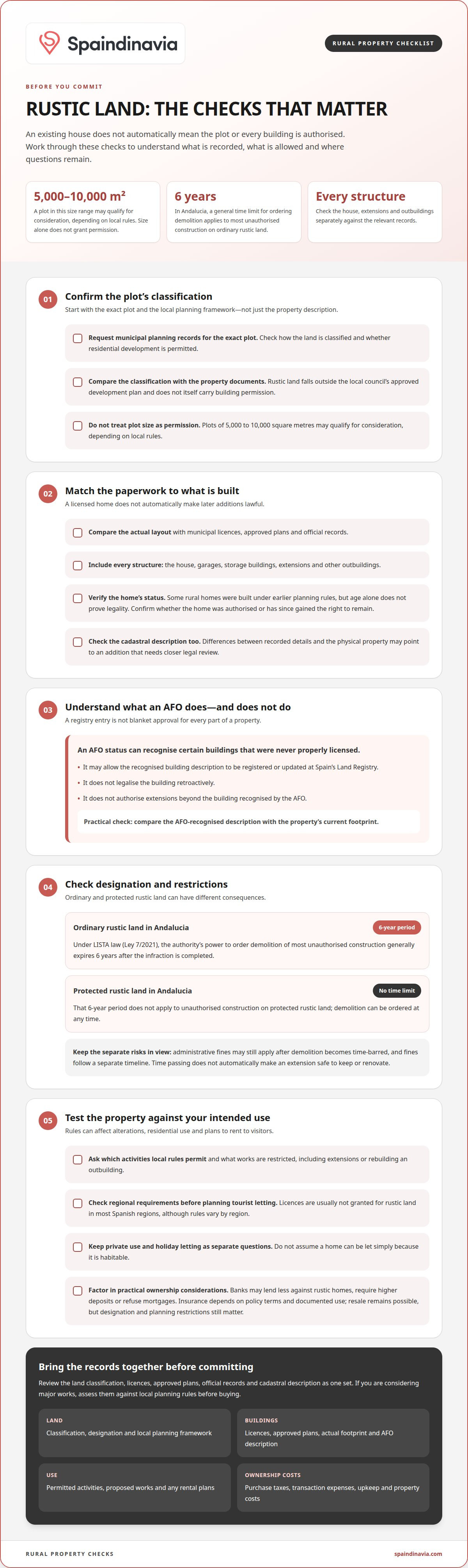
Land classification identifies how a plot may be used and whether residential development is permitted. Ask for the municipal planning records for the exact plot, then compare its classification with the property documents. In Spain, a rustic plot’s size alone doesn’t grant permission: plots of 5,000 to 10,000 square metres may qualify for consideration, depending on local rules. This distinction helps you assess the site before committing.
Legal Status of Homes and Outbuildings
A home or outbuilding is legally established when its status matches the relevant licences, approved plans and official records. Compare the documented layout with the buildings on the ground, including garages, storage buildings and extensions. Some rural homes were built under earlier planning rules, but age alone doesn’t prove legality. Confirm whether the house was authorised or has since gained the right to remain.
Urban land has a different planning status: it is designated for development, and building is permitted under the applicable rules. Planning permissions and building licences for urban homes can generally be checked against official records. A rustic property, by contrast, may contain a house or later additions that lack permission. Assess every structure separately: a licensed home doesn’t automatically make an unrecorded extension lawful.
An AFO status can recognise certain buildings that were never properly licensed, but it doesn’t legalise them retroactively. It may allow the existing building’s description to be registered or updated at Spain’s Land Registry. It doesn’t authorise extensions beyond the building recognised by the AFO. Compare that recognised description with the property’s current footprint, rather than assuming a registry entry approves every room or outbuilding.
When estimating the cost of buying a rural property, account for purchase taxes and transaction expenses, as well as ongoing upkeep and property costs. The amounts depend on the transaction and the property’s condition, services and intended use.
Before paying for an isolated finca, bring together the land classification, licences, approved plans, official records and cadastral description. Differences between the recorded and physical property can point to an extension or outbuilding that needs closer legal review. If you plan major works, assess them against local planning rules before buying. These checks give you a clearer basis for deciding whether the property suits your intended use.
Building restrictions on rustic land
Rustic land is generally intended for agricultural, rural or environmental use, rather than residential development. Restrictions can affect construction, renovations, property use and future plans, so understand the local rules that apply to the plot.
Building and Renovation Limits
Building and renovation limits are planning rules that determine which works are allowed on a rustic plot. They matter because having an existing home doesn’t automatically give you permission to extend it or change its use.
In Andalucia, the LISTA law is Ley 7/2021. On ordinary rustic land, the authority’s power to order demolition of most unauthorised construction generally expires 6 years after the infraction is completed. That period doesn’t apply to unauthorised construction on protected rustic land, where demolition can be ordered at any time.
Time passing doesn’t remove every consequence. In Andalucia, administrative fines for unauthorised construction may still apply after demolition becomes time-barred; the fines follow a separate timeline. A long-standing extension therefore isn’t automatically safe to keep or renovate. Before planning works, establish whether the land is protected, the existing building’s status, and which local rules govern the proposed changes.
Local Rules for Property Use
Local use rules specify the activities permitted on a plot, including whether residential use or tourist letting is allowed. These rules matter if you plan to live in the property, make alterations or earn income from holiday guests.
Tourist rental licences are usually not granted for rustic land in most Spanish regions, although rules vary by region. In most regions, licences are available only for urban land, with some regional variations. Any rental plan therefore needs to account for the land designation and regional requirements. Don’t assume a home can be let simply because it is habitable.
Can rustic land be mortgaged, insured, rented or resold? Banks may lend less against rustic homes, require higher deposits or refuse mortgages altogether. Renting depends on regional rules and the required tourist licence; insurance depends on the policy terms and the property’s documented use. A rustic property can be resold, but its designation and planning restrictions remain relevant to the next buyer.
For a specific plot, consider four separate questions: is it ordinary or protected rustic land, what uses do local rules allow, what works are restricted, and can the intended use be licensed? For example, a rural home for private use raises different planning questions from one intended for holiday letting. Keep these aims distinct when assessing a purchase.
Restrictions can shape a property’s practical value as much as its setting. Plans to add rooms, rebuild an outbuilding or rent to visitors may be affected by different rules. Assess each proposed use or renovation separately, and understand the land designation before making decisions based on future development.
Differences between rustic and urban land in Spain
In Spain, a plot’s classification shapes its intended use, development potential and access to services. Distinguish urban land from rustic land before reviewing a property’s paperwork or considering future plans.
Spanish Land Classifications
Urban land is designated by the local town hall for residential development, while rustic land is intended for agricultural, rural or environmental use. This distinction matters because a house’s setting alone doesn’t show what the plot legally allows. Building on urban land is permitted subject to applicable planning rules; rustic land falls outside the relevant town hall’s approved development plan and does not carry building permission.
Consider the difference between a residential plot within an approved development plan and a rural holding intended for agricultural use. Existing buildings don’t change the land classification. Assess a rural property according to its designation, not merely its appearance or proximity to other homes.
Paperwork for Urban and Rustic Property
Urban property paperwork commonly includes planning permissions, building licences and registrations that are relatively straightforward to verify. Urban homes typically have a First Occupancy Licence or Cédula de Habitabilidad, alongside legal utility connections. These records help establish the dwelling’s status, although requirements and circumstances can differ between areas and properties.
Rustic property paperwork needs closer comparison between the land designation, official records and the property being sold. Land Registry and Cadastral maps for rural properties may not match each other or the physical boundaries. For most older Spanish properties, updating Land Registry paperwork isn’t a legal requirement, but mismatches still matter when establishing the property’s recorded description.
Reclassification isn’t a simple change of label. Rustic land needs a development plan drawn up and officially approved before it can be reclassified as urban. Don’t treat a nearby urbanisation, a new road or a seller’s expectation as evidence that this process has happened. The approved plan is decisive.
Services also differ. Urban properties generally have mains sewerage, although some urbanisations may not. Rustic land cannot have a legal supply of basic services such as drainage, roads, pavements, electricity and water. Rural properties may rely on alternatives, but the land classification affects which services can be legally supplied.
Use the classification to frame your questions about a property in Spain. If you need residential development, establish whether the plot is urban and falls within the relevant approved plan. If you’re considering rustic land, assess it as agricultural, rural or environmental land rather than assuming residential development is permitted. This distinction helps you judge whether the property and its paperwork match your intended use.
Electricity and off-grid infrastructure
Electricity arrangements on rural properties in Spain vary: some country homes have mains supply, while some off-grid areas require solar systems. This affects daily comfort and the practical work needed to run a home. Assess electricity alongside water and wastewater; don’t assume that a rural setting means services are ready.
First establish how the property currently receives electricity. A mains connection and an off-grid arrangement involve different infrastructure and practical considerations. For an off-grid home, identify the systems in place and how they support everyday needs such as lighting, refrigeration and heating. Consider whether these arrangements suit your lifestyle, including how often you plan to occupy the property.
Utility status is also linked to building legality. In Spain, providers commonly refuse mains water, electricity and formal sewage connections to rustic-land buildings without a valid licence or recognised legalisation or AFO status. A visible cable or pipe doesn’t by itself prove that the connection is formally recognised. Treat the building’s documented status and its service arrangements as connected parts of your assessment.
- Electricity: establish whether the home uses mains electricity or a solar system, and understand which arrangement serves the existing property.
- Water: rustic properties may use water deposits, wells or mains agricultural water instead of standard mains supply. Water-use rights for wells, springs and irrigation canals aren’t necessarily included automatically with a purchase.
- Wastewater: some rustic homes use septic tanks rather than mains sewerage. Include the wastewater arrangement when assessing the property’s services.
- Access: check that access-road rights are documented. A route used by the seller doesn’t, by itself, establish a legal right of access.
These points are useful when comparing homes with similar settings. One may have mains electricity, while another relies on a solar system; their daily arrangements and infrastructure differ. A water deposit or septic tank also affects what you need to understand about everyday use. Assess each service separately and relate it to how you plan to occupy the property.
Keep a clear record of which services are mains-connected, off-grid or dependent on documented rights. For example, a property with a well calls for clarity about both its water source and the rights attached to it. Similarly, don’t treat an existing access route as proof of documented access. These distinctions help build a realistic picture of the property before purchase.
Finally, relate the service assessment to your plans. Full-time living, occasional stays and holiday use can place different demands on electricity and other infrastructure. Compare the property’s current arrangements with your intended use, then account for any works or service changes your plans may require. A rural setting may suit your lifestyle, but the services available still shape how you can use the home.
How rustic land is designated in Spain
In Spain, land designation comes from local planning, not simply from a countryside setting or the presence of a house. The key distinction is whether the plot is urban or rustic land, and whether a protective designation affects its permitted use. For buyers, that classification shapes development potential and the property’s investment value.
Urban land is designated by the local town hall for residential development. Rustic land is intended for agricultural, rural or environmental use. Check the planning status of the specific plot rather than assuming nearby homes make it urban. A house among rural fields, for example, doesn’t change the land’s designation.
Local planning records are central to establishing that status. Identify the plot and its municipality, then find out how the approved local plan classifies it. A sales listing or cadastral map is not a substitute for the planning designation. Rural Land Registry and Cadastral maps may also differ from each other or from physical boundaries, so assess each record separately.
Protected rustic land needs particular attention. Its designation can affect whether unauthorised buildings face demolition and may restrict activities on the plot. Compare the site’s recorded classification with applicable local planning information, then consider whether your intended use is permitted. A quiet rural setting doesn’t, by itself, allow unrestricted residential or commercial use.
Reclassifying rustic land as urban requires a development plan to be drawn up and officially approved. Nearby construction, new infrastructure or rising demand doesn’t make reclassification automatic. If your investment depends on future urban status, separate that possibility from the property’s current designation. Base decisions on the approved plan in force, not a seller’s prediction or an assumed change.
The same approach applies across regions, including Costa Cálida in the Murcia region and Costa Blanca in the Valencia region. A plot near Puerto de Mazarrón, Isla Plana, La Azohía or Bolnuevo must be assessed according to its own local planning status, as must a plot on the Costa Blanca. Municipal plans and land designations are location-specific, so don’t apply assumptions from one town or region to another.
For a clear decision, keep three points distinct: the plot’s current classification, any protected status, and the uses permitted under its local plan. This helps distinguish a countryside property suited to its present use from land whose investment appeal depends on future development. Treat reclassification as a formal planning process, not an expected feature of buying rustic property in Spain.
Spaindinavia
Spaindinavia can help you explore property options in Spain after you’ve considered the planning limits, building status and utilities relevant to your decision. If rustic land’s restrictions don’t suit your plans, comparing other types of homes may help clarify what you’re looking for. Explore New Build Villas, Resale Apartments, Townhouses, Bungalows, Resale Villas and New Build Apartments as alternatives for your next step.
Keep your priorities in view, whether you want a particular setting, a home ready to enjoy or a property that suits your longer-term plans. Knowing what matters most can make your search more focused.
Contact Spaindinavia to discuss the kind of property you’re looking for.
Choose the property that fits your plans
A rural home can offer a different pace of life, but the right choice depends on how you plan to use it. Before moving forward, decide which compromises you’re comfortable with and which are deal-breakers. You may value privacy and open countryside, for example, while needing straightforward access and services for year-round living.
Keep your priorities in view as you weigh the risks of buying a property on rustic land (suelo rústico). If its limitations don’t suit your plans, broaden your search to other kinds of homes in Spain. There’s no need to rush a decision that will shape your everyday life.
If you’d like to talk through your property search and possible alternatives, get in touch with Spaindinavia. A thoughtful next step can bring your plans into clearer focus and help you move towards a home that feels right.
Frequently Asked Questions
Are water rights automatically included when I buy rural property?
No. Buying the land doesn’t automatically transfer rights to use water from a well, spring or irrigation canal. Treat water access as a separate part of the purchase: establish which source serves the property and whether the associated rights are documented and included in the sale. A seller’s history of using a well or canal doesn’t, by itself, prove that those rights pass to you.
Can I turn a rural finca into a full-time home legally?
That depends on the finca’s planning and building status, not simply on whether someone already lives there. A house intended for permanent residence needs a lawful status compatible with that use, and its service arrangements matter too. Before making a full-time move part of your plans, distinguish the land’s permitted use from the existing dwelling’s status and any administrative recognition it holds.
Is it harder to sell a finca later compared with an urban apartment?
A finca may be harder to sell if its classification, building records, access rights or water arrangements are unclear. These issues can narrow the pool of buyers, particularly where mortgage lending is more limited for rustic homes. An urban apartment may have more familiar services and paperwork, though its records still need checking. Clear documentation helps explain what the buyer will acquire.
What is a rustic property?
A rustic property is land, with or without buildings, classified for agricultural, rural or environmental use rather than ordinary residential development. Finca is a common term for a rural property, but the word doesn’t establish its legal status. A country house and its plot may both be rustic, for example, while the building’s status and permitted uses need separate consideration.
What does suelo rústico mean in Spain, and how does it differ from urban land?
Suelo rústico means rustic land: land intended for agricultural, rural or environmental use. Urban land is designated for development by the local town hall. The distinction affects whether residential development is permitted and what services are available. A home’s appearance or proximity to an urban area doesn’t change its classification; the local planning status determines it.
What can you legally build or renovate on Spanish rustic land?
There isn’t one nationwide allowance for every rustic plot. Permitted work depends on local planning rules, the land’s designation and whether it is protected. An existing house doesn’t automatically authorise an extension, replacement building or change of use. Check proposed work against the property’s planning status and approved documentation before including it in your renovation plans.
How can I verify a rustic property's zoning classification and permitted uses?
Start with the municipality where the plot is located and identify its classification in the relevant planning records. Then establish whether the land has a protected designation and what uses the applicable plan allows. Compare the plot’s identity across available records, since rural maps and physical boundaries may differ. This gives you a clearer basis for deciding whether your intended use fits the site.
What are the risks of buying an illegal house on suelo rústico in Spain?
Risks when buying a property on rustic land (suelo rústico) include enforcement action, difficulty obtaining formal utility connections and limits on future works. Unauthorised buildings on protected rustic land may be impossible to legalise and could face demolition orders. AFO status recognises certain buildings administratively, but doesn’t retrospectively legalise their construction or authorise extensions beyond the recognised building.


