
Brexit didn't just change your passport colour. It fundamentally changed your right to live in Spain. If you've been dreaming of waking up to Mediterranean sunshine on the Costa Blanca or Costa Cálida, understanding the Spanish residency requirements for UK citizens is no longer optional; it's the essential first step before anything else falls into place.
You're not alone if the whole process feels overwhelming. Between Schengen 90-day limits, financial thresholds, and a stack of official documents, it's easy to feel like the dream is buried under paperwork. That frustration is completely valid, and it's exactly why so many British buyers get stuck before they even get started.
This guide cuts through the confusion. You'll come away with a clear picture of the legal pathways available to you in 2026, the financial requirements you'll need to meet, and how aligning your residency choice with a property investment in places like Puerto de Mazarrón or the Costa Blanca can make the whole process smoother than you might expect. Let's walk through it together.
Key Takeaways
- Understanding the spanish residency requirements for uk citizens is essential in 2026, as Brexit means you're now subject to the 90/180-day Schengen rule — residency is the only legal route to staying longer.
- Two main visa pathways are available to you: the Non-Lucrative Visa for retirees living on existing income, and the Golden Visa for those investing €500,000 or more in Spanish property.
- Your choice of residency visa directly shapes where and what type of property you should be searching for — whether that's a tranquil villa in Puerto de Mazarrón or a sought-after home on the Costa Blanca.
- The application process follows a clear five-step journey, beginning at the Spanish Consulate in the UK, and knowing what to expect at each stage can save you significant time and stress.
- Aligning your property investment with the right residency route — supported by legal and local expertise — is the most effective way to turn your Spanish lifestyle dream into a secure, lasting reality.
Post-Brexit Residency in 2026: The New Reality for UK Citizens
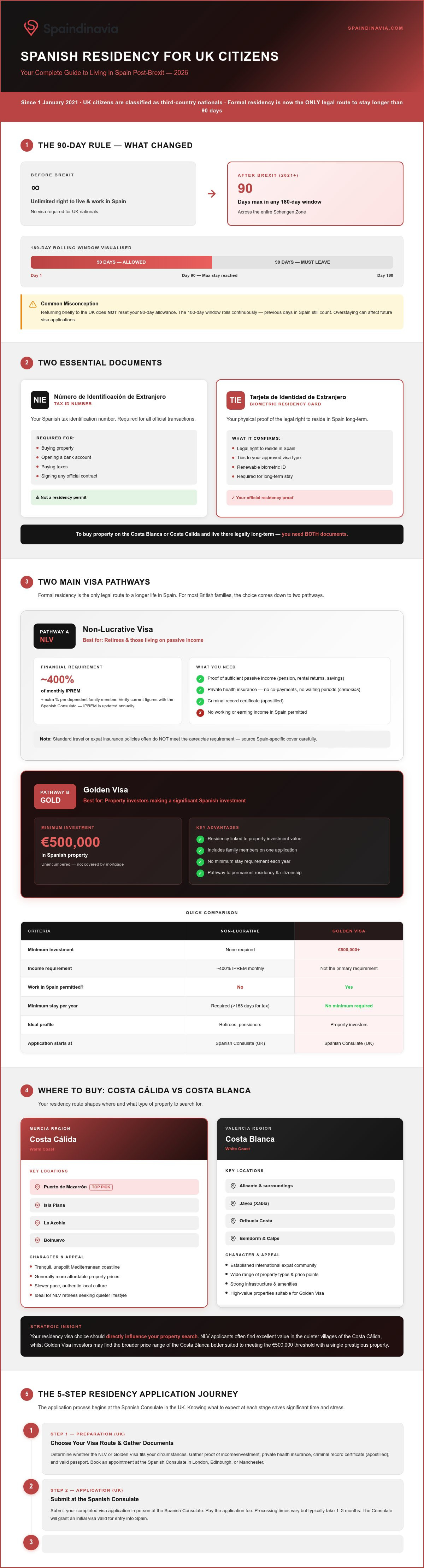
Since 1 January 2021, British nationals are classified as third-country nationals within the European Union. That single change reshaped everything. You no longer have the automatic right to live, work, or retire in Spain indefinitely. Instead, you're subject to the same immigration rules that apply to any non-EU citizen, which means planning your Spanish future now requires a clear legal strategy from the outset.
There is one important distinction worth understanding before anything else. British citizens who were already legally residing in Spain before 31 December 2020, and who registered under the Withdrawal Agreement, hold protected status. Their rights to live and work in Spain are preserved under that agreement. If you're a new applicant arriving after that date, however, you're starting fresh under Spanish immigration law, and the pathway is entirely different.
Understanding the full picture of Spanish residency requirements for UK citizens in 2026 begins with accepting this new reality, then finding the right route through it.
Understanding the TIE Card and the NIE
Two documents come up constantly in any conversation about living or buying property in Spain: the NIE and the TIE. They're not the same thing, and confusing them is one of the most common mistakes British buyers make.
- NIE (Número de Identificación de Extranjero): This is your Spanish tax identification number. You need it to buy property, open a bank account, pay taxes, or sign any official contract. It's an administrative number, not a residency permit.
- TIE (Tarjeta de Identidad de Extranjero): This is your biometric residency card, the physical proof that you have the legal right to reside in Spain.
To buy a property on the Costa Blanca or Costa Cálida and live there legally long-term, you need both. The NIE gets you through the purchase; the TIE confirms your right to stay.
The 90-Day Rule vs. Full Residency
Without residency, UK citizens are subject to the Schengen Area's 90/180-day rule: no more than 90 days within any rolling 180-day period across the entire Schengen Zone. For second-home owners dreaming of longer winters in Puerto de Mazarrón or the Costa Blanca, this is a hard ceiling that catches many people off guard.
One persistent misconception is that returning to the UK briefly "resets" your allowance. It doesn't. The 180-day window rolls continuously, meaning your previous days in Spain count regardless of short trips home. Overstaying isn't just a fine; it can affect future visa applications.
The only legal route to spending more than 90 days in Spain is formal residency. That's where understanding your visa options becomes the most practical step you can take.
Comparing the Non-Lucrative Visa and the Golden Visa
Once you've accepted that formal residency is the only legal route to a longer life in Spain, the next question is straightforward: which visa suits you best? For most British families and couples, the choice comes down to two main pathways, each with its own financial logic and lifestyle implications. Understanding both is central to meeting the spanish residency requirements for uk citizens in a way that actually fits your circumstances.
The Non-Lucrative Visa (NLV) Requirements
The Non-Lucrative Visa is designed for people who can support themselves in Spain without working there. Think retirees, those living on pension income, rental returns, or savings. It's not a route for remote workers or freelancers earning Spanish income; the clue is in the name.
The financial threshold is tied to Spain's IPREM (Indicador Público de Renta de Efectos Múltiples), the country's public income reference index. For 2026, you should verify the current figures directly with the Spanish Consulate, as IPREM values are updated annually. As a guide, the main applicant typically needs to demonstrate roughly 400% of the monthly IPREM in passive income, with an additional percentage required for each dependent family member added to the application. A couple, for example, would need to show a meaningfully higher combined figure than a single applicant.
Alongside proof of income, you'll need comprehensive private health insurance with no co-payments, often referred to as having no carencias (waiting periods). This is a common stumbling block. Many standard travel or expat policies don't meet the requirement, so it's worth sourcing a Spain-specific policy before you apply.
For those drawn to quieter corners of the Costa Cálida, the NLV is particularly popular. Villages like Bolnuevo and Isla Plana attract buyers who want a slower pace, a genuine local community, and lower property costs than the larger coastal resorts. The NLV fits that lifestyle well.
The Spanish Golden Visa: Investment Benefits
The Golden Visa takes a different approach entirely. Rather than proving passive income, you're making a qualifying investment in Spain of at least €500,000 in real estate, free of any mortgage on that portion. That threshold is significant, but it opens doors that the NLV simply doesn't.
Two advantages stand out. First, there's no minimum stay requirement, meaning you can spend time between Spain and the UK without jeopardising your status. Second, Golden Visa holders have the right to work in Spain, which gives it genuine flexibility for those who aren't fully retired.
For buyers considering a luxury new build villa on the Costa Blanca or in the Valencia region, reaching that €500,000 threshold is often a natural fit rather than a stretch. High-specification new builds in sought-after areas can meet or exceed that figure, meaning your property purchase and your residency application become one aligned decision rather than two separate processes.
Here's a quick comparison to help you weigh up your options:
- Non-Lucrative Visa: Passive income-based, no right to work, annual renewal initially, ideal for retirees and those seeking quieter coastal living
- Golden Visa: Investment-based (minimum €500,000 in property), right to work, no minimum stay, suited to higher-budget buyers and those with flexible lifestyles
Neither route is universally better. The right choice depends on your income sources, your budget, how much time you plan to spend in Spain, and whether you're still working. Getting that match right from the start saves considerable time and cost further down the line. Exploring the property options available across the Costa Blanca and Costa Cálida is a practical first step towards understanding which route aligns with your investment level.
Residency Lifestyle: Costa Cálida vs Costa Blanca
Where you choose to put down roots in Spain shapes far more than your postcode. It directly influences your day-to-day costs, the pace of your life, and how comfortably your finances align with the spanish residency requirements for uk citizens. The Costa Cálida and Costa Blanca are both wonderful, but they attract different people for genuinely different reasons.
The Costa Cálida sits within the Murcia region and tends to offer a slower, more authentically Spanish rhythm. The Costa Blanca, stretching through the Valencia region, brings a more established expat infrastructure and a livelier social scene. Neither is better. They simply suit different lifestyles, and understanding that distinction is worth taking seriously before you commit.
Living in the Mazarrón Area
For Non-Lucrative Visa holders, the Mazarrón area deserves serious attention. Puerto de Mazarrón, Bolnuevo, Isla Plana, and La Azohía offer something increasingly rare on the Spanish coast: genuine local character without the tourist overlay. Property prices here tend to be more accessible than equivalent homes on the Costa Blanca, which matters when you're demonstrating financial sufficiency for your visa application. A lower cost of living means your passive income stretches further, making it easier to meet the required thresholds comfortably rather than just barely.
One practical step that many buyers overlook is padrón registration. Once you're resident in a Spanish municipality, registering on the local padrón (the municipal census) is a legal obligation and a genuinely useful document. It supports your TIE application, helps with local services, and anchors you officially to your community. In smaller municipalities like Bolnuevo or Isla Plana, the town hall process is typically straightforward and unhurried.
Spaindinavia's portfolio includes properties across the Mazarrón area, from bungalows with sea views to resale villas with established gardens. Their local knowledge of which properties sit within the right price range to support your residency planning is the kind of practical detail that makes a real difference at the application stage.
Costa Blanca South: A Hub for British Expats
The Costa Blanca South offers a different proposition entirely. Towns like Torrevieja, Orihuela Costa, and the surrounding areas have well-developed English-speaking communities, international supermarkets, private medical clinics, and a social calendar that keeps life busy year-round. For Golden Visa applicants investing at the higher end of the market, the infrastructure here matches an active, connected lifestyle.
The contrast in pace between the two coastlines is real. The Costa Cálida rewards those seeking quiet mornings, local markets, and unhurried evenings. The Costa Blanca suits those who want community, convenience, and energy. Matching that preference to the right spanish residency requirements for uk citizens pathway, whether NLV or Golden Visa, is exactly where the right local guidance makes the whole journey feel far less daunting.
The 5-Step Residency Application Journey
Knowing which visa suits you is one thing. Actually moving through the application process is another. The good news is that the journey follows a predictable sequence, and once you understand each stage, it becomes far less daunting. Here's how it unfolds in practice.
Step 1: Apply at the Spanish Consulate in the UK. Your application begins before you set foot in Spain. Depending on where you live, you'll apply at the Spanish Consulate in London, Manchester, or Edinburgh. Each consulate covers a specific geographic area of the UK, so check which one has jurisdiction for your postcode. You'll submit your full documentation here, pay the visa fee, and attend an in-person appointment. Processing times vary, so build in adequate lead time before your intended move date.
Step 2: Register at the Town Hall (Empadronamiento). Once you arrive in Spain, one of your first tasks is registering on the padrón, the municipal census held by your local town hall. This isn't optional; it's a legal requirement and a document you'll need at multiple points afterwards. In smaller municipalities across the Mazarrón area, such as Bolnuevo or Isla Plana, this process tends to be refreshingly straightforward.
Step 3: Book your TIE appointment (Cita Previa). Your biometric residency card is issued by the National Police, not the consulate. You'll need to book a cita previa (prior appointment) online through the Spanish police system. Appointment availability varies significantly between provinces; Murcia and Alicante can have different wait times, so book as early as possible after arrival.
Step 4: Attend your biometric appointment. At your police appointment, your fingerprints and photograph are taken. Your TIE card is then produced and collected separately, usually from the same station, via the lote system where cards are batched for collection on specific dates.
Step 5: Understand the 183-day tax residency threshold. Once you're resident, spending more than 183 days per year in Spain typically triggers Spanish tax residency. That means your worldwide income becomes potentially taxable in Spain, not just your Spanish income. This is a significant financial consideration that deserves proper advice from a Spanish tax professional before you commit to your timeline.
Essential Documentation Checklist
Getting your paperwork right from the start saves weeks of delays. The key documents for most applications include:
- Criminal record check (ACRO): Obtained from the UK's ACRO Criminal Records Office, apostilled, and translated into Spanish by a certified translator. These certificates have a limited validity window, typically three months, so timing matters.
- Medical certificate: Issued by a registered UK doctor, confirming you have no contagious diseases. This also requires an apostille and certified translation.
- Proof of accommodation: Either a title deed confirming property ownership or a long-term rental contract of at least one year.
- Health insurance documentation: Your policy must meet Spanish consulate standards, including full coverage with no co-payments.
A gestor (a licensed Spanish administrative agent) or an independent solicitor can be genuinely invaluable here. They know exactly how documents need to be presented, can liaise with Spanish authorities on your behalf, and reduce the risk of rejection on technical grounds. Spaindinavia works alongside independent solicitors who understand both the property purchase process and the residency requirements, which means your legal and administrative support can be coordinated rather than fragmented.
Always use a professional, certified translator for any official documents submitted to Spanish authorities; an uncertified translation is grounds for immediate rejection.
Common Pitfalls to Avoid
Even well-prepared applicants can stumble at predictable points. Health insurance is the most frequent issue: policies that include co-payments or waiting periods (carencias) don't meet the consulate's standards, regardless of how comprehensive they appear. Verify your policy against the specific consulate requirements before purchasing it.
Timing is equally critical. Once your visa is granted and you arrive in Spain, you have one month to apply for your TIE card. Missing that deadline creates complications that are entirely avoidable with a little forward planning.
Meeting the full spanish residency requirements for uk citizens is genuinely achievable with the right preparation. If you'd like to understand how a property purchase on the Costa Blanca or Costa Cálida fits into your residency timeline, explore Spaindinavia's property portfolio and get in touch with their team for guidance tailored to your situation.
Strategic Property Investment and Residency Success
Your residency route doesn't just determine your legal status in Spain; it actively shapes what kind of property you should be looking for, where, and at what price point. Treating these as two separate decisions is one of the most common and costly mistakes British buyers make. Get the alignment right from the start, and your property purchase becomes a direct vehicle for your residency rather than a parallel process running alongside it.
New Build vs Resale for Residency Applicants
For Golden Visa applicants, new build villas offer a particularly clean path. The purchase price is typically well-documented through developer contracts and official valuations, which makes demonstrating the €500,000 threshold straightforward during the application process. There's less ambiguity than with resale properties, where declared values, renovation histories, and market appraisals can occasionally complicate the picture.
New builds also deliver something equally practical: a turnkey property that's immediately habitable. For residency purposes, proof of accommodation is a required document at multiple stages, and a brand-new villa with a completed title deed satisfies that requirement cleanly from day one. There's no waiting for works to finish or contracts to be renegotiated. If you're considering this route, our guide on buying property in Spain walks through the full purchase checklist in detail.
Resale properties remain a strong option for Non-Lucrative Visa applicants, particularly in the Mazarrón area where well-priced bungalows and resale villas offer genuine value. The key is ensuring the property is legally sound before you commit, which is precisely where independent legal support earns its place.
The Role of an Independent Solicitor
An independent solicitor isn't a luxury; it's a safeguard. They carry out due diligence on the property title, check for outstanding debts or planning irregularities, and ensure your purchase contract protects your interests. Critically, they also understand how the property transaction intersects with the spanish residency requirements for uk citizens, ensuring your documentation is structured correctly for both processes simultaneously. Spaindinavia works alongside independent solicitors who operate across both the Costa Cálida and Costa Blanca, so your legal and property support is coordinated rather than fragmented.
Long-term Planning: From Residency to Citizenship
It's worth thinking beyond the initial application. After five continuous years of legal residency in Spain, you become eligible to apply for permanent residency, which removes the need for periodic renewals and offers considerably greater security. The path to Spanish citizenship for UK nationals is longer, typically ten years of legal residency, but it's a genuine possibility for those who commit to building their life here.
Spaindinavia's role doesn't end at the point of sale. Their knowledge of property management across both coastlines, combined with their understanding of the local communities in places like Puerto de Mazarrón, Isla Plana, and the Costa Blanca South, means they remain a practical resource as your life in Spain takes shape. That continuity of support, from the first property search through to settling into your community, is what turns a transaction into a genuine transition.
If you're ready to take the first step, contact Spaindinavia to begin your residency and property journey today. The Mediterranean lifestyle you've been imagining is closer than it might feel right now.
Your Spanish Life Is Closer Than You Think
Meeting the spanish residency requirements for uk citizens in 2026 is genuinely achievable when you approach it with the right information and the right support. Whether the Non-Lucrative Visa fits your retirement income or the Golden Visa aligns with a luxury property investment, the key is matching your financial situation to the correct pathway from the very start.
Three things will serve you well: choose your visa route before you choose your property, get independent legal advice early, and don't underestimate how much your choice of location, whether the quieter Costa Cálida villages around Mazarrón or the vibrant Costa Blanca South, shapes your day-to-day life and costs.
Spaindinavia specialises in new build villas and resale properties across both coastlines, with deep local knowledge of the Mazarrón area and comprehensive support from your first viewing through to residency. You don't have to navigate this alone.
Start your Spanish property and residency journey with Spaindinavia and take the first confident step towards the Mediterranean life you've been planning.
Frequently Asked Questions About Spanish Residency Requirements for UK Citizens
Can I still work in Spain if I have a Non-Lucrative Visa?
No, the Non-Lucrative Visa explicitly prohibits you from working in Spain, whether employed or self-employed. It's designed for people who can support themselves entirely from passive income sources such as pensions, savings, or rental returns. If you're still working remotely for a UK employer or running a business, you'll need to explore a different visa category, as the NLV isn't the right fit for your situation.
How much money do I need in the bank for a Spanish residency application in 2026?
The financial threshold is tied to Spain's IPREM index, which is updated annually, so always verify the current figures directly with your Spanish Consulate before applying. As a general guide, the main applicant needs to demonstrate roughly 400% of the monthly IPREM in provable passive income, with an additional percentage required per dependent. Savings can supplement income in some cases, but the consulate primarily wants to see a reliable, ongoing income stream rather than a lump sum balance.
Do I need to buy a property before I apply for residency?
No, property ownership isn't a requirement for most residency routes. A long-term rental contract of at least one year is generally accepted as proof of accommodation for Non-Lucrative Visa applications. However, if you're pursuing the Golden Visa, the qualifying property investment of at least €500,000 is the foundation of the entire application, so in that case, the purchase genuinely does come first.
What happens if my residency application is rejected?
A rejection isn't necessarily the end of the road. You typically have the right to appeal the decision, and in many cases, applications are refused on technical grounds such as incomplete documentation or a non-compliant health insurance policy rather than fundamental eligibility issues. Getting independent legal advice before reapplying is strongly recommended. Understanding exactly why your application failed is the most important step before submitting again.
Can I bring my family with me on a Spanish Golden Visa?
Yes, the Golden Visa allows you to include family members as dependants on your application. This typically covers your spouse or partner and dependent children, and can extend to dependent parents in certain circumstances. Each dependant receives their own residency rights linked to the main applicant's status. It's one of the genuinely attractive features of this route, making it a practical option for families relocating together rather than just individual investors.
How long does the residency application process take for UK citizens?
Processing times vary depending on the consulate and time of year, but you should realistically plan for several months from initial application to holding your TIE card in Spain. The Spanish Consulate in the UK typically takes a number of weeks to process a visa once your appointment has been attended. After arriving in Spain, booking your police appointment for the TIE can add further time, particularly in busier provinces. Build generous lead time into your plans rather than working to a tight deadline.
Is private health insurance mandatory for all Spanish residency types?
For the Non-Lucrative Visa, comprehensive private health insurance is an absolute requirement, and the policy must meet strict standards: full coverage in Spain with no co-payments and no waiting periods. The Golden Visa has different requirements, and applicants who become registered residents may eventually access the Spanish public health system. Regardless of your route, verifying that your chosen policy meets the specific consulate requirements before purchasing it will save you considerable frustration.
Will I become a Spanish tax resident if I get a TIE?
Not automatically, but it's a real risk to plan around. Spending more than 183 days in any calendar year in Spain typically triggers Spanish tax residency, meaning your worldwide income could become taxable in Spain. Holding a TIE card confirms your legal right to reside in Spain; it doesn't by itself determine your tax status. The Spanish residency requirements for UK citizens and Spanish tax residency are two separate frameworks, and getting advice from a qualified Spanish tax professional before committing to your timeline is genuinely important.


