

Imagine standing on your sun-drenched balcony in Bolnuevo or overlooking the vibrant marina in Puerto de Mazarrón, only to have your peace interrupted by one nagging worry: "Will my children actually thrive in a Spanish classroom?" It's completely natural to feel a mix of excitement and trepidation when moving your family to the Costa Cálida or the Costa Blanca. You want the best for your children, but the complexities of the Spanish school system can feel like a maze, especially when you're also managing residency paperwork and a new language.
This 2026 guide is designed to replace that uncertainty with absolute confidence. We'll walk you through the age-specific stages from Educación Infantil to university entrance, explaining the latest 2026 regulations such as the new caps of 22 students per primary class and the expanded public places for toddlers across the Murcia and Valencia regions. From comparing state schools in Isla Plana and La Azohia to preparing your registration checklist, we provide everything you need to ensure your children's education is as sunny as your new life by the Mediterranean.
Key Takeaways
- Understand the core stages of the Spanish school system, distinguishing between compulsory education and optional nursery or post-16 pathways.
- Evaluate the benefits of public, private, and concertada schools to find the perfect fit for your child’s language skills and your family’s lifestyle.
- Master the enrolment process by learning how to organise your relocation around the crucial "matrícula" windows to secure a place at your preferred school.
- Compare the educational landscapes of the Costa Blanca and the Costa Cálida, including specific insights into schooling near Puerto de Mazarrón, Isla Plana, and Bolnuevo.
- Prepare for the future by exploring the academic Bachillerato and modern vocational training routes that open doors to universities and global careers.
Understanding the Structure of the Spanish School System
The Spanish education system is beautifully decentralised. This means that whilst the national government sets the core framework, autonomous regions like the Region of Murcia and the Valencian Community have significant control over how schools are run. If you're looking at property in Puerto de Mazarrón or Isla Plana, you'll be following the Murcia regional guidelines. Conversely, if you choose a home on the Costa Blanca, you'll fall under the Valencia region's jurisdiction. This decentralisation often results in slight variations in school holiday dates and language requirements, making it essential to look at the specific rules for your chosen coast.
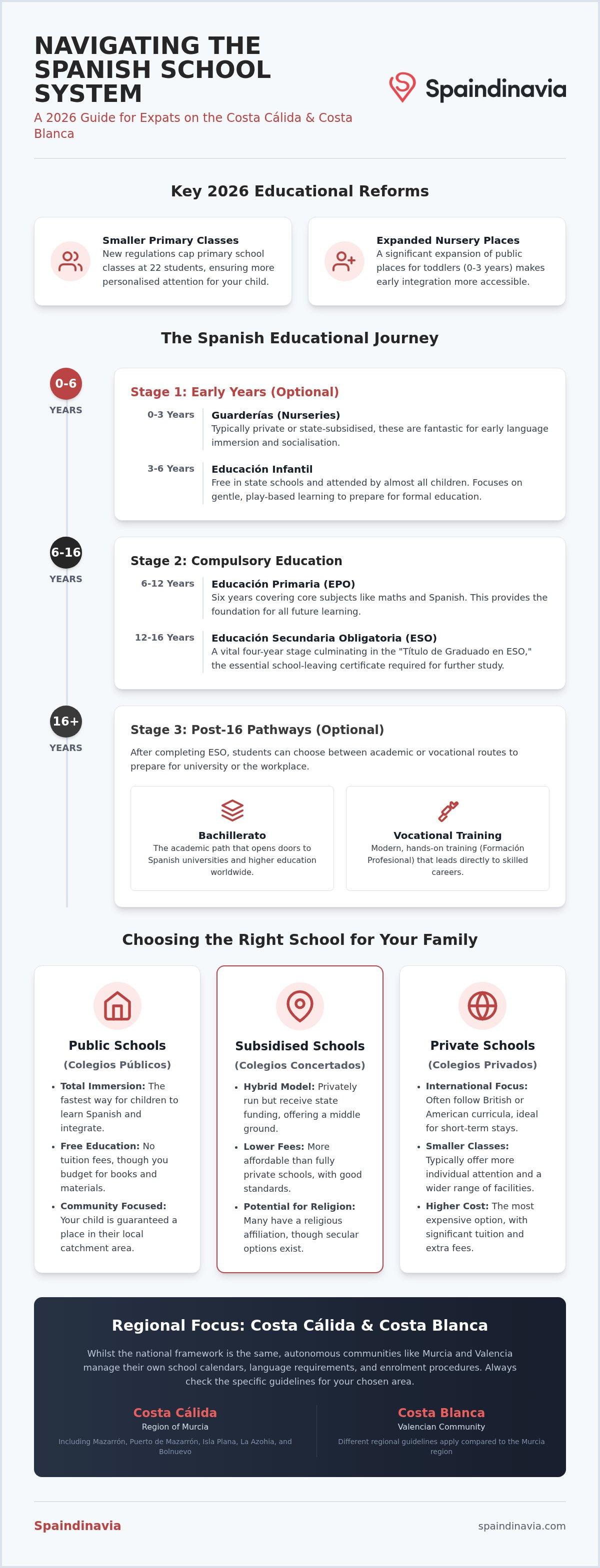
The Spanish school system is divided into clear stages based on age. Education is only compulsory between the ages of 6 and 16, covering Primary and Secondary levels. However, the system is designed to be inclusive from birth, with a heavy emphasis on social development and community integration from the very beginning. For many expat families, these early years are the perfect time to build a foundation in the local culture.
Early Years: Guardería and Educación Infantil
Starting your journey in Spain with young children is often the easiest way to integrate into the local community. Guarderías (nurseries) cater for children aged 0 to 3. These are typically private or state-subsidised, and they're fantastic for early language immersion. Under new 2026 regulations, there's a significant expansion of public places for this age group, making it more accessible for parents in areas like La Azohia or Bolnuevo.
From ages 3 to 6, children move into Educación Infantil. Whilst this stage isn't compulsory, almost all Spanish children attend. It's free in state schools and focuses on "learning through play." It's a gentle, nurturing environment where your child will pick up Spanish naturally through songs, games, and socialising with their new peers before the formal Spanish school system requirements begin.
Compulsory Primary and Secondary Education (EPO & ESO)
Once your child turns 6, they enter Educación Primaria (EPO). This stage lasts six years and provides the foundation for all future learning. In both the Murcia and Valencia regions, you'll find a strong emphasis on core subjects like maths, Spanish, and the local environment. Each year is designed to build confidence, with 2026 reforms ensuring smaller class sizes of 22 students to allow for more personalised attention.
At age 12, students transition to Educación Secundaria Obligatoria (ESO). This four-year stage is vital. It culminates in the "Título de Graduado en ESO," which is the essential school-leaving certificate. Without this qualification, students cannot progress to higher academic studies or specific vocational training. It's a period of growth where students are encouraged to become more independent and responsible for their own academic success.
Choosing Between Public, Private, and Concertada Schools
Selecting the right environment for your child is perhaps the most significant decision you'll make after deciding to move. In the Spanish school system, you have three primary paths, each offering a distinct experience based on your family's priorities, budget, and how long you plan to stay in Spain. Whether you're drawn to the rugged beauty of Bolnuevo or the bustling community of Puerto de Mazarrón, your choice will shape your child's daily rhythm and their integration into Mediterranean life.
Whilst the national structure of the education system remains consistent, the atmosphere can vary wildly between a secular state school and a traditional Catholic institution. Religion still plays a visible role in many Spanish schools, though you always have the right to choose a secular track for your child during the enrolment process.
The Public System (Colegios Públicos)
Public schools offer a direct route into the heart of Spanish life. If you've settled in a coastal village like Isla Plana or La Azohia, your children will likely attend the local state school. This is the best option for total language immersion, especially for younger children who pick up new tongues with ease. Admission is strictly based on the padrón (your local town hall registration), meaning your child is guaranteed a place in their catchment area. It's entirely free, though you'll need to budget for textbooks and materials, which can cost several hundred euros at the start of the term.
The Concertada Model: Semi-Private Education
The Colegio Concertado is a uniquely Spanish middle ground. These are privately owned schools that receive state subsidies, allowing them to offer smaller class sizes and often more modern facilities than purely public options. Whilst they're technically free, most ask for a "voluntary contribution" which typically ranges from €20 to €100 per month. They often have a more traditional feel and are a popular choice for families on both the Costa Blanca and the Costa Cálida who want a balance of private-school standards with a local community feel.
International and Private Schools
For older children or those who might struggle with an immediate language switch, international schools are a fantastic alternative. These institutions usually follow the British curriculum, offering IGCSEs and A-Levels, ensuring your child doesn't lose academic pace whilst they learn Spanish as a second language. This is a premium choice; tuition fees for private education in Spain can range from €5,000 to over €20,000 per year. These schools are particularly prevalent in expat hubs along the Costa Blanca and near the larger cities in the Murcia region. Finding the right home near these top-tier institutions is a key priority for many of our clients, and we can help you find a property that simplifies the daily school run.
Practicalities: Enrolment, School Terms, and Daily Life
Moving to a new country involves a whirlwind of logistics, but few things are as vital as syncing your move with the Spanish school system's enrolment calendar. The main application window, known as the matrícula, typically occurs in the spring, often March or April, for the following September. If you miss this window, you might find your choices limited, particularly in popular areas like Puerto de Mazarrón or the vibrant coastal towns of the Costa Blanca. Planning your property search and residency application ahead of these dates ensures a much smoother transition for your children.
Daily life in a Spanish school often revolves around two types of schedules. The Jornada Continua runs from roughly 9:00 am to 2:00 pm, whilst the Jornada Partida includes a long lunch break, with classes finishing later in the afternoon. Most schools offer a Comedor (canteen) service, which is more than just a place to eat; it's a social pillar where children learn Mediterranean dining etiquette and socialise across year groups. For families living in quieter spots like Isla Plana or La Azohia, the Ruta (school bus) provides a reliable and safe connection to larger educational centres.
The Enrolment Process for Expats
Your first step is obtaining your NIE (foreigner identification number) and registering on the Padrón at your local town hall. This residency certificate is the golden ticket for state school placement in both the Murcia and Valencia regions. You'll need to gather several documents, including birth certificates, immunisation records, and potentially translated academic transcripts for older children. Placement often relies on the Baremo system, a points-based method that considers factors like proximity to the school and family income. Whilst some families opt for International schools in Spain to bypass some of these local hurdles, the state system is very welcoming to new residents who have their paperwork in order.
The Spanish Academic Calendar
The 2026-2027 school year is set to begin between 7 September and 15 September 2026, depending on whether you're in the Murcia or Valencia region. The year is split into three distinct terms, concluding between 18 June and 23 June 2027. You'll quickly learn to love the Puentes (bridge days), where a mid-week holiday leads to a four-day weekend. July and August are sacred for family life, with most local activity shifting to the beaches of Bolnuevo or the shaded plazas of the Costa Cálida. This rhythm ensures that whilst academics are taken seriously, the lifestyle remains balanced and focused on well-being and family time.
Beyond 16: Bachillerato and Vocational Training
Once your child completes their compulsory secondary education (ESO) at age 16, the Spanish school system opens up into two distinct pathways. This is a pivotal moment where students begin to specialise based on whether they're aiming for university or a specific trade. Whether your family is enjoying the coastal lifestyle in Puerto de Mazarrón or the tranquil surroundings of Isla Plana, you'll find that the local options for further study are diverse and increasingly modern.
The choice between academic study and vocational training is no longer a matter of prestige; both routes are highly respected and well-funded in the Murcia and Valencia regions. For British families, this stage is often where the benefits of bilingualism really start to show, as students can choose to study in Spanish whilst maintaining their English proficiency for future international opportunities.
The Bachillerato Specialisations
The Bachillerato is a two-year academic programme designed for students who intend to go to university. Unlike the broad range of A-Level choices in the UK, students here must choose a "Modalidad" or stream. These typically include Science and Technology, Humanities and Social Sciences, or the Arts. This structure ensures a deep foundation in a specific field whilst keeping core subjects like Spanish, Philosophy, and a foreign language on the timetable.
A significant advantage of this system is how the final grade is calculated. Your child's Grade Point Average (GPA) from the two years of classwork accounts for 60% of their final mark. The remaining 40% comes from the Selectividad (now often called EBAU), the national university entrance exam. This balanced approach rewards consistent effort rather than putting everything on a single set of exams. If your child plans to return to the UK for university, the Bachillerato is widely recognised by UCAS, though it's always wise to check specific entry requirements for your chosen course.
Vocational Training (FP) Opportunities
For students who prefer a more hands-on approach, Formación Profesional (FP) is an excellent alternative. This path is divided into Grado Medio (Intermediate) and Grado Superior (Advanced). These programmes are designed in close collaboration with local industries, ensuring that students graduate with skills that are actually in demand. In regions like the Costa Blanca and Costa Cálida, there's a growing number of bilingual FP programmes, particularly in sectors like tourism, maritime studies, and renewable energy.
This route offers a clear bridge into the workforce or even a pathway back into university later on. If you're looking to settle in areas like Bolnuevo or La Azohia, choosing a home with easy access to these educational hubs is a smart move for your child's future. We can help you find a property that places your family within reach of the best secondary and vocational centres in the region.
Relocating to the Coast: Education in Costa Blanca and Costa Cálida
Choosing to move your family to the Mediterranean coast is a decision that extends far beyond the four walls of a new villa. It's an investment in a lifestyle where the Spanish school system acts as a gateway to cultural integration and long-term well-being. Both the Costa Blanca and the Costa Cálida offer exceptional environments for children to grow, but they do so with slightly different flavours. In the Valencia region, you'll find a strong emphasis on bilingualism that often includes the local Valenciano language. Meanwhile, the Murcia region focuses heavily on Castilian Spanish and English bilingual programmes, making it a popular choice for families who prefer a more singular linguistic focus.
Proximity to quality schools is a major factor in property value. Whether you're looking at new build villas in Puerto de Mazarrón or resale apartments in the heart of the Costa Blanca, being within the catchment area of a respected school ensures your investment remains robust. For families seeking a holiday rental property that might eventually become a permanent home, these educational hubs provide a sense of security and community that is hard to match elsewhere.
Family Life in the Murcia and Valencia Regions
Life on the coast is defined by the outdoors. With over 300 days of sunshine each year, children in areas like Bolnuevo and La Azohia spend their afternoons at the beach or in local sports clubs rather than in front of screens. This healthy, active lifestyle is a cornerstone of the Mediterranean dream. Integration often happens naturally through the "AMPAs" (parent-teacher associations), where international and local families meet to organise events and support the school community.
In smaller coastal villages like Isla Plana, the community feel is palpable. You'll find that local businesses and neighbours quickly become part of your extended support network. This welcoming nature makes the transition into the Spanish school system much less daunting for children, as they feel a sense of belonging both inside and outside the classroom. It's this balance of academic growth and social happiness that makes the Murcia and Valencia regions so attractive to expat families.
Expert Guidance for Your Move
We understand that your move is a journey with many moving parts. Finding the right location is just as vital as finding the right property. Our team lives and works in these communities, giving us first-hand knowledge of which neighbourhoods offer the best access to the schools that will suit your children's needs. We're here to support you from that very first viewing until the day your children proudly walk through their new school gates.
A secure move starts with the right preparation. To help you navigate the practical steps of your relocation, start your journey today with our 2026 property checklist. This resource ensures you have all your bases covered, from residency requirements to finding a home that perfectly aligns with your family's educational goals.
Secure Your Family's Future by the Sea
Moving your family to the Mediterranean is more than just a change of postcode; it's an opportunity for your children to flourish in a vibrant, inclusive environment. You now have a clearer understanding of how the Spanish school system supports every stage of development, from the nurturing play-based years to the practical employability of vocational training. By mastering the timing of the enrolment window and choosing a location that aligns with your educational goals, you're setting the foundation for a successful relocation.
We've spent over a decade helping families navigate these big life decisions with confidence. Our bilingual team provides personalised support across the Costa Blanca and the Costa Cálida, ensuring you find a property that's perfectly placed for the best local schools. Whether you're searching for a villa in Puerto de Mazarrón or a modern apartment on the Costa Blanca, our deep local expertise is at your service throughout the entire journey.
Find your perfect family home with Spaindinavia and take the first step towards your new life today. We're excited to help you turn this dream into a beautiful reality for the whole family.
Frequently Asked Questions
Is school free in Spain for British expats?
State education is free for all registered residents in Spain, including British expats, from the ages of 3 to 18. Whilst tuition costs nothing, you should budget for textbooks, stationery, and school materials, as these are typically paid for by the parents. This applies to all state schools across both the Murcia and Valencia regions, providing a high-quality and accessible route for your children to integrate into their new Mediterranean community.
What is the "Padrón" and why do I need it for school enrolment?
The Padrón is a certificate from your local town hall that confirms your residential address within the municipality. It's a vital requirement for the Spanish school system because state school places are primarily allocated based on where you live. To secure a place for your child in a school in Bolnuevo or Puerto de Mazarrón, you must first register your family on the Padrón to prove you belong to that specific catchment area.
Will my child struggle if they do not speak Spanish yet?
Children are remarkably resilient and usually pick up the language within a few months through pure immersion. Most state schools in the Costa Cálida and Costa Blanca are well-equipped to support international students, often providing specialised "ATAL" classes for linguistic adaptation. Whether you're in Isla Plana or a busier part of the Valencia region, schools prioritise helping newcomers catch up so they can thrive both socially and academically.
What are the school hours in Spain?
School hours typically follow one of two patterns: the "Jornada Continua" (9:00 am to 2:00 pm) or the "Jornada Partida," which includes a long lunch break and finishes around 4:30 pm. In the Mazarrón area, many primary schools have adopted the morning-only schedule. This allows families more time to enjoy an active outdoor lifestyle in the sunny afternoons, whilst secondary schools almost always finish their academic day by 3:00 pm.
Can I choose any school I want for my child?
You can list several preferences on your application, but placement in the state system is determined by a points-based system that considers your home address and family circumstances. If you have your heart set on a specific institution outside your immediate area in the Murcia or Valencia regions, you may find that private or international schools offer more flexibility. These institutions allow you to choose a curriculum that best fits your child's long-term goals.
What is a "Concertada" school?
A Concertada is a semi-private school that is privately owned but receives government subsidies to keep fees low. This model is a popular element of the Spanish school system, often offering smaller class sizes and a more traditional or religious environment than purely state-run schools. Whilst tuition is subsidised, most concertadas ask for a small monthly voluntary contribution from parents to cover extra services and modernised facilities that the state doesn't fully fund.
Do Spanish schools have uniforms?
Uniforms are generally not required in state schools, though they are almost universal in private and concertada institutions. In many public schools in La Azohia or Puerto de Mazarrón, younger children wear a "babi" (a protective smock) over their everyday clothes to keep them clean during lessons. If you prefer the structure and ease of a school uniform, you'll likely want to explore the private education options available throughout the Costa Blanca and Costa Cálida.
When does the school year start and end in Spain?
The 2026-2027 school year will begin between 7 and 15 September 2026 and conclude in late June 2027. Specific dates are set annually by the regional governments of Murcia and Valencia, so they can vary slightly depending on your exact location. Following the final exams in June, children enjoy a long summer break in July and August, which is the perfect time for families to relax and enjoy the coastal lifestyle together.


