

What if the end of the Golden Visa wasn't a closed door, but rather a more personal invitation to find your perfect place in the sun? Since the programme officially closed to new applicants in April 2025, many feel a sense of uncertainty about buying property in spain as a non-eu citizen. You might worry that your dream of retiring to a villa in Bolnuevo or enjoying the vibrant lifestyle in Puerto de Mazarrón is slipping away due to complex new requirements and shifting legislation.
We agree that the 2026 residency landscape feels daunting, especially when you are trying to balance financial security with a life-changing move. This article promises to demystify the process by revealing the most effective residency pathways currently available to property investors and expats today. We provide a clear roadmap through the latest income thresholds for the Non-Lucrative and Digital Nomad visas. Whether you are looking at new build apartments in the Costa Blanca or charming resale properties in the Costa Cálida, including Isla Plana and La Azohia, you will find a secure way to move forward with confidence and peace of mind.
Key Takeaways
- Understand the 2025 legal changes that prioritised housing as a right and how to adapt your residency strategy for the 2026 landscape.
- Explore the latest financial criteria for the Non-Lucrative and Digital Nomad Visas as the primary routes for buying property in spain as a non-eu citizen.
- Contrast the authentic Mediterranean feel of the Costa Cálida, especially Bolnuevo and Isla Plana, with the established lifestyle options found across the Costa Blanca.
- Identify the ideal property types for your residency path, from new build villas in Puerto de Mazarrón to resale apartments in La Azohia, whilst considering both the Costa Cálida and the Costa Blanca.
- Learn how expert local support can act as a vital bridge between your property investment and a successful, stress-free residency application.
The 2026 Landscape: Why the Spanish Golden Visa Ended
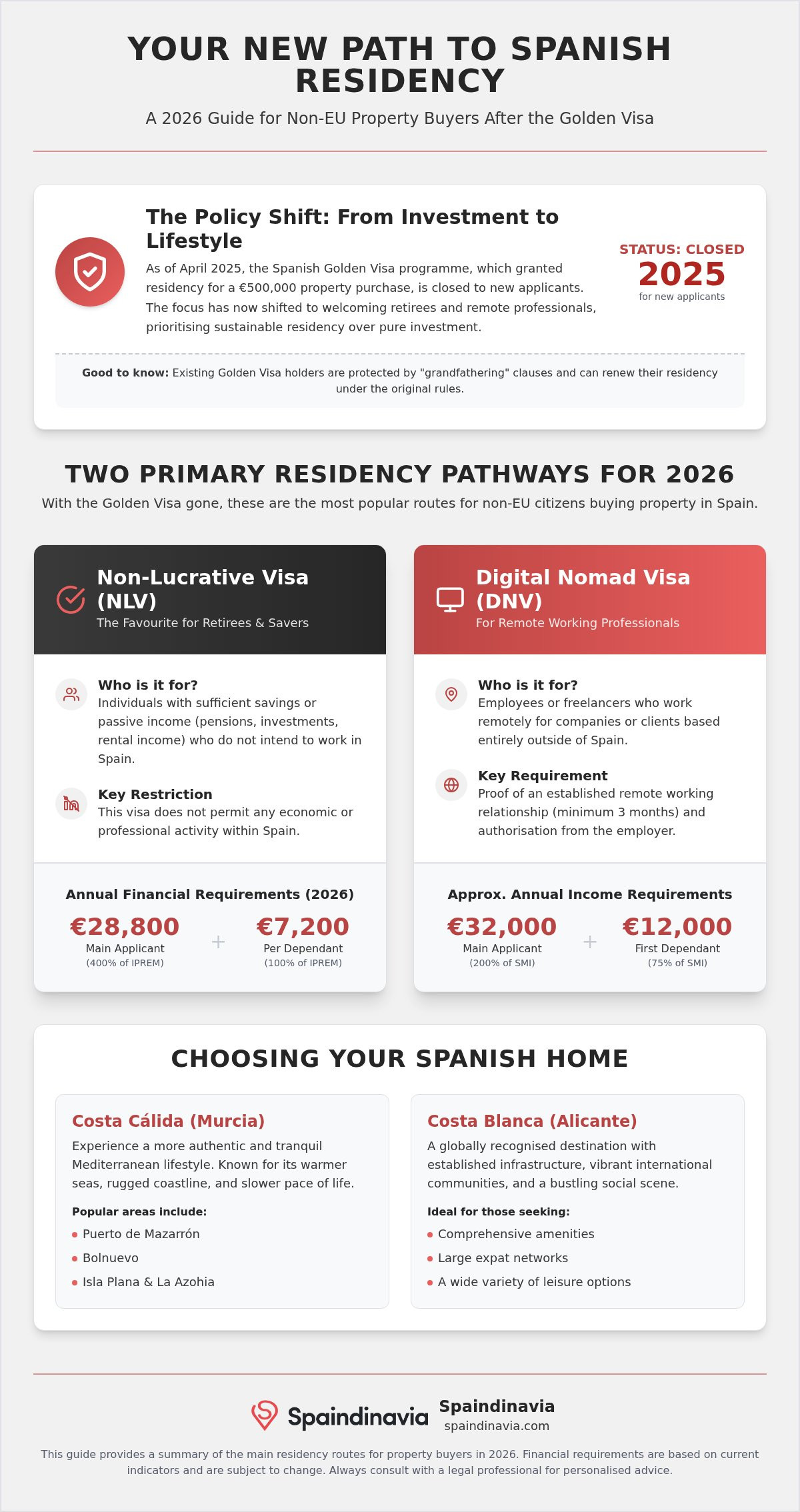
The dawn of 2026 marks a significant turning point for international investors. On 3 April 2025, the Spanish government officially closed the Golden Visa programme to new applicants, ending a decade-long era where a €500,000 real estate investment guaranteed residency. This shift wasn't an isolated event; it was part of a broader European trend to reform Immigrant investor programs. The legislative focus moved decisively towards protecting "housing as a right" for local citizens, aiming to curb property speculation in high-demand urban and coastal areas.
If you're currently buying property in spain as a non-eu citizen, you'll notice that the market feels different. Prices rose by 12.8% during 2025, but as we move through 2026, the market is beginning to stabilise. This change makes choosing the right alternative visa more critical than ever. It's no longer just about the cheque you write; it's about how you plan to live, work, and contribute to the local community in beautiful regions like the Costa Cálida and the Costa Blanca.
This movement towards intentional, community-focused living is a global trend. For those exploring regenerative lifestyles, projects like The ARK in Costa Rica provide an inspiring example of how modern residency can be built around sustainability and shared values, much like the evolving property landscape in Spain.
Understanding the Shift in Residency Policy
Spain has transitioned from an investment-led residency model to one that prioritises lifestyle, remote talent, and retirees. Whilst the Costa Blanca remains a firm favourite for its established infrastructure and vibrant social scene, the Costa Cálida is attracting those seeking a more authentic Mediterranean experience. Areas such as Bolnuevo and Puerto de Mazarrón offer a slower pace of life that aligns perfectly with the new residency requirements. This policy shift means that whilst you can still secure your dream home, your right to stay is now tied to your personal financial profile or your professional skills rather than just the value of your villa.
Status of Pending Applications and Renewals
For those who secured their residency before the 2025 cut-off, there's a sense of security. The Spanish government included "grandfathering" clauses that protect existing Golden Visa holders. If you already have your TIE (Tarjeta de Identidad de Extranjero), you can continue to renew your status under the old rules, provided you still meet the original investment criteria.
For everyone else, the 2026 reality is clear. You need a new strategy. Here's what you need to know about the current status:
- Existing holders can renew their permits for the standard durations.
- Pending applications submitted before April 2025 are still being processed under the old law.
- New property buyers must now look towards the Non-Lucrative Visa or the Digital Nomad Visa.
As of early 2026, the specific Golden Visa path is closed to new applicants, meaning residency is no longer a direct consequence of a property investment alone.
The Non-Lucrative Visa (NLV): The Favourite for Retirees
For those dreaming of long afternoons in the sun without the pressure of professional commitments, the Non-Lucrative Visa (NLV) has emerged as the premier choice. It's particularly popular amongst those buying property in spain as a non-eu citizen who have already built their nest egg and wish to enjoy it in a warmer climate. Unlike the now-closed Golden Visa, the NLV doesn't require a specific €500,000 investment. Instead, it focuses on your ability to support yourself through passive income or existing savings, making it a much more accessible route for many expats.
The core philosophy of this visa is simple: you're here to enjoy the Spanish lifestyle, not to enter the local labour market. This prohibition on working in Spain suits retirees perfectly, as it aligns with their goal of a peaceful life in areas like the Costa Cálida or the Costa Blanca. By choosing a home in a tranquil spot like Bolnuevo or the charming coastal village of Isla Plana, you're not just buying a house; you're securing a lifestyle that the Spanish government is keen to welcome.
Financial Requirements and Proof of Funds in 2026
The financial threshold for the NLV is tied to Spain's IPREM (Public Multiple Effects Income Indicator). In 2026, the main applicant must demonstrate a minimum annual income of €28,800, which represents 400% of the IPREM. If you're moving with a partner or family, you'll need an additional €7,200 per year for each dependent. You can find the full list of official Non-Lucrative Visa requirements through the Ministry of Foreign Affairs, but typically, authorities look for stable passive income. This includes state or private pensions, investment dividends, or rental yields from properties back home. Alongside these funds, securing comprehensive private health insurance from a Spanish provider is a non-negotiable step for your first year of residency.
Property Ownership and the NLV
Whilst the NLV doesn't strictly require you to own a home, having a property in Puerto de Mazarrón or La Azohia significantly strengthens your application. It demonstrates "roots" and a clear intent to reside permanently in the region. When you're buying property in spain as a non-eu citizen, the "Nota Simple" becomes a vital document in your visa pack. This is an official registry report that confirms you are the legal owner of the property and that it's free of unexpected debts.
We act as a vital bridge during this process, collaborating with independent solicitors to ensure your property purchase aligns perfectly with residency standards. Whether you're looking at new build villas or resale apartments, we ensure the paperwork is flawless. Owning a home in the Costa Cálida offers a sense of permanence that renting simply can't match, providing a secure anchor for your new life in Spain whilst you explore the distinct differences between the Murcia region and the neighbouring Costa Blanca.
The Digital Nomad Visa (DNV): Working Remotely from the Coast
If you aren't quite ready to hang up your professional hat but still yearn for a Mediterranean backdrop, the Digital Nomad Visa (DNV) is a game-changer. It's quickly become a favourite for those buying property in spain as a non-eu citizen because it offers something the Non-Lucrative Visa doesn't: the legal right to work. This pathway is designed for remote workers, freelancers, and contractors who provide services to companies located outside of Spain. It allows you to trade a grey office view for the sparkling turquoise waters of Puerto de Mazarrón or the rugged beauty of Bolnuevo whilst maintaining your career.
To qualify, you don't necessarily need a high-level executive role. You do, however, need to prove your professional standing. The Spanish authorities look for either a degree or postgraduate qualification from a prestigious university or business school; alternatively, you can demonstrate at least three years of professional experience in your field. This flexibility makes the DNV accessible to a wide range of talent, from tech developers to creative consultants. Whilst the Costa Blanca has long been a hub for international workers, the Costa Cálida is emerging as a preferred "nomad hub". Areas like Isla Plana and La Azohia offer the perfect balance of high-speed fibre optic connectivity and a tranquil, authentic lifestyle that's hard to find in more commercialised regions.
Step-by-Step Application for Remote Workers
The application process is logical but requires meticulous attention to detail. You must prove that your employer or the company you contract for has been active for at least one year. You also need to demonstrate that your remote working relationship has existed for at least three months prior to applying. In 2026, the minimum income requirement is verified at €2,849 per month for the main applicant. Once your visa is approved, the next steps involve obtaining your NIE (Foreigner's Identity Number) and registering with the Spanish social security system. We often see that having a local base, such as one of our new build villas or resale apartments, provides the stability needed to navigate these administrative steps with ease.
Tax Incentives: The 'Beckham Law' Advantage
One of the most compelling reasons to choose the DNV over other residency paths is the tax efficiency it offers. New residents can often apply for the 'Beckham Law' tax regime. This allows you to pay a flat tax rate of 24% on Spanish-sourced income up to €600,000 for six years. This is a significant advantage compared to standard progressive tax rates, making luxury investments in regions like the Costa Blanca or the Costa Cálida much more affordable in the long term. It's a level of tax predictability that the old Golden Visa didn't inherently provide, giving you more financial freedom to enjoy the local culture and lifestyle.
Entrepreneur and Student Visas: Other Paths to Residency
Whilst retirees often favour the Non-Lucrative Visa and remote workers flock to the Digital Nomad route, there are other creative avenues for buying property in spain as a non-eu citizen. If you're looking to build a new venture or perhaps reinvent your career through education, the Entrepreneur and Student visas offer unique benefits. These pathways allow you to establish roots in the sun whilst contributing to the local economy or your own personal development.
The Entrepreneur Route for Business Owners
Unlike the passive nature of the old Golden Visa, the Entrepreneur Visa is designed for those with an active, innovative spirit. To qualify, your business project must be approved by ENISA (Empresa Nacional de Innovación, S.A.). They look for ventures that are "innovative" and have a high potential for job creation or economic impact. Whilst there is no set minimum capital investment, it's generally recommended to have between €25,000 and €35,000 in savings to demonstrate your financial independence during the startup phase.
The choice of location can significantly impact your business success. The Costa Blanca offers established commercial hubs and a high density of international clients, whilst the Costa Cálida, particularly the Murcia region, provides a more cost-effective entry point with less competition. You might consider purchasing commercial premises in Puerto de Mazarrón or Bolnuevo to serve as your new headquarters. This region offers a growing market and a supportive local community that welcomes fresh ideas and new services.
Family Visas and Dependency
One of the most frequent concerns we hear involves the logistics of moving a family. Both the Entrepreneur and Student routes allow you to include your spouse and children as dependents in your primary application. This ensures your family can stay together from day one. Once residency is granted, your children gain full access to the Spanish education system and the public healthcare network, which are both highly regarded in the Valencia and Murcia regions.
Moving with a family requires extra layers of security and planning. Before you commit to a specific property or visa path, it's vital to have your paperwork in order. We recommend reviewing our Buying Property in Spain Guide: The Essential 2026 Checklist for Secure Investment to ensure your transition is as smooth as possible. Whether you're eyeing a resale apartment in Isla Plana or a modern home in La Azohia, understanding the legal nuances of family reunification will give you the peace of mind you need to make your move a success.
If you're ready to explore family-friendly homes or commercial opportunities in these beautiful coastal areas, view our latest property portfolio here to find your perfect match.
Securing Your Spanish Home: The Spaindinavia Approach
We believe that buying property in spain as a non-eu citizen should be an inspiring journey rather than a stressful administrative hurdle. Our role is to act as your dedicated bridge, connecting your vision of a Mediterranean lifestyle with the practical reality of the Spanish property market. We specialise in the distinct coastal regions of the Costa Cálida and the Costa Blanca, offering a hand-picked portfolio that ranges from modern new build villas to charming resale apartments. By focusing on these two unique coastlines, we help you find the specific environment that aligns with your residency goals and personal preferences.
Our approach is built on a foundation of local expertise and personal warmth. We don't just show you houses; we guide you through the nuances of each neighbourhood. Whether you're drawn to the established infrastructure of the Costa Blanca or the untouched beauty of the Costa Cálida, our team is there to ensure your investment is secure. We collaborate closely with independent solicitors who specialise in residency applications, ensuring that every document, from your NIE to your property deeds, supports your chosen visa path perfectly.
Why the Mazarrón Area is the Perfect 2026 Choice
As we look at the 2026 property landscape, the Mazarrón area stands out as a hidden gem for those seeking exceptional value and an authentic lifestyle. Puerto de Mazarrón offers a unique microclimate with over 300 days of sunshine a year, making it a paradise for those escaping colder northern climates. Whilst the Costa Blanca provides a bustling, cosmopolitan atmosphere, the Costa Cálida offers a more traditional Spanish experience that many of our clients find deeply refreshing.
In Bolnuevo, you'll find a perfect balance of traditional charm and modern living, with new build villas that respect the local aesthetic whilst providing contemporary comforts. Further along the coast, the peaceful enclaves of Isla Plana and La Azohia offer a sense of serenity that is becoming increasingly rare. These areas provide a slower pace of life, yet they remain well-connected to essential services and vibrant local culture, making them an ideal base for your new life in Spain.
Our Comprehensive Support Throughout the Journey
Our commitment to you doesn't end when the contract is signed. We provide a full suite of support services to help you settle in, including property management and holiday rental services for those who aren't yet ready to move full-time. Professional management is vital whilst you organise your move from abroad, giving you peace of mind that your new home is being cared for in your absence. From the first viewing to key holding and beyond, we take a holistic responsibility for your experience.
Spaindinavia ensures a stress-free transition to Spanish life by providing a continuous, expert presence from your initial search through to the successful completion of your residency paperwork. If you're ready to take the first step towards your dream home, browse our latest new build villas and resale properties to see what the Costa Cálida and Costa Blanca have to offer.
Your Mediterranean Future Awaits
The transition away from the Golden Visa marks a new chapter where residency is defined by your lifestyle choices rather than just your bank balance. Whether you're a retiree looking for the peace of the Non-Lucrative Visa or a remote worker utilising the Digital Nomad route, the path to buying property in spain as a non-eu citizen remains open and full of potential. By focusing on the authentic charm of the Costa Cálida or the vibrant energy of the Costa Blanca, you can find a home that perfectly supports your residency goals.
Our team provides expert local knowledge of the Mazarrón property market, offering a quality-focused portfolio of new build and resale properties in Bolnuevo and Puerto de Mazarrón. We pride ourselves on being your bridge to a new life, offering comprehensive support from your very first viewing through to the final residency paperwork. You don't have to navigate these changes alone; we're here to ensure your journey is secure and inspiring.
Take the first step towards your new life in the sun. Find your dream villa in the Costa Cálida with Spaindinavia today and let us help you turn your Mediterranean dream into a beautiful reality.
Frequently Asked Questions
Is Spain's Golden Visa still available in 2026?
No, the Spanish Golden Visa programme is officially closed to new applications as of 3 April 2025. Whilst existing holders can still renew their status, new investors can no longer use the €500,000 property investment route to secure residency. This shift has changed the landscape for those buying property in spain as a non-eu citizen, prioritising residency routes like the Non-Lucrative or Digital Nomad visas instead of investment-led ones across both the Costa Cálida and the Costa Blanca.
What is the cheapest way to get residency in Spain now?
The Non-Lucrative Visa (NLV) and the Entrepreneur Visa are generally the most cost-effective routes as they don't require a large capital investment in real estate. Whilst the old Golden Visa required a minimum of €500,000, these alternatives focus on your personal income or business potential. Choosing a home in a value-driven area like Puerto de Mazarrón in the Costa Cálida (Murcia region) can also keep your initial setup costs lower than in the busier Costa Blanca (Valencia region).
Can I still buy a house in Spain if I don't have a Golden Visa?
Yes, you can absolutely purchase property in Spain regardless of your residency status. Buying a villa in Bolnuevo (Costa Cálida) or an apartment in the Costa Blanca is a straightforward legal process for non-EU citizens. Whilst owning a home doesn't automatically grant you the right to live in Spain full-time, it provides a strong foundation for residency applications by demonstrating your clear intent to reside in either the Murcia or Valencia regions.
How much money do I need in the bank for a Non-Lucrative Visa in 2026?
In 2026, the main applicant needs to demonstrate a minimum annual income of €28,800, which represents 400% of the Spanish IPREM indicator. If you're moving with family, you'll need an additional €7,200 per year for each dependent member. These funds must come from passive sources such as pensions or dividends. Demonstrating these savings is vital when buying property in spain as a non-eu citizen and planning a permanent move to the Murcia region or the neighbouring Valencia region.
Does the Digital Nomad Visa allow me to buy property in Spain?
The Digital Nomad Visa (DNV) gives you the right to live and work in Spain, which includes the complete freedom to purchase a home. Many nomads are choosing to buy in tranquil areas like Isla Plana or La Azohia in the Costa Cálida to enjoy a better quality of life whilst working remotely. It's a popular choice for those who want to invest in a permanent base in the Murcia region whilst staying connected to the international hubs found across the Costa Blanca.
Can I work in Spain on a Non-Lucrative Visa?
No, the Non-Lucrative Visa is strictly for individuals who do not intend to work in Spain. It's designed for retirees or those with sufficient passive income to support themselves without entering the local job market. If you wish to work, you should explore the Digital Nomad or Entrepreneur routes instead. These restrictions apply regardless of whether you settle in the Murcia region (Costa Cálida) or the Valencia region (Costa Blanca).
What are the tax implications of the Digital Nomad Visa vs the Golden Visa?
The Digital Nomad Visa offers a significant tax advantage through the 'Beckham Law', which allows a flat 24% tax rate on Spanish-sourced income for up to six years. The Golden Visa didn't automatically provide this specific tax benefit. This makes the DNV a very tax-efficient way to live in the Costa Blanca or the Costa Cálida. You'll generally be exempt from paying Spanish tax on your foreign-sourced passive income whilst residing in either the Valencia or Murcia regions.
How long does it take to get a Spanish residency visa in 2026?
Processing times vary, but the Digital Nomad Visa is currently one of the fastest, with decisions often made within 20 working days when applied for from within Spain. The Non-Lucrative Visa typically takes between 30 and 90 days depending on the specific consulate's workload. We recommend starting your property search in Puerto de Mazarrón (Costa Cálida) or the Costa Blanca early so your home is ready by the time your residency is approved in either the Murcia or Valencia regions.


