

Could your dream of a sun-drenched life in Mazarrón be overshadowed by a confusing electricity bill? It's a common concern for anyone looking to relocate to the Costa Cálida or Costa Blanca. Understanding the typical utility bills for a 3 bed villa in spain is essential for a stress-free transition, yet the jargon surrounding Spanish energy contracts often creates more questions than answers. You want to focus on the Mediterranean lifestyle, not worry about whether your cooling costs will spike unexpectedly during a July heatwave.
We understand that financial clarity is the foundation of a secure move. This 2026 guide breaks down the realistic running costs for a three-bedroom property, from the regulated price of butane gas to the specific municipal taxes in Puerto de Mazarrón and Bolnuevo. We'll examine how modern villa features can significantly reduce your monthly outgoings whilst explaining those often-misunderstood community fees. You'll gain a clear, manageable budget that lets you embrace your new life with absolute peace of mind.
Key Takeaways
- Gain a realistic monthly budget by breaking down the typical utility bills for a 3 bed villa in spain, including seasonal fluctuations in cooling and water usage.
- Identify how to optimise your electricity contract by avoiding the common "potencia contratada" trap that often leads to overpaying for unused capacity.
- Explore the long-term financial advantages of new build villas, where superior energy ratings and solar panels can dramatically reduce your costs.
- Understand your annual obligations for property taxes and community fees, ensuring you have total clarity on the fixed costs of owning a villa in Costa Cálida or Costa Blanca.
- Learn how professional property management in areas like Puerto de Mazarrón can help you monitor utilities whilst you are away, protecting your investment and peace of mind.
Understanding the Core Utility Costs in Spain
Managing a property abroad shouldn't feel like a guessing game. When you transition from a holidaymaker to a homeowner, the shift in how you view your monthly outgoings is significant. For those looking at the typical utility bills for a 3 bed villa in spain, the primary categories are electricity, water, and gas, alongside connectivity services like high-speed fibre optic internet. Unlike a compact apartment, a villa requires a slightly broader budget to account for its private outdoor spaces and independent systems. We've seen that understanding these costs early provides the confidence needed to truly enjoy your new Mediterranean lifestyle.
Owning a villa means you aren't just powering a kitchen and lighting; you're often maintaining a private swimming pool and an irrigated garden. Pool pumps and filtration systems are essential for keeping your Mediterranean oasis pristine, but they do add a consistent layer to your energy consumption. Similarly, keeping a lush garden in the Spanish heat requires a strategic approach to water usage. These factors mean that whilst your lifestyle is more expansive, your monthly budget needs to be structured to reflect these extra comforts.
Fixed vs Variable: The Spanish Billing Structure
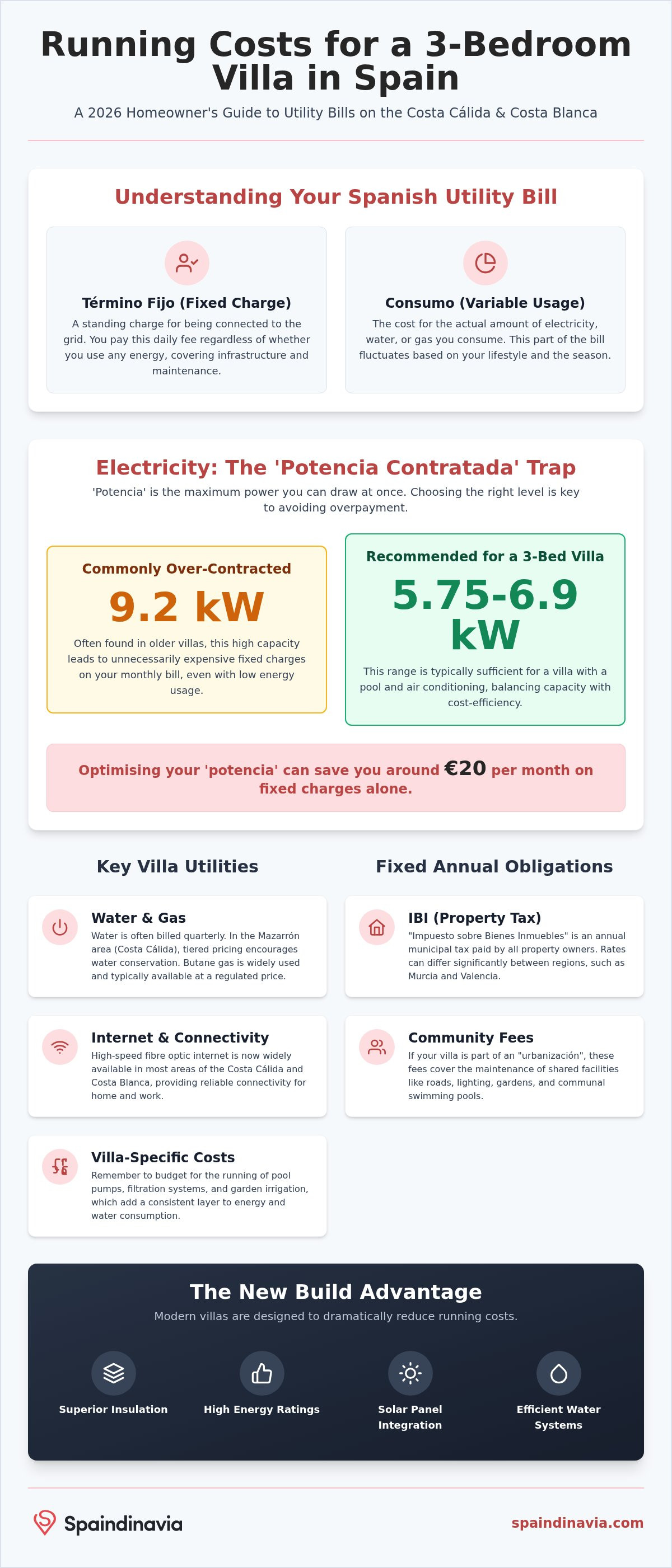
Every utility bill you receive will be split into two distinct parts: the término fijo (fixed term) and the variable consumption. The fixed term is a daily rate you pay simply for being connected to the grid, regardless of whether you've switched on a single light bulb. In Spain, standing charges are the fixed daily or monthly fees paid to utility providers to cover the maintenance of the connection and infrastructure before any actual energy is consumed.
Usage is typically billed monthly for electricity, whilst water is often billed quarterly, depending on your local municipality. Understanding the energy infrastructure in Spain helps clarify why these standing charges exist, as the country continues to invest heavily in its renewable grid. By monitoring both parts of your bill, you can identify if you're paying for more capacity than your three-bedroom villa actually requires.
Regional Nuances: Murcia vs Valencia
Location plays a pivotal role in your annual costs. In the Murcia region, specifically around Puerto de Mazarrón and Bolnuevo, property tax (IBI) rates can differ from those in the neighbouring Valencia region on the Costa Blanca. Water is a precious resource in the Mazarrón area; pricing is often tiered, meaning the more you use, the higher the rate per cubic metre becomes. This makes smart irrigation systems a wise investment for your garden.
If you're looking at new build villas in Isla Plana or La Azohía, you'll find that baseline costs are frequently lower. Modern construction standards focus on high-spec insulation and efficient water systems, which helps mitigate the impact of regional price fluctuations. By choosing a property with a high energy rating, you're effectively future-proofing your lifestyle against rising utility trends whilst ensuring your home remains a sanctuary of comfort.
Electricity Bills: Managing Potencia and Climate Control
Electricity is often the largest variable in the typical utility bills for a 3 bed villa in spain, particularly in regions like Murcia and Alicante where Iberdrola is the dominant provider. While the cost per kilowatt-hour remains a key figure, the way your contract is structured can have a surprising impact on your monthly outgoings. Managing your energy effectively isn't just about switching off lights; it's about understanding how the Spanish grid allocates power to your home and how your lifestyle choices, like cooling and pool maintenance, influence the final total.
The Potencia Explained: Choosing Your Capacity
One of the most unique aspects of Spanish electricity billing is the potencia contratada. This is the maximum amount of power you can draw at any single moment. If you try to run your oven, dishwasher, and air conditioning simultaneously and exceed this limit, your power will trip via the ICP (Interruptor de Control de Potencia). Many older villas are on contracts with unnecessarily high capacity, which means you're paying a premium on your standing charge every day.
For a standard three-bedroom villa with a private pool and central air conditioning, a potencia of 5.75 kW or 6.9 kW is usually sufficient. If you find your villa is currently contracted at 9.2 kW or higher, you're likely caught in a common trap. Reducing your potencia through your provider can often save you around €20 per month in fixed costs. If you're considering an upgrade to a more efficient home, exploring new build villas with modern electrical installations can make this optimisation even simpler.
Air Conditioning and Heating Costs
Climate control is the primary driver of seasonal fluctuations. In the peak of August, running air conditioning for 8 to 12 hours a day can see monthly bills rise to between €150 and €200. Conversely, modern inverter systems found in newer properties are significantly more efficient than older units, providing both cooling in summer and cost-effective heating during the shorter winter months. Your private pool also plays a role; a standard pump typically needs to run for 6 to 8 hours a day during the summer to maintain water quality, adding a consistent draw to your daily usage.
| Season | Typical Usage Profile | Estimated Monthly Bill (2026) |
|---|---|---|
| Summer (July–August) | High AC usage + 8hr pool pump | €150 – €210 |
| Winter (January–February) | Moderate heating usage | €100 – €140 |
| Shoulder (April–May) | Minimal climate control | €60 – €85 |
By shifting heavy appliance usage to off-peak hours, such as running the pool pump or dishwasher overnight or during the midday "valle" period, you can take advantage of lower hourly rates. This proactive approach ensures your Mediterranean lifestyle remains as affordable as it is enjoyable.
Water, Gas, and Connectivity: The Essentials
While electricity often dominates the conversation, water, gas, and digital connectivity are the quiet essentials that keep your Mediterranean home running smoothly. When calculating the typical utility bills for a 3 bed villa in spain, these costs are generally more stable than energy prices, yet they require a different management approach. Whether you're planning to live in Bolnuevo year-round or use your villa as a seasonal retreat, understanding how these local services are billed ensures there are no surprises in your letterbox.
Water and Rubbish Collection (Basura)
Water billing in the Mazarrón region, including coastal gems like La Azohía and Bolnuevo, typically follows a quarterly cycle. For a three-bedroom villa with a landscaped garden, you should budget between €30 and €50 per month, though you'll pay this as a lump sum every three months. It's important to remember that water pricing is tiered; as your consumption increases to fill a pool or irrigate a large lawn, the cost per cubic metre rises to encourage conservation in our sun-drenched climate.
A unique feature of the local system is the Tasa de Basura (rubbish collection fee). In many parts of the Costa Cálida, this municipal tax is bundled directly into your water bill. This convenient arrangement covers the daily collection of waste and maintenance of the local recycling points. By keeping an eye on your quarterly statement, you can easily track both your environmental footprint and your municipal contributions in one go.
Fibre Optic and Home Security
Spain boasts some of the most advanced fibre optic infrastructure in Europe, and even tranquil areas like Isla Plana enjoy high-speed access. In 2026, a 600Mb or 1Gb fibre connection typically costs between €25 and €55 per month. Many providers offer "holiday home" packages, allowing you to pause the service or reduce the speed whilst the property is vacant, which is a fantastic way to keep costs down without losing connectivity entirely.
For villa owners, a monitored security system is a standard and sensible addition. Subscription fees for these services usually range from €30 to €60 per month, providing 24/7 peace of mind and often a slight reduction in your home insurance premium. Traditional orange Butano bottles remain a popular, low-cost choice for cooking and hot water because they offer a high energy yield without the monthly standing charges associated with mains gas. As of late 2026, a standard 12.5kg cylinder is regulated at €18.84, making it an incredibly cost-effective option for many households.
Managing these essentials from afar is much simpler with a local partner. Our property management services in Puerto de Mazarrón help owners monitor their usage and ensure all bills are paid via direct debit, preventing any service interruptions. This level of support allows you to focus on the joy of your Spanish home, knowing the practicalities are being handled by experts who care about your investment.
Fixed Annual Costs: Community Fees and Property Taxes
Beyond the monthly fluctuations of electricity and water, owning a villa involves several fixed annual obligations. These costs are the bedrock of your property's legal and social standing in Spain. When considering the typical utility bills for a 3 bed villa in spain, it's vital to look at the "big picture" of annual taxes and maintenance fees. By understanding these figures upfront, you ensure your Mediterranean dream remains a sound financial investment for years to come.
Calculating Your IBI (Council Tax)
The Impuesto sobre Bienes Inmuebles (IBI) is the Spanish equivalent of council tax. It's calculated based on the valor catastral, which is the administrative value assigned to your property by the town hall. This value is almost always significantly lower than the market price. For a typical three-bedroom villa in the Costa Blanca or Costa Cálida, IBI rates generally range between 0.4% and 1.1% of this cadastral value. For instance, in areas like Alicante or Torrevieja, rates often hover around 0.62% to 0.67%.
For new build villas, the cadastral value is determined after the construction is registered, meaning your first IBI bill might arrive a year or two after completion. It's wise to set aside a contingency fund based on local averages during this period. For a deeper dive into how these taxes fit into the initial purchase, our buying property in Spain guide provides a comprehensive roadmap for a secure investment.
Community of Owners (Comunidad)
Community fees apply if your villa is part of a managed urbanisation. These fees fund shared amenities such as street lighting, private security, and the maintenance of communal gardens or roads. Whilst luxury estates can command high annual fees, many independent villas in Puerto de Mazarrón and Bolnuevo have zero community fees. This is a significant advantage for those seeking total independence and lower fixed outgoings.
In addition to taxes, you should budget for annual home insurance. In 2026, a standard premium for a well-located three-bedroom villa typically ranges from €250 to €450, depending on your coverage level. Non-resident owners must also account for the Modelo 210 tax. This is a non-resident income tax calculated on the "imputed rental income" of the property. For EU residents, the rate is 19% of a small percentage of the cadastral value, whilst non-EU residents pay 24%.
Navigating these annual requirements is straightforward when you have local experts by your side. If you're looking for a property that offers high value with minimal fixed costs, explore our selection of Investments Properties tailored to your lifestyle goals.
Reducing Running Costs with Modern New Build Villas
While the typical utility bills for a 3 bed villa in spain provide a baseline for your budget, choosing a modern new build can fundamentally change those numbers. Traditional resale properties often suffer from poor thermal insulation and outdated climate systems, leading to energy leakage that you pay for every month. We prioritise properties with superior energy ratings (A or B), ensuring your home is built with advanced materials that naturally regulate temperature. This architectural focus significantly reduces the need for constant air conditioning, keeping your sanctuary cool whilst the Mediterranean sun is at its peak.
Smart home technology has also become a standard feature in our selection of new properties. These systems allow you to monitor and control your utilities remotely from your smartphone, which is an invaluable tool for holiday home owners. You can switch off water heaters, adjust the pool pump schedule, or set the climate control to activate just before you arrive from the airport. This level of precision ensures that not a single cent is wasted on unnecessary energy consumption.
The Solar Advantage in 2026
Integrating solar technology is no longer a luxury; it's a strategic investment. In 2026, incentives across the Murcia and Valencia regions continue to make installation highly attractive, often allowing you to slash your electricity bills by up to 70%. The typical payback period for a three-bedroom villa is now remarkably short, especially when combined with intelligent storage solutions. For those embracing the future of transport, "Zöld Mód" style smart charging allows EV owners to power their vehicles directly from their own roof, bypassing rising grid costs and ensuring your lifestyle remains as sustainable as it is luxurious.
Why New Builds Win on ROI
The financial benefits of a new build extend far beyond the monthly electricity statement. Maintenance costs for a modern villa are significantly lower than those for older resale properties in areas like Bolnuevo or La Azohía, where aging plumbing and electrical systems can lead to expensive hidden utility costs. By choosing a property through Spaindinavia, you benefit from our deep local expertise in Puerto de Mazarrón and Isla Plana. We help you monitor your home's performance through professional property management, ensuring your systems are running at peak efficiency even when you aren't there.
Don't let inefficient housing dampen your Spanish dream. Contact us today to explore our latest new build villas and discover how a high-spec home in Costa Cálida or Costa Blanca can secure your long-term financial peace of mind. We are here to guide you through every step of the process, ensuring your transition to a warmer climate is both secure and inspiring.
Secure Your Future in the Spanish Sun
Embracing a Mediterranean lifestyle is entirely achievable when you have a clear, realistic picture of your monthly outgoings. We've explored how the typical utility bills for a 3 bed villa in spain are shaped by proactive choices, from optimising your electrical capacity to choosing modern thermal insulation. By selecting a property built to 2026 standards, you aren't just buying a beautiful home; you're investing in a lifestyle that remains affordable and sustainable for the long term.
Our team at Spaindinavia acts as your dedicated bridge to the property market in Puerto de Mazarrón, Bolnuevo, and across the Costa Blanca South. We offer a hand-picked portfolio of high-efficiency homes and provide expert guidance through the entire buying and management process. As local specialists, we ensure you feel secure and supported at every stage of your journey, from the first viewing to the first utility bill.
View our energy-efficient new build villas in Costa Cálida and Costa Blanca to find a home that perfectly balances luxury with low running costs. Your new life in the sun is waiting, and we're here to help you make it a reality with total peace of mind.
Frequently Asked Questions
What is the average monthly utility bill for a 3-bed villa in Spain?
The average monthly cost for typical utility bills for a 3 bed villa in spain usually falls between €150 and €250. This range covers your electricity, water, and connectivity. Your actual outgoings will fluctuate based on the season, with summer air conditioning and pool maintenance increasing the total. By opting for a modern new build with high energy efficiency, you can often keep these costs at the lower end of the scale.
Is electricity more expensive in Spain than in the UK?
Electricity prices in Spain are often comparable to those in the UK, although the billing structure is different. Spain applies a 21 per cent VAT rate on electricity, and your bill includes a fixed capacity charge regardless of your usage. While the cost per unit is similar, many homeowners find their bills are lower overall if they utilise solar panels or live in modern properties that require less artificial heating and cooling.
How much does it cost to maintain a private swimming pool in Spain?
Maintaining a private swimming pool typically costs between €60 and €100 per month. This budget includes the electricity required to run the filtration pump for several hours daily and the necessary chemicals to keep the water safe. You should also account for water evaporation during the height of summer. Modern, energy-efficient pumps can help reduce this expense, especially when integrated with a solar power system that offsets the daily draw.
What is "potencia contratada" and how do I choose the right level?
Potencia contratada is the maximum power capacity your home can draw from the grid at once. For a three-bedroom villa with air conditioning and a pool, a level of 5.75 kW or 6.9 kW is usually ideal. Choosing the correct level is vital; if you set it too low, your power will trip when using multiple appliances. Conversely, setting it too high means you are paying unnecessary standing charges every single month.
Do I have to pay community fees if I own a detached villa?
You only pay community fees if your villa is located within a private urbanisation or complex with shared amenities. Many detached villas in areas like Puerto de Mazarrón are independent and have zero community fees. If your property is part of a community, these fees cover street lighting, shared security, and the upkeep of communal gardens. It is essential to check the specific legal status of any property before you complete your purchase.
How much is the annual IBI (property tax) for a villa in Mazarrón?
The annual IBI for a villa in the Mazarrón municipality is calculated as a percentage of the property's valor catastral. While rates vary, you can generally expect to pay between €400 and €900 per year for a standard three-bedroom home. This tax is paid once a year to the local town hall. New build properties may have a slightly different initial assessment compared to older resale villas, so checking the latest municipal rates is always advisable.
Are utility bills higher on the Costa Blanca compared to the Costa Cálida?
Utility costs are broadly similar across both regions, though municipal water rates and IBI taxes can vary between the Murcia and Valencia regions. When looking at typical utility bills for a 3 bed villa in spain, the Costa Cálida often provides excellent value compared to busier hubs. Ultimately, the energy efficiency and insulation of your specific villa will have a much larger impact on your monthly budget than the regional border itself.
Can I manage and pay my Spanish utility bills from the UK?
You can easily manage your Spanish utility bills from the UK by setting up direct debits from a Spanish bank account. Most providers like Iberdrola or Aqualia offer online portals or mobile apps for tracking your usage. For total peace of mind, our property management services in Puerto de Mazarrón provide key holding and routine inspections. We monitor your home whilst you are away, ensuring everything remains secure and your bills are handled correctly.


