
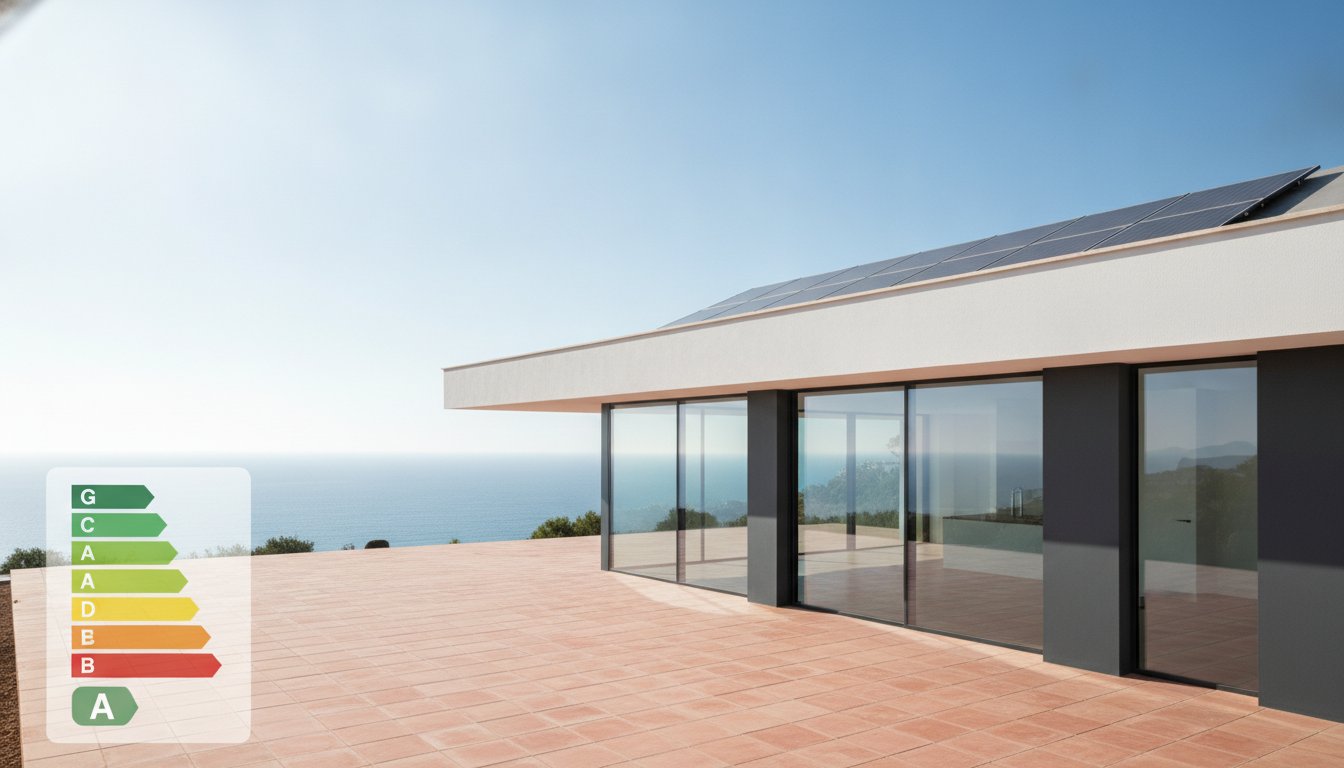
Did you know that a property with an 'A' rating can command a market value up to 10% higher than one rated 'G'? We understand that for many homeowners across the Costa Blanca and the Costa Calida, dealing with Spanish bureaucracy often feels more like a chore than an opportunity. It's natural to feel anxious about the costs of upgrading a resale villa in Bolnuevo or a townhouse in Isla Plana, especially with new regulations on the horizon. This is why understanding energy efficiency certificates for spanish homes is no longer just a legal box to tick; it's a vital tool for protecting your property investment value.
Whether you own a beachfront apartment in Puerto de Mazarrón or a quiet retreat in La Azohia, we're here to guide you through the process with clarity and warmth. Whilst you'll find small registration fees in the Valencia region (Costa Blanca) that differ from the administrative steps in the Murcia region (Costa Calida), we promise to help you master the EPC system regardless of your location. This guide provides a clear roadmap for the 2030 EU requirements and explains how a top-tier rating can help you secure more favourable mortgage rates.
Key Takeaways
- Understand the upcoming 2030 and 2033 EU deadlines that mandate a minimum 'E' rating for selling or renting your home in Spain.
- Discover how energy efficiency certificates for spanish homes can enhance your property’s market value and unlock 'Green Mortgages' with lower interest rates.
- Compare the efficiency standards of new build villas in the Costa Blanca with resale apartments in the Costa Calida to make an informed investment choice.
- Learn the practical steps to upgrade your property in Puerto de Mazarrón or Bolnuevo by following the specific recommendations found in your CEE report.
- See how we protect your purchase in Isla Plana or La Azohia by ensuring every home is fully vetted for energy compliance and registered correctly.
What is the Energy Efficiency Certificate (CEE) in Spain?
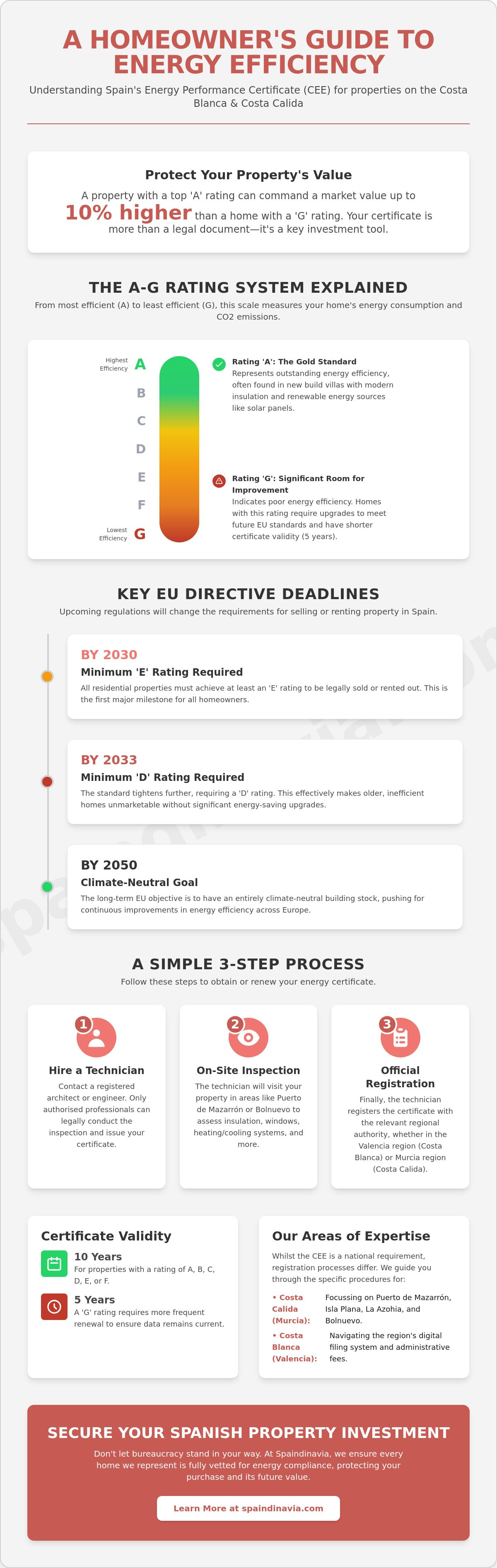
The Certificado de Eficiencia Energética (CEE) is a vital legal document for any property owner in Spain. If you're planning to sell a resale apartment in Puerto de Mazarrón or rent out a townhouse in Bolnuevo, you must have energy efficiency certificates for spanish homes in place before you find a buyer or tenant. It provides an objective look at how much energy your home consumes and its level of CO2 emissions. Ratings are assigned on a clear scale from A to G. An 'A' rating represents the gold standard of efficiency, whilst a 'G' rating indicates significant room for improvement. Effectively, the CEE is the Spanish equivalent of the UK’s EPC but with stricter implications for future rentals that owners must prepare for now.
This system originates from the EU's Energy Performance of Buildings Directive, which aims to reduce the carbon footprint of housing across the continent. When you receive your certificate, it includes a tailored list of recommended improvements. These suggestions help you boost your property's rating over time, which is becoming increasingly important for maintaining market value. Whether you're looking at properties in the Costa Blanca or the Costa Calida, these ratings provide essential transparency for every transaction.
Validity and Legal Obligations for Owners
Standard energy efficiency certificates for spanish homes remain valid for 10 years from the date of issue. However, there's a crucial exception; properties with a 'G' rating must have their certificates renewed every 5 years to ensure the data remains current. Staying compliant is essential for your peace of mind. Fines for failing to provide a valid CEE during a transaction range from €300 to €6,000. Spanish property portals and notaries now strictly monitor these ratings. Advertising a home without one simply isn't an option in today's market.
The Role of the Registered Technician
Obtaining your certificate requires a physical visit from a qualified professional. Only registered architects or engineers are authorised to conduct these inspections and sign the final document. The technician's job isn't just to look at your bills; they examine specific elements of the property including:
- The quality of thermal insulation in walls and roofs.
- The efficiency of windows and external doors.
- The age and performance of heating and cooling systems.
- The use of renewable energy sources, such as solar panels.
Once the inspection is complete, the technician must register the document with the regional industry department. In the Costa Blanca (Valencia region), this process involves a small administrative fee and a specific digital filing system. Conversely, in the Costa Calida (Murcia region), the registration steps might differ slightly, especially for homes in Isla Plana or La Azohia. We always advise buyers to verify that the registration number is active and official before completing a purchase to ensure total security in their investment.
The A-G Rating System: Navigating 2030 and 2033 EU Directives
The timeline for property owners in Spain is becoming increasingly clear. Whilst the Mediterranean sun provides plenty of natural warmth, the way our homes retain that energy is now under the spotlight. To achieve a climate-neutral building stock by 2050, the European Union has introduced aggressive targets that will change how we buy and sell property. According to the official EU directive on energy performance, all residential properties must achieve a minimum rating of 'E' by 2030 to be sold or rented. This is just the first milestone. By 2033, the minimum standard rises again to a 'D' rating, effectively outlawing older, inefficient homes from the market unless they undergo significant upgrades.
Understanding energy efficiency certificates for spanish homes is the first step in future-proofing your lifestyle. These regulations aren't designed to be a hurdle, but rather a guide towards more comfortable and sustainable living. Whether you are looking at a classic resale apartment in Puerto de Mazarrón or a modern villa in the Costa Blanca, these ratings will soon dictate the legal viability of your investment. It's a significant shift that rewards proactive owners who choose to modernise their homes sooner rather than later.
The "G-Rated Trap" and Market Value
Properties currently sitting at the bottom of the scale with an 'F' or 'G' rating face what experts call a "brown discount". In the 2026 market, buyers are becoming incredibly savvy. Investors are increasingly avoiding low-rated apartments in Isla Plana or Bolnuevo in favour of modernised townhouses that already meet future standards. A low rating often leads to longer time-on-market and gives buyers a powerful lever for aggressive price negotiations. If you're currently exploring investment properties along the coast, prioritising a higher energy class is essential for maintaining liquidity and long-term value.
Green Mortgages and Financial Incentives
Financial institutions across Spain are now actively supporting this transition. Many banks have introduced "Hipotecas Verdes" (Green Mortgages), which offer lower interest rates for homes with an 'A' or 'B' rating. This isn't just about saving the planet; it's about saving you thousands of euros in interest over the life of your loan. Additionally, official appraisers (tasadores) in both the Murcia and Valencia regions are now required to factor energy efficiency into their final valuations. A high rating on energy efficiency certificates for spanish homes can literally boost your borrowing power and improve the overall equity in your Mediterranean retreat.
New Build Villas vs Resale Properties: Regional Standards
When choosing your dream home, the gap between modern architecture and older charm has never been wider. New build villas are now designed with sustainability at their core; they are legally required to meet stringent standards that frequently result in an A or B rating. It's reassuring to know that Spaindinavia specialises in new build villas that already exceed 2033 standards. This gives you total peace of mind for the decade ahead. Whilst resale properties often carry a unique history, they frequently lag behind in the current 2026 energy landscape.
In the Costa Cálida, particularly around the Mazarrón area, the approach to energy efficiency certificates for spanish homes is heavily influenced by the local climate. With over 320 days of sunshine annually, the priority shifts from keeping heat in to keeping the intense summer heat out. Contrast this with the Costa Blanca, where older resale properties often face different structural hurdles. Choosing between these regions isn't just about the view; it's about understanding how the build quality affects your daily comfort and monthly outgoings.
The Efficiency Advantage of Costa Cálida New Builds
Modern developments in Puerto de Mazarrón and Isla Plana are leading the way with advanced aerothermal systems. These clever setups use the outside air to provide cooling and hot water with incredible efficiency. In Bolnuevo, many of our new villas incorporate passive cooling techniques. These include strategic shading and cross-ventilation to keep interiors fresh without relying solely on expensive air conditioning. High-quality glazing is another non-negotiable feature in the Murcia region; it's essential for managing solar gain whilst maintaining a comfortable indoor temperature year-round.
Challenges for Resale Homes in Costa Blanca South
Whilst resale apartments in the Costa Blanca offer plenty of character, they often present a different set of challenges for energy efficiency certificates for spanish homes. Many older buildings lack modern wall cavity insulation, which often leads to disappointing E or F ratings. Retrofitting these homes with external insulation or solar panels is possible, but the cost-benefit analysis often tilts in favour of new builds when you factor in long-term energy savings. In the Valencia region, it's also important to understand how the 'Certificado de Segunda Ocupación' (the habitation certificate) interacts with your energy rating. Ensuring both are up to date is crucial for a smooth transaction and for securing the best possible utility contracts for your new Mediterranean lifestyle.
How to Obtain and Improve Your Energy Certificate
Taking the first step towards securing your property’s future is simpler than you might think. Whilst the technical details of energy efficiency certificates for spanish homes can seem complex, the actual process of obtaining one is straightforward when you have the right local guidance. In areas like Puerto de Mazarrón and Bolnuevo, we often see homeowners transform their properties from simple holiday retreats into high-value, efficient assets by following the specific roadmap provided in their technician's report. This document is more than a legal requirement; it's a practical guide to making your home more comfortable and cost-effective.
The 5-Step Process to Getting Your CEE
Organising your certificate involves a clear sequence of events. First, you must find a registered technician, typically a qualified architect or engineer, who is authorised to work in your specific region. Whether your property is in the Costa Blanca or the Costa Calida, always ensure your chosen professional is registered with the regional industry body. The process follows these steps:
- Physical Inspection: The technician visits your home in Isla Plana or La Azohia to measure windows, check insulation thickness, and inspect the boiler and air conditioning units.
- Data Entry: Using official Spanish software such as HULC or CE3X, the professional inputs the measurements to calculate energy demand.
- Emission of Certificate: The software generates the rating based on CO2 emissions and primary energy consumption.
- Regional Registration: The document is filed with the regional authority. In the Valencia region, this requires a specific digital tax payment, whilst the Murcia region has its own administrative procedure.
- Official Label: Once registered, you receive the official A-G label, which is essential for any property sale or rental agreement.
Top 3 Upgrades for Maximum Rating Boost
If your current rating is lower than you'd like, don't worry. There are several ways to improve your standing. Installing solar panels (photovoltaics) is the fastest way to see a dramatic jump, often moving a property from a D to an A rating almost instantly. Replacing old, draughty windows with modern double or triple glazing featuring "Climalit" thermal breaks is another vital step for the Spanish climate. Finally, upgrading to an aerothermal heat pump for your hot water and climate control is a modern standard that offers incredible long-term savings. These improvements ensure that energy efficiency certificates for spanish homes reflect the true value of your investment.
It is also worth considering the impact of "Zonas Comunes" or common areas. If you own an apartment in a gated community in Puerto de Mazarrón, the efficiency of communal pool pumps and hallway lighting can influence individual property ratings. This makes community-wide green initiatives a smart move for every owner. If you're ready to find a home that is already optimised for the future, browse our latest investment properties to see the best of what the coast has to offer.
Secure Your Investment: The Spaindinavia Approach
At Spaindinavia, we believe your journey to a Mediterranean lifestyle should be filled with excitement, not paperwork. We act as a reliable bridge between your dreams and the local property market, ensuring every detail is handled with care. This includes a rigorous vetting process where we verify that energy efficiency certificates for spanish homes in our portfolio are fully valid and officially registered. By working alongside independent solicitors, we provide a layer of security that allows you to focus on choosing the right view whilst we handle the technical compliance. Whether you are looking at a modern bungalow in the Costa Blanca or a resale villa in the Costa Calida, our expertise ensures your investment is protected from day one.
Our passion for the local area drives us to be more than just intermediaries. We position ourselves as local experts who genuinely care about your long-term happiness. We prioritse new build villas because they represent the most secure financial path in the 2026 market. These homes are designed to exceed current standards, meaning you won't have to worry about the evolving EU regulations that might affect older properties. It's about providing peace of mind through professional expertise and personal warmth.
Expert Guidance in Puerto de Mazarrón and Beyond
Our dedicated team provides direct, hands-on support for buyers exploring the beautiful coastal stretches of La Azohía and Bolnuevo. We understand that navigating regional energy requirements can feel daunting, so we lead you through the process step-by-step. For those looking to sell, we help organise the CEE before the property even hits the market, ensuring a smooth and legal transaction for everyone involved. If you want to dive deeper into how efficiency impacts your returns, our Spain property investment guide offers excellent insights into maximising ROI whilst enjoying a better quality of life.
Focusing on Quality and Long-Term Value
We carefully select properties that are "future-proofed" against the upcoming 2033 EU directives. This proactive approach is a cornerstone of our philosophy. Beyond the initial purchase, our property management services help owners in Isla Plana and Puerto de Mazarrón maintain high efficiency levels, which leads to lower utility bills and a smaller environmental footprint. We want your home to be a sanctuary of well-being and safety. As an actionable tip, we always recommend that you ask to see the official energy efficiency certificates for spanish homes before making a formal offer on any resale property. This simple step ensures there are no surprises regarding the home's thermal performance or future legal standing.
Secure Your Future in the Spanish Sun
Navigating the evolving landscape of energy efficiency certificates for spanish homes is about more than just legal compliance; it's about ensuring your Mediterranean retreat remains a valuable and comfortable sanctuary for years to come. By understanding the shift towards higher standards for 2030 and 2033, you can make informed decisions that protect your capital and reduce your monthly outgoings. Whether you're drawn to the quiet coves of Isla Plana or the vibrant atmosphere of the Costa Blanca, prioritising energy performance is the smartest way to future-proof your investment.
Since 2016, we've collaborated with independent solicitors to ensure every property we represent meets the highest standards of safety and efficiency. Our hand-picked portfolio focuses on A and B rated new builds that already exceed upcoming EU directives, giving you total peace of mind. From Puerto de Mazarrón and Bolnuevo to the southern Costa Blanca, we're here to guide you through every step of your journey with professional expertise and personal warmth. Take the first step towards a more sustainable and secure lifestyle today.
Browse our energy-efficient New Build Villas in Costa Cálida and discover the perfect balance of modern luxury and environmental responsibility.
Frequently Asked Questions
Is an energy certificate mandatory for all homes in Spain?
Yes, the Certificado de Eficiencia Energética (CEE) is a legal requirement for almost every property transaction in Spain. Whether you own a resale apartment in Puerto de Mazarrón or a villa in the Costa Blanca, you must present this document at the point of sale or when signing a rental contract. There are very few exceptions, such as stand-alone buildings with a total floor area of less than 50 square metres.
How much does an Energy Efficiency Certificate cost in 2026?
In 2026, the cost for a standard apartment up to 90 square metres typically ranges from €60 to €150. Prices are liberalised, meaning they vary based on the technician's fees and the property's location. You should also account for regional registration fees; for instance, the Valencian Community (Costa Blanca) charges a small fee whilst the Murcia region (Costa Calida) has its own specific administrative structure.
Can I rent out my Spanish property if it has a G rating?
You can currently rent out a G-rated property, but this will change significantly by January 1, 2030. Under upcoming EU regulations, residential properties must achieve at least an 'E' rating to be legally rented or sold. If your home in Isla Plana or Bolnuevo currently sits at 'G', it's wise to start planning the upgrades suggested in your technician's report now to avoid future legal restrictions.
What happens if I sell my home without a CEE?
Attempting to sell a property without energy efficiency certificates for spanish homes can lead to serious legal and financial consequences. Notaries will generally refuse to sign the deeds without one, and you could face fines ranging from €300 to €6,000 depending on the severity of the omission. It also weakens your negotiating position, as savvy buyers in La Azohia or the Costa Blanca will use the lack of certification as a reason to lower their offer.
How long does it take to get the certificate registered?
The physical inspection usually takes less than an hour, but the official registration process varies by region. In the Costa Calida, you can often expect the registered document within a few working days. However, in the Costa Blanca (Valencia region), administrative timelines can sometimes take up to two weeks. We recommend starting the process at least a month before listing your property to ensure your paperwork is in order.
Do new build villas always have an A or B rating?
Modern building regulations in Spain now mandate that new constructions meet exceptionally high-efficiency standards. Most new build villas in our portfolio across Puerto de Mazarrón and the Costa Blanca achieve an 'A' or 'B' rating. These homes utilise advanced insulation and aerothermal systems, ensuring they are already compliant with the strict 2033 EU requirements, which makes them a very secure long-term investment choice.
Is the Spanish CEE the same as the British EPC?
They are very similar in purpose, as both provide a snapshot of a property's energy performance on an A-G scale. Whilst the British EPC is widely understood, the Spanish CEE carries heavier weight regarding future rental legality due to the 2030 EU targets. The technical indicators used in energy efficiency certificates for spanish homes were also updated in April 2026 to include new metrics like Global Warming Potential (GWP).
Can I improve my rating without spending a fortune on solar panels?
Absolutely, there are several cost-effective ways to boost your rating. Simple changes like switching to 100% LED lighting or adding professional draught-proofing can make a noticeable difference. However, more impactful mid-range improvements include adding insulation to wall cavities or upgrading to high-quality thermal glazing. These steps can often lift a property in Bolnuevo or the Costa Blanca by one or two letter grades without the higher initial outlay of a full solar installation.


