

Could a property look straightforward on paper yet show different details in the Catastro and the Registro de la Propiedad? If you're wondering how to check for land registry (catastro) discrepancies, start by comparing each record with your property documents and what you can see on site. A mismatch can feel unsettling when you're buying or selling, but first pinpoint exactly what differs.
The Catastro describes a property's physical characteristics and is used for tax purposes, while the Registro de la Propiedad records legal ownership and charges. Compare the cadastral details with the property deed and a recent nota simple, the Land Registry extract. Check the stated area, boundaries and recorded structures, such as extensions or a pool. This guide explains what to gather when details do not match, and why you should not assume the issue is settled just because one record looks correct. An independent solicitor can assess the legal significance of a discrepancy and advise on sensible next steps.
Key Takeaways
- Learn how to check for land registry (catastro) discrepancies by comparing records with your property documents and the property itself.
- Gather documents, confirm the property’s identity and note differences without jumping to conclusions.
- Sort mismatches into practical categories, then ask an independent solicitor to assess their legal significance.
- Keep copies, write a neutral summary and collect relevant evidence before discussing next steps with your solicitor.
- Spaindinavia can support your wider property purchase and introduce you to independent legal professionals.
What a Catastro discrepancy means when checking a property in Spain
A difference between property records is something to investigate, not proof by itself that a purchase is defective. Identify what differs, which documents show it and whether the discrepancy has legal significance. That distinction is central to how to check for land registry (catastro) discrepancies without jumping to conclusions.
A Catastro discrepancy is a difference between the cadastral description of a property and another description of it, such as its registered details, deed or physical features. The term identifies a mismatch to examine. It does not, on its own, explain why the difference exists or determine which record needs attention.
Catastro and Registro de la Propiedad: what each record describes
The Catastro is Spain’s cadastral record, containing information that describes property. For general background on the purpose of cadastral systems, see What is a Cadastre? The Registro de la Propiedad (Registro) records legal information relating to property, including registered ownership and other entries. The records serve different purposes, so a difference between them is a question to investigate, not an automatic verdict about the property.
Your escritura, or property deed, and the building or land itself provide further points of comparison. A record may describe a parcel, while the deed relates to the transaction or rights recorded in it, and the physical property shows what is actually present. The descriptions may not match word for word. Their legal meaning depends on the specific documents and circumstances, which an independent solicitor can interpret.
Which details can appear inconsistent?
As you compare the records, look for differences in the details each source provides. Note them precisely without deciding yet that they prove a legal problem:
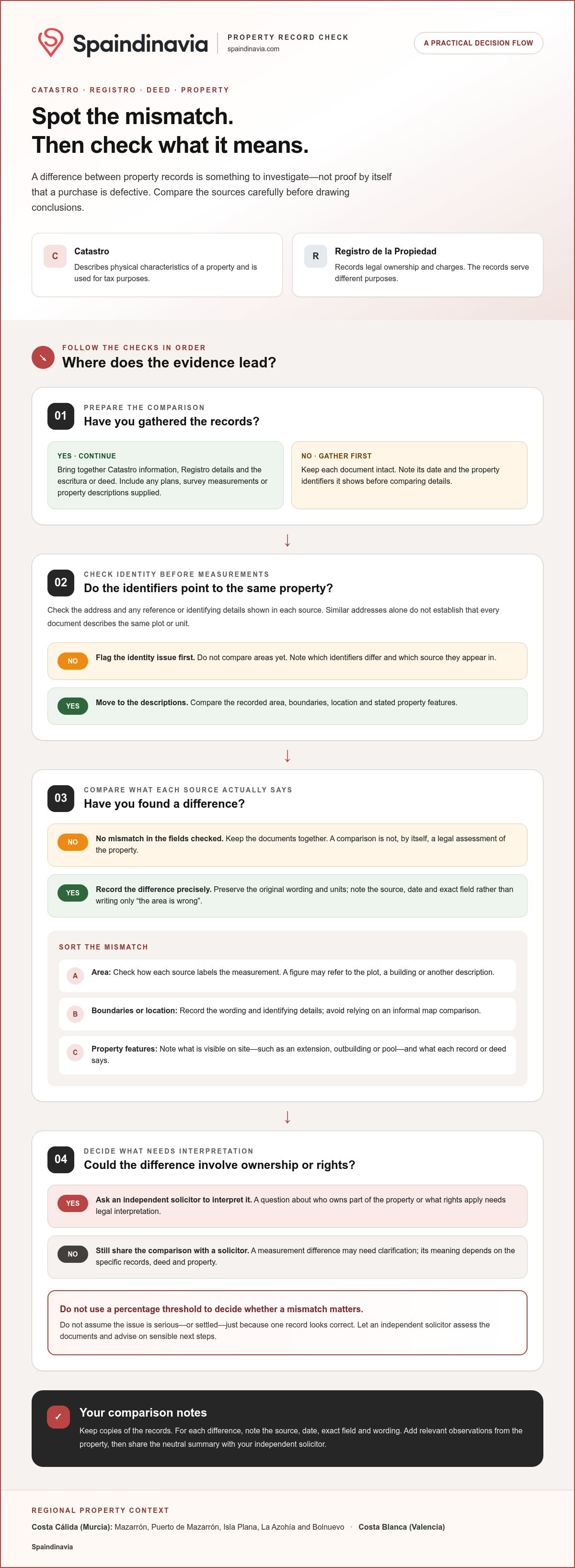
- Area: One document may state a different surface area. Check how each document labels or describes the measurement before treating the figures as directly comparable.
- Boundaries or location: Descriptions of the plot, adjoining land or location may vary. Record the wording and identifying details rather than relying on an informal map comparison.
- Property description: A house, extension, outbuilding or pool visible on site may not appear in every record or deed. Note what is present and what each document actually says.
A difference in measurement is not the same as a difference in ownership or legal status. A larger or smaller area figure may need clarification; a question about who owns part of the property or what rights apply needs legal interpretation. Do not rely on a single percentage threshold to decide whether a mismatch matters. The appropriate interpretation and next steps depend on the specific records, deed and property, so ask an independent solicitor to assess the documents before assuming the issue is either serious or settled.
How to check Catastro records against your property documents
A careful comparison is easier when you work from a consistent set of documents and keep a clear note of what each one says. This gives you useful evidence to discuss with an independent solicitor, without trying to decide the legal effect of a mismatch yourself.
To check a property, compare the Catastro, Registro, escritura and physical property, then record exactly where their descriptions differ. Follow the steps in order. Confirming that you are looking at the same property comes before comparing measurements.
Gather the records before comparing them
Bring together the cadastral information available to you, the relevant Registro details and the escritura or deed. Include any plans, survey measurements or property descriptions already supplied. Keep each document intact, note its date and write down the property identifiers it shows. This makes it easier to check whether the records refer to the same property and share a clear set of documents with your solicitor.
- Collect the documents. Gather the Catastro information, Registro details and deed, alongside any plans or measurements supplied for the property.
- Match the property identifiers. Check the address and any reference or identifying details shown in each source. If these appear inconsistent, flag that before comparing areas.
- Compare descriptions. Place the recorded area, boundaries, location and stated property features side by side, using only details available in the documents.
- Check against the property. Note visible features that appear relevant, such as an extension or outbuilding, but do not treat an observation as a legal conclusion.
- Record each difference and seek interpretation. Write down the source, date, exact field and wording, then share the comparison with an independent solicitor.
Compare identifiers, area and boundaries carefully
Start with identity, not arithmetic. Similar addresses do not necessarily establish that every document describes the same plot or unit. Once you are confident the records relate to the property you are checking, put the area figures side by side. Preserve the original wording and units, and note whether a figure refers to the plot, a building or another description.
Be precise. Instead of writing “the area is wrong”, record something like: “The Catastro information states one area; the deed states another.” Copy the relevant wording where possible, and note any differences in boundary or location descriptions. This neutral summary helps your solicitor review the evidence without mistaking your interpretation for a fact. A measurement difference alone does not establish a difference in ownership or legal status. Its significance depends on the documents and circumstances.
If you are buying a property, keep your document comparison with the wider purchase paperwork. Spaindinavia supports international buyers throughout the purchase process and introduces them to independent solicitors for legal checks. Read about property purchase support as you organise your next steps.
How to assess a mismatch without relying on a misleading threshold
A figure can show that two descriptions differ, but it cannot tell you on its own whether the difference is a minor record detail or something that needs further investigation. To check for land registry (catastro) discrepancies responsibly, classify what you have found, keep the evidence and ask an independent solicitor to interpret the specifics.
Use this comparison as a working note, not a legal assessment. “Matching” means the details appear consistent in the documents you have reviewed; it does not confirm a property’s legal status.
| Detail to compare | What to record | Question for your solicitor |
|---|---|---|
| Property identity | Do the identifiers and descriptions appear to refer to the same property? Note any different references, addresses or wording. | Are these records describing the same plot or unit? |
| Clerical-looking detail | Is there a spelling, formatting or other apparent difference? Copy each version exactly, and avoid assuming it is only a typo. | Does the difference have any legal or practical significance? |
| Area or boundaries | Record each area figure, its units and the wording around it. Note any different boundary descriptions. | What evidence is relevant to interpreting the measurement or boundary? |
| Built features | Note structures or changes visible at the property that appear differently described or absent from a document. | Could this affect the recorded property description or a planned transaction? |
When a difference may deserve closer attention
Prioritise a mismatch that makes you unsure which property a record refers to, describes boundaries differently, gives conflicting area details or treats a built feature inconsistently. These are prompts for investigation, not findings that ownership is affected or that a sale will fail. The significance depends on the documents, circumstances and applicable legal process, so avoid labelling a difference harmless or serious before receiving advice.
You may encounter a claim that a 10% area difference separates a simple correction from a more involved one. Do not use that figure as a universal rule or assume it determines your case. Ask an independent solicitor to verify whether any threshold is current and relevant to the particular records and circumstances.
What to ask an independent solicitor to clarify
Share the documents and your neutral comparison, then ask which records and supporting evidence matter for this property. Ask whether the difference could affect ownership, the planned purchase or sale, or the way the property is described. Finally, ask what lawful correction options currently apply, if any. The route depends on the specific issue; do not start a procedure based on a percentage or general online guidance.
Clear questions help turn an uncertain mismatch into a focused legal review. Keep the solicitor’s interpretation separate from your factual notes, and do not treat a possible explanation as confirmation until the relevant documents have been assessed.
What to do after finding a Catastro discrepancy
Finding a mismatch gives you a practical next step: organise what you have found and ask an independent solicitor to assess it. Do not assume the difference is harmless, fatal to a purchase or straightforward to correct. Its significance depends on the documents and circumstances, and the appropriate route needs legal interpretation.
Prepare a clear discrepancy file
Keep copies of the relevant Catastro information, Registro details and escritura. Preserve original records unchanged, and add any plans, measurements, photographs or other property information you already have. A tidy file helps your solicitor focus on the issue rather than reconstruct what you compared.
- List each difference. Note the exact field, the wording or figure shown, the document it appears in and that document’s date.
- Describe what you observed. If a feature at the property appears different from a written description, state what you saw and where. Keep observations separate from assumptions about why the records differ.
- Attach supporting material. Include relevant plans or other existing information, clearly labelled by source and date. Do not alter records or treat an informal annotation as an official correction.
- Arrange legal review. Send the file to an independent solicitor and ask them to assess which records and evidence matter for this specific property.
For your consultation, use this short checklist:
- Which record, deed or property description appears to need attention?
- Could the difference affect ownership, the planned purchase or sale, or how the property is described?
- What additional evidence, if any, would help clarify the mismatch?
- What current lawful options apply, and what should happen before I make a decision?
Keep the purchase decision and the record issue in perspective
Treat the mismatch as one part of your solicitor’s wider legal checks, not as a conclusion about the whole transaction. The solicitor can assess whether the source record, deed or property description needs attention and explain the implications for your circumstances. Do not skip legal checks, submit an application based on a general online example or assume a correction will happen automatically.
If you are weighing up a purchase, the guide Buying Property in Spain Guide: The Essential 2026 Checklist for Secure Investment can sit alongside your discrepancy notes as you consider the wider process. For practical support through a property purchase, explore Spaindinavia’s buyer support. Spaindinavia is a real-estate agency that introduces buyers to independent solicitors for legal verification, keeping legal advice with the solicitor.
How Spaindinavia supports a transparent property purchase
Spaindinavia supports international buyers with personalised property searches and guidance throughout the buying process in the Costa Cálida and Costa Blanca. The regions enjoy over 300 days of sunshine per year. Spaindinavia’s hand-picked property portfolio includes new builds, villas and resale apartments, with a focus on quality and long-term investment potential.
The agency helps coordinate the purchase journey and introduces buyers to independent solicitors, notaries and banks for relevant checks. It does not provide legal advice. An independent solicitor should interpret any Catastro or Registro discrepancy and advise on its significance, whether you are considering a home in the Costa Cálida or the Costa Blanca.
What the documented buying figures mean for your planning
The figures below are general purchase-planning context. They are not fees or timings for investigating or correcting a property-record discrepancy, which should be assessed separately for your circumstances.
- Reservation fee: between €3,000 and €10,000, varying between resale and new development.
- Arras deposit: typically around 10% of the purchase price, payable under the private purchase contract after the reservation fee.
- Non-resident mortgage financing: typically 60% to 70% of the property value.
- Additional buying costs: budget approximately 10% to 15% of the property price for taxes and fees, including transfer tax or VAT, notary, land-registry, legal and administrative costs.
- Buying process after reservation: usually 4 to 6 weeks.
These are broad planning figures, not a substitute for checking the terms and costs relevant to your own purchase. Keep advice about a record mismatch separate from this general budget and timeline. The Costa Cálida and Costa Blanca each provide a different regional context for your property search, so weigh location alongside the practical details of each home.
Continue with independent legal checks
Ask an independent solicitor to verify ownership, debts, contracts and the records relevant to the particular property. Share the documents you have gathered and your neutral summary of any differences. The solicitor can assess whether the Catastro information, Registro details, deed or property description needs attention, and explain which next steps apply. Agency coordination, a notary appointment or an apparent correction is not a substitute for independent legal review.
Spaindinavia can support your personalised property search and help coordinate the purchase process around that independent advice. To explore property options in the Costa Cálida and Costa Blanca, Explore Spaindinavia’s property services.
Take your next property step with confidence
A property decision becomes clearer when you know which questions still need answers. Before moving forward, make sure the discrepancy has been reviewed in the context of your plans, whether you are considering a purchase, preparing to sell or checking the records. The aim is not to resolve every uncertainty alone, but to make your next decision with a reliable understanding of the details.
Keep your notes and documents together, and let an independent solicitor advise on the legal position. Knowing how to check for land registry (catastro) discrepancies gives you a practical starting point, but tailored guidance matters when a real property and transaction are involved.
If you are beginning or continuing your search, Spaindinavia can help you explore your options and support your wider property journey. Explore Spaindinavia’s property services and take your next step towards a purchase that feels clear and considered.
Frequently Asked Questions
Is the Catastro the same as the Registro de la Propiedad?
No. They are distinct records, and the cadastral description may not match the property’s registered legal description. Do not use the names interchangeably or assume that matching details in one record settle questions raised by another. Compare the documents you have, including the deed, and ask an independent solicitor which information is relevant to your property and whether any action is appropriate.
How can I check the Catastro details for a property in Spain?
Gather the cadastral information and available property documents, including the escritura and Registro details. Confirm that the identifiers refer to the same property, then compare the area, boundaries and other descriptions provided. Note the exact wording and document date rather than relying on memory, and keep copies together. This gives an independent solicitor a useful starting point to interpret the records and advise on next steps.
What happens if the Catastro and property deed show different areas?
A difference in area is a point to investigate, not proof by itself that a purchase is invalid or that the property is unsafe. Check whether both figures describe the same part of the property and whether their wording or units differ. Keep the original documents, then ask an independent solicitor to assess the context. Avoid relying on an area percentage found online unless the solicitor confirms it applies to your circumstances.
Does the Property Registry always prevail over the Catastro?
Do not assume one record automatically resolves every discrepancy. The records serve different purposes, and the legal effect of a particular mismatch depends on the documents and circumstances. Ask an independent solicitor to review the escritura, cadastral information and Registro details together. For example, a difference in a property description may raise a different question from one about ownership, so the relevant records and any need for further evidence depend on the specific issue.
Can a Catastro discrepancy delay buying a property in Spain?
It may raise questions during legal checks, but a mismatch does not automatically mean a purchase will be delayed or stopped. The independent solicitor can review the documents and explain whether the issue affects the transaction. Spaindinavia’s buying process after reservation usually takes 4 to 6 weeks, but that general timeframe is not a promise about resolving a discrepancy. Ask your solicitor how the finding relates to your purchase before making decisions based on assumptions.
Is the 10% Catastro discrepancy threshold a rule I can rely on?
No. Do not treat a percentage quoted online as a universal legal rule or a decision tool for your purchase. Its relevance may depend on current law, the type of mismatch and the property’s circumstances. Ask an independent solicitor to verify whether any threshold applies to your case and what evidence is relevant. A percentage alone cannot establish the legal or practical significance of a discrepancy.
Should I hire an independent solicitor if the Catastro details do not match?
Yes. An independent solicitor should verify ownership, debts, contracts and other property details relevant to your purchase. Share the records you compared and a concise note of each mismatch, including the document and exact wording. The solicitor can explain the significance and appropriate next steps. Spaindinavia can support the wider buying process and introduce buyers to independent legal professionals, but agency coordination does not replace independent legal advice.


