

Could a seller’s urgent move be a warning sign, or simply a personal decision? A property listing may say little about why it’s for sale, leaving you unsure what to ask and whether the answer should affect your plans. If you’re wondering how to find out why a spanish property is being sold, start by treating the seller’s reason as useful context, not proof that something is wrong.
It’s reasonable to want clarity before taking the next step. Ask the agent direct, respectful questions about the seller’s circumstances and timescale, then consider the answers alongside what you can verify about the property. Separating seller motivation from the property’s condition and legal position can help you make a considered choice.
This guide explains what to ask, how to assess the available evidence and when to seek independent legal checks. You’ll also learn why an agent can provide useful context, while an independent solicitor should verify ownership, debts and contracts before you commit.
Key Takeaways
- To learn how to find out why a spanish property is being sold, ask the agent neutrally whether the seller has shared a reason, then clarify any vague answers.
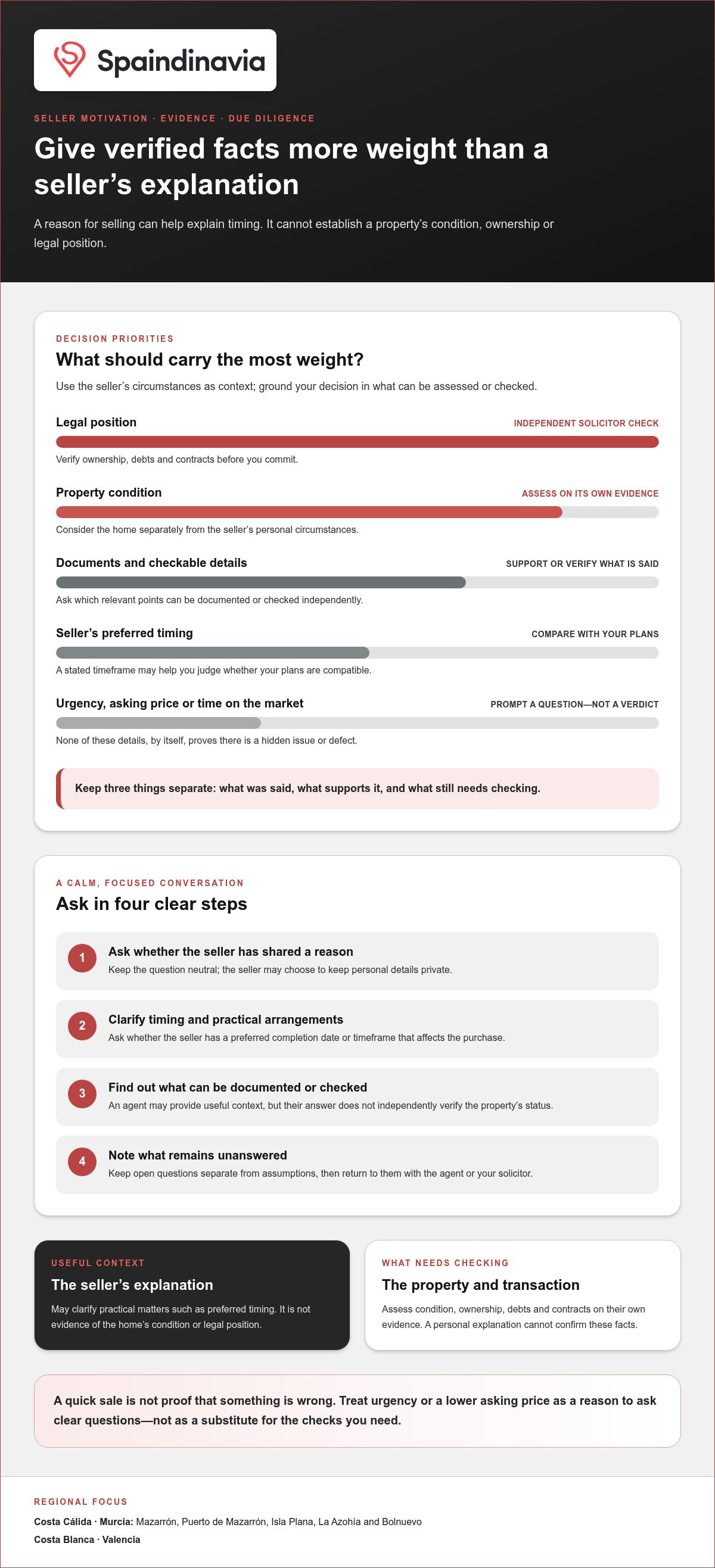
- Keep statements separate from evidence: note what the seller or agent says, what documents support it and what still needs checking.
- Ask an independent solicitor to verify ownership, debts and contracts. A seller’s explanation is not a substitute for legal checks.
- Compare the seller’s preferred timing with your own budget and readiness. The reservation fee is €3,000-€10,000, varying between resale and new development, followed by an Arras deposit typically around 10% of the purchase price.
- Spaindinavia can help with personalised property searches and guided visits, and introduce you to independent legal and financial professionals.
Why a Spanish property is being sold: what the reason can and cannot tell you
A seller’s motivation is the personal or practical context behind their decision to put a property on the market. It might relate to finances, a move, a change in family circumstances or plans that have shifted. These are possibilities, not conclusions. Don’t assume you know the cause from the listing, asking price or seller’s behaviour. A practical starting point for how to find out why a spanish property is being sold is to ask the agent whether the seller has shared a reason, then treat the response as one piece of context.
The seller may prefer to keep personal details private. That’s their choice, and it doesn’t prove there’s a problem with the home or transaction. Keep separate what the seller says from what can be established about the property itself, including its condition, ownership, debts and contracts. A personal explanation cannot confirm those facts. Likewise, assess a property concern on its own evidence rather than inferring it from the seller’s circumstances.
Does a quick sale mean something is wrong?
Not by itself. A seller may want to complete a sale quickly for personal, financial or practical reasons, but urgency doesn’t tell you why or whether the property has a defect. A lower asking price or a short time on the market is not proof of a hidden issue either. Treat these details as prompts to ask clear questions, not as a verdict.
Keep your decision grounded in what you can verify. Consider the property’s condition and the transaction’s legal position separately from the seller’s timing. Assess the property on its own merits, and don’t let a tight deadline replace the checks you need before proceeding.
What a seller’s reason can help you understand
An explanation can clarify practical matters, such as whether the seller has a preferred completion date or may be open to discussing timing. This can help you decide whether your own plans are compatible. Ask only for information that could affect the purchase. Private details may not be relevant, and you don’t need to know the full story to make a careful decision.
Seller motivation is useful context for timing and negotiation, not evidence of a property’s condition or a substitute for due diligence. If the answer is unclear, note what you still need to understand and keep that question separate from the seller’s personal circumstances. This makes it easier to weigh what has been said without treating an explanation as proof.
How to ask why a Spanish property is for sale without making assumptions
A calm, specific question is more useful than trying to read between the lines of a listing. Ask the estate agent whether the seller has shared a reason for putting the property on the market, then clarify what the answer means for timing or the transaction. You don’t need to ask for private details. The aim is to gather relevant context, not to persuade the seller to disclose more than they wish.
Use a simple sequence to keep the conversation focused:
- Ask whether the seller has shared a reason for the sale.
- Clarify whether that reason affects their preferred timing or any practical arrangements for viewing and purchase.
- Ask what relevant details can be supported by documents or checked independently.
- Write down what remains unanswered, so you can return to those points with the agent or your solicitor.
This gives you a clear record without confusing a spoken explanation with proof. An agent can share information they have about the sale, but their answer doesn’t independently verify the property’s status. For wider market context, Spanish property market trends can help you explore market movements, though they can’t establish why an individual owner is selling.
Questions to ask the estate agent
Keep your questions neutral and tied to the purchase. For example: “Has the seller shared why they’re putting the property on the market?” and “Do they have a preferred completion date?” You can then ask what is known about the property or transaction, rather than probing into personal circumstances. If an answer raises a practical question, ask what information can be documented or checked independently.
- Has the seller volunteered a reason for selling?
- Does the seller have a preferred timeframe that could affect the transaction?
- Is there relevant property or transaction information available to review?
- Which points would need a document or independent check to establish?
How to read answers and evasiveness fairly
Listen for the difference between a direct statement from the seller, the agent’s interpretation and a point neither can confirm. A short answer or a clear privacy boundary doesn’t prove wrongdoing. If something important remains unknown, record it as an open question rather than filling the gap with a theory. This is a practical part of how to find out why a spanish property is being sold without mistaking speculation for evidence.
Keep notes in three simple categories: what was said, what has supporting information, and what still needs checking. Note the seller’s preferred timing separately from questions about ownership or the home’s condition. A personalised search and guided property visits can help you compare homes while keeping your questions organised. Explore property searches and guided visits as you plan your next steps.
How to check whether the seller’s explanation matches the available evidence
A seller’s reason and the facts of a purchase answer different questions. The explanation may help you understand the seller’s plans, but it can’t establish who owns the property, whether debts need attention or what the contracts say. To make sense of what you’ve been told, separate statements from information that can be reviewed and matters that need independent legal advice.
Use this simple framework to organise the information:
| What you hear | What may support or clarify it | What to raise with an independent solicitor |
|---|---|---|
| The seller says they’re moving or changing plans. | Any relevant information or documents shared through the agent. | Whether the legal arrangements allow the proposed transaction to proceed as expected. |
| The agent says the seller prefers a particular timeframe. | Written details of the proposed timing or sale arrangements, if available. | How the relevant terms are set out in the contracts. |
| A question about ownership or debts remains unanswered. | Documents that relate directly to ownership or the financial position. | What the available information means for ownership, debts and contracts. |
The table isn’t a test of whether the seller is telling the truth. It’s a way to identify what’s known, what has supporting information and what still needs professional review. Keep personal or lifestyle reasons separate from legal questions, even if both come up in the same conversation.
What an independent solicitor should verify
Ask an independent solicitor to check ownership, debts and contracts. This gives you a professional review of the legal position rather than relying solely on the seller’s account or an agent’s explanation. Spaindinavia can introduce buyers to independent solicitors, and this guide to buying property in Spain offers further purchase-process context.
An independent solicitor checks the legal position, not the seller’s personal motivation. The seller’s circumstances don’t replace legal checks on the individual transaction.
Seller explanation versus transaction facts
Compare the explanation with relevant purchase information without expecting one to prove or disprove the other. For example, a seller may say they’re relocating while a contract question remains unresolved. The explanation could be accurate, but it doesn’t answer the legal question. Likewise, an unanswered question isn’t proof of a problem; it’s a prompt to seek clarification and professional review.
Keep a short written record of any mismatch: note what was said, what information you’ve seen and what remains unclear. Share those specific points with the agent or solicitor. This turns “something doesn’t feel clear” into a practical next step, without jumping to conclusions about the property or the seller.
How to weigh the reason for sale against your budget and buying timeline
A seller’s preferred timing is one part of your decision, not a deadline you must accept. Set it alongside your own finances, mortgage arrangements and independent legal review. A clear reason for a quick sale might explain the seller’s preference, but it doesn’t remove the need to understand the commitments involved or decide whether you’re ready to take them on.
Budget for the stages of the purchase, not just the asking price. The reservation fee is €3,000-€10,000, varying between resale and new development. After reservation, the Arras deposit is typically around 10% of the purchase price. Additional buying costs for taxes and fees are approximately 10%-15% of the property price. Before agreeing to proceed, make sure you understand when each amount is due and how it fits your available funds.
If you’re a non-resident considering a mortgage, typical financing is 60%-70% of the property value. Treat this as general context, not a personal offer or approval. Discuss your own position with a financial professional and plan around the amount you may need to fund yourself, alongside the additional buying costs.
Questions to resolve before making a commitment
Before you decide, check that the seller’s preferred timing leaves room for your preparation and independent legal review. Confirm that you’ve accounted for the reservation fee, Arras deposit and buying costs, and understand how your financing plan fits the purchase. If a legal question or payment term remains unclear, pause to resolve it rather than letting urgency make the decision for you.
- Does the proposed timing fit your finances and the checks you need?
- Have you planned for the reservation fee, deposit and additional costs?
- If you need a mortgage, have you discussed your own circumstances with a financial professional?
- Are your questions about ownership, debts and contracts being addressed by an independent solicitor?
The buying process after reservation usually takes 4-6 weeks. Keep this timeframe in mind as you organise your next steps, but don’t confuse a typical process duration with a reason to skip preparation. Understanding how to find out why a spanish property is being sold can help you ask better questions, while your readiness should come from your own financial and legal checks.
How the reason for sale fits into a considered decision
Weigh the home’s suitability, the legal findings, your financing and practical plans as separate factors. Foreigners can buy property in Spain with no restrictions, and a NIE is required for purchase and financial transactions. Costa Blanca and Costa Cálida enjoy over 300 days of sunshine per year. That can inform your lifestyle choice, but it doesn’t explain an individual seller’s decision or establish the property’s legal position.
A seller’s urgency shouldn’t replace independent advice or pressure you into a commitment. Take the time you need to make a safe, simple and transparent decision. Explore Spanish property options with Spaindinavia and plan your search with support through the purchase journey.
How Spaindinavia can help you investigate a Spanish property sale
Asking why a home is for sale is one part of choosing the right property. Spaindinavia is a real-estate agency supporting international buyers. Through personalised searches and guided visits to selected properties, the team can help you compare homes against your priorities and keep sale-related questions in view as you explore your options.
If you’re working out how to find out why a spanish property is being sold, having a consistent point of contact can make it easier to carry questions from the initial search into viewings and follow-up conversations. Share what matters to you, such as your preferred property type and practical requirements. The search can then focus on suitable options, while questions about a particular seller’s timing or property can be noted and followed up through the agent.
From the first question to selected property visits
Start by describing what you’re looking for and what you need to understand about a sale. A personalised search can help you compare selected properties against those priorities, rather than treating each listing as an isolated choice. During guided visits, you can assess the home for yourself and raise relevant questions about the sale with the agent.
After a viewing, record what you’ve learned and what remains open. For instance, you might have an answer about the seller’s preferred timing but still need clarification about a transaction detail. Keeping those points distinct helps you follow up clearly and decide which questions belong with the agent and which require independent professional review.
Keep the purchase journey transparent and supported
Once you’re considering a property, Spaindinavia can assist through the purchase journey, including the reservation, legal checks, purchase contract and notary completion. The agency can introduce you to independent solicitors, notaries and banks, while helping you keep track of the process. These professionals have distinct roles: an independent solicitor checks ownership, debts and contracts, while the notary is involved in completion. The agency supports the process but doesn’t replace independent legal or financial advice.
A clear record of your questions can help you stay organised as you move from viewing to the next purchase steps. Keep notes on what the agent has explained, what information you still need and what you want your solicitor to review. This makes it easier to make decisions based on your priorities and the available information, rather than feeling rushed by a seller’s preferred timing.
If you’re ready to explore suitable homes, bring your priorities and questions into the conversation. Explore property searches with Spaindinavia and take a considered next step towards finding a property that fits your plans.
Take your next step with confidence
The reason a seller gives can help you understand the timing, but your next step is to decide what matters most in your own search. Think about the kind of home and lifestyle you’re hoping to find, the questions you still need answered and what would help you feel ready to move forward. This gives you a clear starting point for discussing how to find out why a spanish property is being sold, without letting someone else’s urgency set your priorities.
You don’t need to have every detail settled before exploring your options. A thoughtful conversation can help you shape your search, compare suitable properties and identify the right questions as you go. Spaindinavia can support you as you consider properties, with independent professionals involved where their expertise is needed.
Explore property searches with Spaindinavia and take a considered step towards finding a home that feels right for you. Your plans can begin with a clear question and grow at a pace that works for you.
Frequently Asked Questions
Can I find out exactly why a Spanish property is being sold?
Not always, as the seller may choose to share a reason or keep personal circumstances private. To understand how to find out why a spanish property is being sold, ask the estate agent whether the seller has provided an explanation. Treat it as context, not confirmation of the home’s condition or legal position. Before making a commitment, ask an independent solicitor to verify ownership, debts and contracts.
Is a Spanish property being sold quickly a warning sign?
Not necessarily. A quick sale may reflect the seller’s personal circumstances or preferred timing, but urgency alone doesn’t show that there’s a property problem. Ask the agent what is known about the sale, then consider the home and purchase information on their own merits. Have an independent solicitor check ownership, debts and contracts. If something remains unanswered, seek clarification rather than assuming either that all is well or that something is wrong.
What should I ask an estate agent about why a property is for sale?
Ask whether the seller has shared a reason and whether they have a preferred timing for the transaction. You can also ask what relevant information about the property or purchase is available. Keep your questions neutral and focused on what affects your decision. If the seller chooses not to discuss personal matters, respect that boundary. For legal questions, arrange for an independent solicitor to check ownership, debts and contracts.
Do foreigners have restrictions on buying property in Spain?
No. Foreigners can buy property in Spain with no restrictions. You’ll need a NIE, or Número de Identificación de Extranjero, for the purchase and financial transactions. This is a practical part of preparing your buyer paperwork, separate from questions about the seller or the property’s history. An independent solicitor can advise on the legal checks for your purchase, including verifying ownership, debts and contracts.
How much should I budget for buying a property in Spain?
Budget approximately 10%-15% of the property price for additional costs, including taxes and fees such as transfer tax or VAT, notary, land registry, legal and administrative costs. The reservation fee is €3,000-€10,000, varying between resale and new development. After reservation, the Arras deposit is typically around 10% of the purchase price. Plan for these amounts alongside the property price when reviewing your available funds.
How long does buying a Spanish property usually take after reservation?
The buying process after reservation usually takes 4-6 weeks. The seller’s preferred timing may be useful to know, but your own preparation and legal checks still matter. Ask the agent about the expected steps and timing for the transaction, then share the relevant details with your independent solicitor. They can verify ownership, debts and contracts before completion, helping you understand the legal position as the purchase progresses.
What does a non-resident mortgage typically cover in Spain?
Mortgage financing for non-resident buyers is typically 60%-70% of the property value. This is a general range, not a promise of approval or a figure that necessarily applies to your circumstances. Speak with a bank about your own financing arrangements, and consider how the remaining funds fit alongside the reservation fee, Arras deposit and additional buying costs. Your independent solicitor can separately review the legal side of the purchase.


