

Imagine walking into a sun-drenched chiringuito in Puerto de Mazarrón and ordering your lunch with a witty remark that makes the waiter laugh. For many, learning spanish for retirement in costa blanca and the Costa Cálida feels like a steep mountain to climb, particularly if you're worried about "brain fog" or feeling isolated within an expat bubble. You might have chosen a villa in Isla Plana or a townhouse in Bolnuevo for the Mediterranean views, but it's the genuine conversations with your Spanish neighbours that will truly make you feel at home.
We know that the thought of handling a medical appointment in La Azohia or managing legal paperwork in the Costa Blanca can feel overwhelming. It's completely normal to want that sense of independence and security in your new life. This guide will show you how mastering the local lingo transforms your retirement from a simple holiday into a deeply rewarding lifestyle. You'll find practical advice for 2026, including local Mazarrón council courses and gentle techniques to build your confidence one "hola" at a time.
Key Takeaways
- Understand why "social fluency" is far more valuable than a perfect accent for building genuine friendships with your Spanish neighbours in Bolnuevo or Isla Plana.
- Compare the learning environments of the Costa Blanca and Costa Cálida to decide if you prefer a "soft landing" or a more immersive experience in the Murcia region.
- Learn how to prioritise "survival Spanish" and essential medical vocabulary to navigate daily life and healthcare appointments with total confidence.
- Discover why learning spanish for retirement in costa blanca is significantly easier when you choose a property location that encourages daily interaction with the local community.
- Explore how to organise your language journey using 2026 resources, from private tutors to local council courses in Puerto de Mazarrón.
Why Learning Spanish is Vital for Your Retirement in 2026
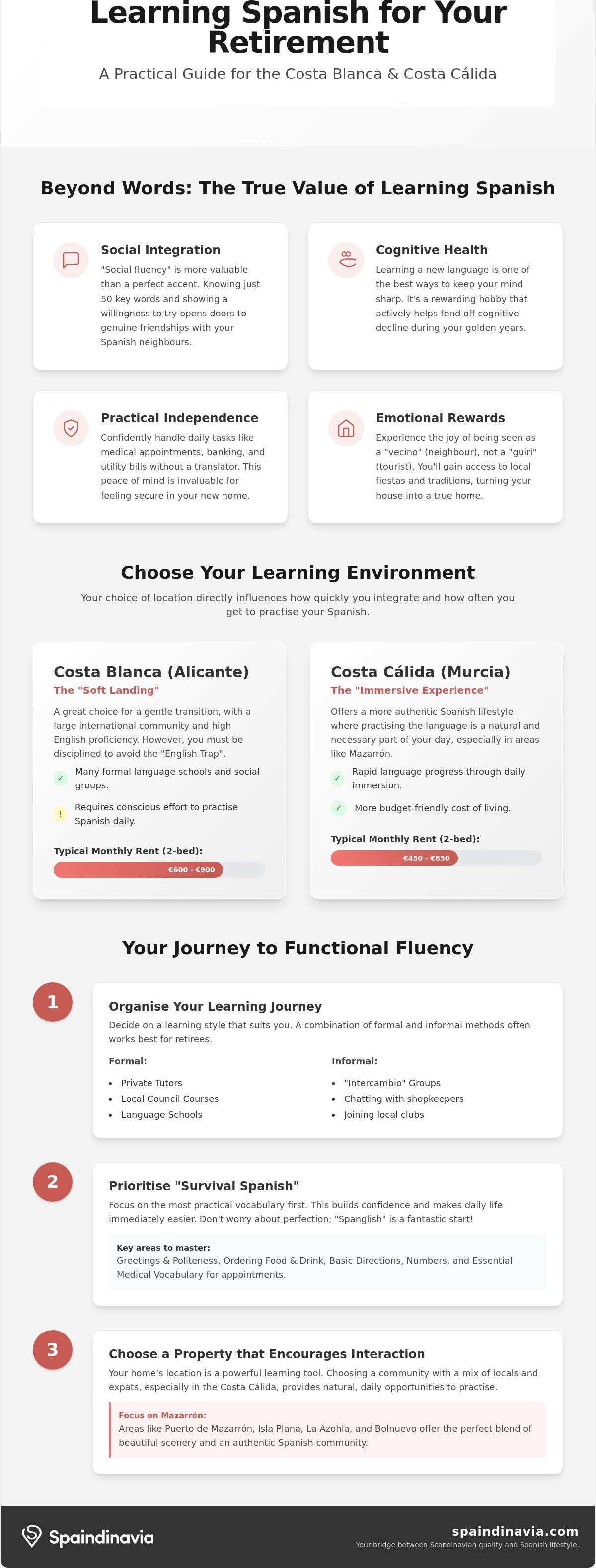
Moving to the Costa Blanca or the Costa Cálida is a dream come true for many. However, the difference between a perpetual holiday and a truly integrated life lies in the language. When learning spanish for retirement in costa blanca, you aren't just memorising verbs; you're building a bridge to your new community. Social fluency doesn't require a perfect accent. In fact, knowing just 50 key words and showing the willingness to try often opens more doors than a textbook-perfect sentence ever could. It signals to your new neighbours that you're here to stay and respect their culture.
Beyond the social perks, there's a significant cognitive advantage. Learning a new language is one of the best ways to keep your mind sharp and fend off cognitive decline during your golden years. It's an active, rewarding hobby that pays dividends in your daily life. It's also a matter of fundamental security. Imagine needing to explain a specific symptom at a pharmacy in Bolnuevo or discussing a utility bill in Puerto de Mazarrón. Being able to handle these moments without a translator provides a level of peace of mind that no expat bubble can offer.
The Emotional Reward of Integration
There's a unique joy in being recognised as a "vecino" (neighbour) rather than just another "guiri" (tourist). When you can share a joke with the panadero in Isla Plana or ask the camarero in La Azohia about his family, the atmosphere changes. You'll find yourself invited to local fiestas and cultural traditions that remain hidden from those who stick strictly to English-speaking circles. It's about feeling a sense of belonging in the Murcia region and beyond, turning a foreign house into a true home.
Practical Independence in Spain
Daily life involves more than just sunshine and tapas. You'll need to manage banking, internet installations, and perhaps even a renovation project. Understanding the basics makes these tasks far less daunting. If you're still in the early stages of your journey, our buying property in Spain guide offers a solid foundation for the legal side of things. Learning spanish for retirement in costa blanca allows you to double-check details yourself, ensuring your investment is secure. Don't worry about being perfect; "Spanglish" is a brilliant starting point for any 2026 retiree. It shows effort, and in the warm communities of the Costa Blanca and Costa Cálida, effort is always rewarded with a smile.
Costa Blanca vs. Costa Cálida: Different Learning Environments
Choosing where to plant your roots is the most significant decision you'll make in your relocation journey. It dictates whether you'll be surrounded by English-speaking neighbours or immersed in a local Spanish community. Whilst both regions offer stunning coastlines, the linguistic atmosphere varies significantly between the two. Your choice of location will directly influence how often you're prompted to use your new skills in daily life.
In the Costa Blanca, specifically in Alicante province which is home to over 500,000 foreign residents, you'll find a high level of English proficiency. This makes it a fantastic "soft landing" for those who feel anxious about their initial move. However, learning spanish for retirement in costa blanca can actually be more challenging here because you rarely have to use it. It's easy to fall into the "English Trap", where daily life in hubs like Torrevieja is conducted entirely in your native tongue, slowing your progress toward fluency.
The Costa Cálida, particularly within the Murcia region, offers a different pace. Here, property prices and the cost of living are generally more budget-friendly. For example, a 2-bedroom apartment in the Costa Cálida typically rents for between €450 and €650 per month, compared to €600 to €900 in popular parts of the Costa Blanca. This affordability often attracts a more authentic, local population, making Spanish practice a natural and necessary part of your day.
The Costa Blanca Experience
Formal language schools are plentiful in the larger hubs. You can easily find "intercambio" groups where you trade an hour of English conversation for an hour of Spanish. These are brilliant for socialising, but you must be disciplined. Without a conscious effort, you might find your skills plateauing because everyone from the pharmacist to the waiter is happy to speak English to you.
The Costa Cálida Advantage
Puerto de Mazarrón serves as a perfect middle ground. It retains its fishing village charm whilst offering excellent support for new arrivals. In 2026, the local Ayuntamiento (town hall) in Mazarrón continues to offer dedicated Spanish programmes for foreign residents, providing a structured way to meet fellow retirees. If you prefer a quieter setting, the coastal stretches of Isla Plana and La Azohía encourage a slower pace of life. Here, conversations with locals aren't rushed; they're an opportunity to connect. Bolnuevo is another favourite, offering a genuine Spanish lifestyle where your neighbours will likely be local families who truly appreciate your efforts to speak their language.
Finding a home in the right neighbourhood is the first step toward this integration. You can explore our selection of resale apartments and new build villas to see which community feels like the right fit for your learning journey.
How to Organise Your Language Journey: Formal vs. Informal
Deciding how to tackle the language is a personal choice that should reflect your personality and goals. Some retirees find the structure of a classroom comforting, whilst others prefer the organic flow of a conversation over a café solo. In 2026, the options for learning spanish for retirement in costa blanca and the Costa Cálida are more varied than ever. You don't have to follow a rigid academic path to achieve functional fluency. Instead, you can blend formal study with informal socialising to find a rhythm that suits your new Mediterranean lifestyle.
Intensive language schools offer a brilliant "jumpstart" for those who want to see quick progress. These programmes are popular in larger centres like Alicante or Murcia city, but they can be exhausting. If you prefer a more tailored approach, private tutors are a fantastic investment. They can focus on the vocabulary you actually need, such as discussing garden maintenance or property renovations, rather than outdated business jargon. Digital tools have also evolved; many 2026 retirees use AI-driven apps to practice basic dialogue in the privacy of their own home before trying it out at the local pharmacy or town hall.
Formal Courses in the Valencia and Murcia Regions
Both regions provide excellent formal education. The Official Language Schools (EOI) are government-run and offer very affordable courses, though they often require a commitment to a full academic year. If you prefer a shorter, more academic environment, the University of Alicante offers intensive Spanish programmes, with 8-week sessions typically available for those who want to dive deep. In the Murcia region, "Golden Age" programmes are designed specifically for older learners, focusing on cultural appreciation alongside grammar. These are perfect for building a solid foundation whilst meeting like-minded people who are also settling into the area.
Informal Learning in Mazarrón
For a more relaxed experience, the "Tertulia" method is incredibly effective. This simply involves joining local coffee mornings where locals and expats meet to chat. In Puerto de Mazarrón, several beachfront cafes host "Intercambio" evenings where you can trade half an hour of English for half an hour of Spanish. It's a low-pressure way to build confidence. We also recommend the "Market Challenge". Head to the weekly Mazarrón market and set yourself a goal: buy your fruit, vegetables, and local honey entirely in Spanish. Whether you are living in the quiet hills of Bolnuevo or the coastal stretches of Isla Plana and La Azohía, these daily interactions are where real fluency is born. Learning spanish for retirement in costa blanca and the Costa Cálida is as much about these small victories as it is about any certificate.
5 Steps to Functional Fluency for Retirees
Achieving functional fluency isn't about passing a university exam; it's about making your daily life in the Costa Cálida or Costa Blanca smoother and more enjoyable. We define functional fluency as the ability to handle 80% of daily interactions with 20% of the grammar. By focusing on high-impact vocabulary, you'll find that learning spanish for retirement in costa blanca becomes a series of small, satisfying wins rather than a chore. Follow these five practical steps to integrate quickly into your new community.
- Focus on 'Survival Spanish' first: Prioritise the language of the chiringuito and the market. Learn how to greet neighbours, ask for directions in Puerto de Mazarrón, and order your favourite "café con leche" with confidence.
- Master the 'Medical Lexicon': Given that 2026 residency requirements for the Non-Lucrative Visa mandate private health insurance, you'll likely be visiting private clinics. Learn the Spanish words for basic body parts, common symptoms, and pharmacy essentials to manage these appointments independently.
- Learn the 'Homeowner's Vocabulary': Whether you've bought a resale apartment in Bolnuevo or a new build villa in Isla Plana, you'll eventually need to speak with a "fontanero" (plumber) or an "electricista" (electrician). Knowing these specific terms is vital for maintaining your property.
- Embrace the 'Siesta' schedule: Learning when to speak is as important as what to say. Observe the local rhythm in the Murcia region; shops often close between 14:00 and 17:00. This is the perfect time for quiet study or listening to Spanish radio.
- Don't fear the 'Error': Spanish people are incredibly warm and generally love it when you try to speak their language. A misplaced verb or a shaky accent won't stop you from making friends; in fact, your effort is often the best icebreaker.
Prioritising Your Vocabulary
You don't need to master the complex subjunctive tense just to buy a loaf of bread or a newspaper. Focus instead on "polite imperatives" and basic social etiquette. Using "por favor" and "gracias" goes a long way in the local shops of La Azohía. By stripping away unnecessary academic fluff, you can focus on the phrases that actually help you navigate a community meeting or a lunch with neighbours in the Valencia region.
Daily Habits for Success
Consistency beats intensity every time. Try watching the local Spanish news with Spanish subtitles turned on; this helps you connect sounds to words whilst providing regional context. If you're still in the process of choosing your home, reading local property magazines can help you learn architectural terms. For a practical boost, use the "sticky note" method in your new home. Label your kitchen appliances and furniture with their Spanish names; you'll be surprised how quickly "la nevera" and "la mesa" become part of your everyday vocabulary.
If you're ready to start your journey in a community that welcomes your efforts, explore our new build villas and resale properties to find your perfect base.
Finding Your Home: How Location Influences Your Language Skills
Your choice of property is the single most important factor in how quickly you'll pick up the language. It's easy to assume that a modern, new build villa might lead to isolation, but that isn't the case if you choose strategically. By selecting developments within walking distance of local shops and plazas, you ensure that learning spanish for retirement in costa blanca or the Costa Cálida happens naturally. Every stroll to the bakery becomes an informal lesson. When you're surrounded by the sounds of the local community, you'll find yourself absorbing phrases without even trying.
Isla Plana and La Azohía are perfect examples of hidden gems that offer a traditional Spanish pace. These coastal villages in the Murcia region provide a tranquil environment where the local culture remains the heartbeat of daily life. Similarly, certain pockets of the Costa Blanca offer a blend of international comfort and authentic Valencian charm. The key is to look for areas where the "social infrastructure" like markets, pharmacies, and cafes are frequented by locals. This proximity encourages you to step out of your comfort zone and use your Spanish in real-world situations.
Strategic Property Selection
Choosing a home in Bolnuevo that's within walking distance to local amenities is a brilliant move for social integration. You won't need to rely on a car for every errand, which means more opportunities to greet your neighbours. If you prefer a more established feel, resale apartments in traditional Spanish neighbourhoods often place you right in the centre of the action. These locations are ideal for those who want to hear Spanish spoken on their doorstep every day. For long-term investors, our property management services can handle the logistics of your home, giving you more time to focus on your studies and social life.
Let Spaindinavia Guide Your Transition
We're committed to finding you a community, not just a property. Our local experts in Puerto de Mazarrón act as your first language coaches, introducing you to the best spots to practice and helping you understand the local customs. We bridge the gap between different cultures, ensuring you feel secure and supported from the moment you arrive. Whether you're looking for a townhouse in the Costa Blanca or a bungalow in the Costa Cálida, we help you find a place where you can truly belong. Take the first step toward your new lifestyle and explore our hand-picked portfolio of New Build Villas.
When you begin viewing properties, do so with an eye on the local social scene. Look for the "terrazas" where people gather and the parks where neighbours chat. These are the places where your new life will unfold. By choosing the right location, you're not just buying a house; you're choosing the people who will help you become fluent in your new Spanish life.
Embrace Your Authentic Mediterranean Lifestyle
Embarking on a new chapter in the sun is about more than just finding the perfect view. It's about the people you meet and the community you build. By prioritising functional fluency over academic perfection, you ensure that your time in the Costa Blanca or Costa Cálida is filled with genuine connection rather than isolation. Whether you're navigating a medical check-up or sharing a laugh at a chiringuito in Puerto de Mazarrón, your efforts will be the foundation of a secure and joyful retirement.
Choosing the right base is essential. From the peaceful shores of Isla Plana and La Azohía to the vibrant streets of Bolnuevo, your location dictates your daily opportunities for practice. At Spaindinavia, we provide expert local knowledge of both the Costa Cálida and Costa Blanca to help you find a home where you can truly flourish. We specialise in high-quality new build villas and resale apartments, offering personalised support through the entire buying process. We act as your local bridge, ensuring that learning spanish for retirement in costa blanca feels like an exciting adventure rather than a daunting hurdle.
Start your Spanish journey with a dream home from Spaindinavia and discover how a little language can transform your retirement into something extraordinary. Your new neighbours are waiting to say "hola".
Frequently Asked Questions
Is it too late to learn Spanish if I retire at 65?
It's never too late to start your language journey; in fact, retirement is the perfect time to begin. Research shows that learning a new skill at 65 or older is one of the most effective ways to keep your mind sharp and fend off cognitive decline. Focus on "social fluency" rather than academic perfection. Whether you're in the Costa Blanca or a coastal village like Isla Plana, locals will always appreciate your effort regardless of your age.
Do I really need Spanish if I live in a popular expat area like Orihuela Costa?
Whilst you can survive with English in hubs like Orihuela Costa, speaking Spanish transforms your experience from a tourist to a resident. Knowing the local lingo is vital for navigating medical appointments or understanding community meetings with confidence. Learning spanish for retirement in costa blanca gives you the independence to step outside the expat bubble and enjoy a more authentic, rewarding life.
Are there free Spanish classes for retirees in the Mazarrón area?
Yes, the local council (Ayuntamiento) in Mazarrón frequently organises Spanish courses specifically designed for foreign residents. These are often free or very low-cost and are held at various times throughout the year in Puerto de Mazarrón or Mazarrón town. It's a fantastic way to meet other retirees whilst learning the essentials for your new life in Bolnuevo or La Azohía.
What is the best app for learning Spanish for older adults in 2026?
In 2026, many retirees find AI-powered conversation apps like Babbel or specialized 50+ learning platforms most effective for building confidence. These tools allow you to practice realistic scenarios, such as ordering at a chiringuito or visiting a pharmacy, in a low-pressure environment. They're a brilliant supplement to real-world practice in the local shops and markets of the Costa Cálida.
How long does it take to reach a conversational level in Spanish?
Most retirees achieve functional, conversational fluency within six to twelve months of consistent, daily practice. You don't need to be perfect to be understood by your neighbours. By focusing on the 20% of grammar that covers 80% of daily interactions, you'll be chatting with your local community in the Valencia region much sooner than you might expect.
Can I buy a property in Spain without speaking any Spanish?
You can certainly purchase property without speaking Spanish, especially when working with experts like Spaindinavia. We collaborate with local solicitors and banks to ensure your transaction is secure and transparent. However, learning spanish for retirement in costa blanca after you move will help you manage your new build villa or resale apartment with far more independence and peace of mind.
What are the most important Spanish phrases for a new homeowner?
Start with polite greetings, numbers for shopping, and essential household terms to manage your property effectively. Phrases like "¿Dónde está...?" (Where is...?) and "Necesito un fontanero" (I need a plumber) are incredibly practical for new residents. Knowing how to describe a basic leak or a power issue is vital for maintaining your home in the Murcia region.
Is the Spanish spoken in Murcia different from the Spanish in Alicante?
Yes, there are distinct regional differences, though the core language remains the same across both areas. In the Costa Cálida, you'll encounter the Murciano accent, which often involves dropping certain consonants. In the Costa Blanca, you might also hear Valenciano spoken alongside Spanish. Locals in both regions are very used to different accents and will understand standard Spanish without any issues.


